

If I was a criminal, stationery stores and bakeries would be the two kinds of places I would concentrate on.
John Turturro
Paper and …?

When it comes to writing on paper, what’s your preferred implement? Go into as much detail as you like – this is a Stationery Geek Safety Zone!
Illness, Vintage-Style
I have, of late, been undertaking some unprofessional nursing: the Caped Gooseberry had his wisdom teeth out this week, and bronchitis the week before. (These things happen. Especially they happen during (PseuDo)NaNoWriMo.)

Unprofessional nursing… It sounds like the censure of conduct that should have been professional and wasn’t, but in fact a good many people in this world undertake such work in caring for a loved one, either temporarily or long-term.
These days it is termed ‘caregiving’ to make the distinction that nursing is done by nurses, but it used to be considered that nursing the sick was nursing the sick, regardless of the qualifications involved, and many household guides had advice for these only-to-be-expected times in life.
Take, for example, that worthy tome, Whitcombe’s New Everyday Cookery, published in 1966 by Whitcombe and Tombs. (My copy, one of the “35oth Thousand,” has my mother’s maiden name inscribed on the title page.) Chapter XXXVI is entitled ‘Food for the Sick’, and it begins with a section of advice on sickbed room-service. For example:
“3. Serve only small portions daintily, and so encourage a flagging appetite.
4. Vary the method of service by changing the linen and china and by placing a small posy of flowers on the tray. Linen must be well laundered and scrupulously clean, china and silver well cared for.”

All very well, although it does suggest rather a lot of dish-washing and laundry will be involved in Keeping Standards Up. While my dearly beloved did get a variety of linen and china in his bed-bound meals, that was more because I hadn’t washed the last lot than from some angelic wish to put a bit of spice in his life. Posies there were none.
Where New Everyday Cookery really excels itself, however, is in the suggested dishes. Most of it is sensible enough: soft, easy to digest foods etc. However… Things I would not like to see on my tray, were I sick, ill or invalided, include a raw egg beaten up with a little sugar, sherry and cold water; gruel; beef tea (which contains about a teaspoon of actual nutrition per half-pint, according to Florence Nightingale); and fricasseed brains or sweetbreads (with white sauce, presumably by way of disguise).
Especially not the fricasseed brains, although I might well make a sudden and miraculous recovery, if the alternative was to be eating brains (fricasseed or otherwise, and with or without white sauce). I feel enough like a zombie when I’m sick, I don’t need to eat brains to enhance the illusion.
 Needless to say, I did not inflict these horrors on the Caped Gooseberry.
Aunt Daisy’s New Book of Handy Hints is also an invaluable vol., and also published by Whitcombe and Tombs, though it doesn’t say when. Prices are given in shillings and pence; and my grandmother’s maiden name is inscribed on the cover. (Answer: 1951, according to Te Ara.)
While Aunt Daisy doesn’t mention the nursing of the sick (apart from recommending a brisk massage of pressure points with neat meths to avoid bedsores), she does include a number of First Aid hints, not all of which would be looked upon with kindness by the medical authorities of today. For example, if someone drinks a corrosive poison, soothe the burnt membranes with something bland, like milk or egg-white – and then “a little brandy for a stimulant.” If there is one thing I would not like poured down my throat after a corrosive poison, it is brandy, little or otherwise. Ouch.

Aunt Daisy also suggests liver tea for anaemia, made by pouring warm water over minced liver, steeping, and then adding marmite, pepper and salt. This can be made palatable, she argues, if you heat all the utensils before you use them. Personally, I have my doubts. For neuritis, she recommends neat lemon juice, first thing in the morning, which would at least take your mind off it!
But it’s Eileen Ascroft, in her book The Magic Key to Charm (first published 1938) who really takes the cake for vintage sickbed advice. While she doesn’t touch on the work of caring for a sick person yourself, she has plenty of advice for women in those difficult times of life when it is harder than usual to show your inner charm.
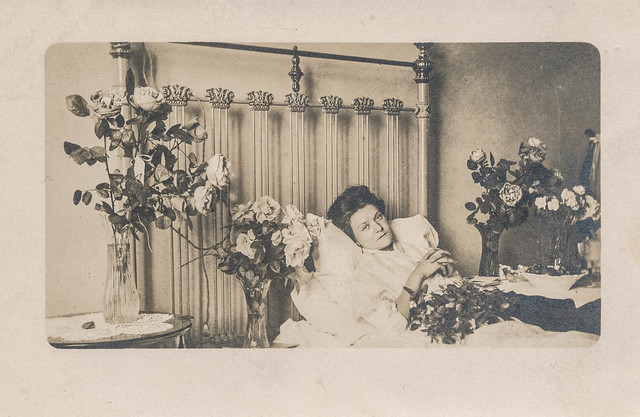
“Change your nightie every day and keep your curls brushed and combed and tied up with a pretty ribbon to match your nightie,” she advises. “Keep a soft big baby shawl to cuddle into when you are alone and a pretty, fresh dressing jacket for visitors or when the doctor comes.” Like this one, perhaps?
_(14579330107).jpg) “Keep the skin of your face nourished with face cream and your nails prettily manicured.
“Keep the skin of your face nourished with face cream and your nails prettily manicured.
If you can’t do them yourself, nurse will be only too pleased to do them for you.” One can only assume she is not talking about a hospital nurse here; I am sure they have much better things to do with their professional qualifications than give people manicures.
She does, however, suggest that you give up worrying about how people will cope without you and just enjoy the chance to rest and relax. After all, “it gives you time to pause in your life and think where you are going… to take stock of yourself and make plans for the future. So lie peacefully and dream and plan for your career, your home, your husband, your children, your clothes, your hobby, your interests, your games and your future behaviour.”
Once you are convalescing, she recommends improving your mind by reading the newspaper from cover to cover, reading the latest books and catching up with your correspondence. And keep your hands busy: “Embroidery, sewing, knitting, crochet, drawing or painting – there are a dozen exciting things to do.”
 After all, if you’re going to be ill, you might as well enjoy yourself.
What are your tips for sickness in style – or unprofessional nursing?