Naming the Teapot

When writing my answers to last week’s interview, the phrase “my trusty pot of tea” sprang unbidden to my lips – or rather fingertips. Possibly this was influenced by Richard IV’s “trusty fruit knife” which saw him safely through a single-handed confrontation with ten thousand Turks at the gates of Constantinople.

There is of course a long history of the naming of swords, particularly mythical or otherwise fictional ones – Excalibur, Durendal, Anduril, Rhindon – but mostly it’s just swords, axes, and hammers that get this acclaim, all weapons of assault and battery. Cooking pots, fountain pens, and other useful articles don’t generally rate a name, which is a bit depressing when you think how much more beneficial non-destructive things are.

Setting a much better example for us all is Lord Ickenham (a.k.a. Pongo Twistleton’s Uncle Fred), who sallies forth to the bathroom at Blandings Castle “armed with his great sponge Joyeuse”. Named, presumably, after Charlemagne’s sword Joyeuse, which would have been a much less pleasant bathtime companion.

The-crown-jewels-blaise-alexandre-desgoffe
Voici Joyeuse! The sword – the big squishy green thing’s a cushion, not a sponge.
Continue & Comment

Classic Pleasures: The Gardening Catalogue

It was Agatha Christie who first introduced me to the gardening catalogue. Being Agatha Christie, she naturally made it a harbinger of sudden and mysterious death (you’ll have to read The Thirteen Problems to find out how).

Of course, gardening catalogues were nothing new in 1932, when the book came out. The first ever was, according to Wikipedia, produced by an Englishman in 1667, back when Charles II was ruling Britain, Louis “l’etat c’est moi” XIV ruling France, and the Mughal emperor Aurangzeb (son of Mumtaz Mahal, as in Taj Mahal) ruling the Indian subcontinent.

Sweerts florilegium
Continue & Comment

The T-Rex’s Remarkable Grandchild

Grandchild being in this case a major understatement, but seriously, chickens are amazing. Amazing and amazingly weird.

Take the whole issue of eggs for example. It takes a hen about 26 hours to produce an egg. But when the hen sits on a whole batch of them – up to a dozen – they all hatch around the same time, not at 26 hour intervals for a fortnight. (Assuming a rooster was involved prior to egg-laying. Otherwise no business results and the hen gets bored after a while and wanders off.)

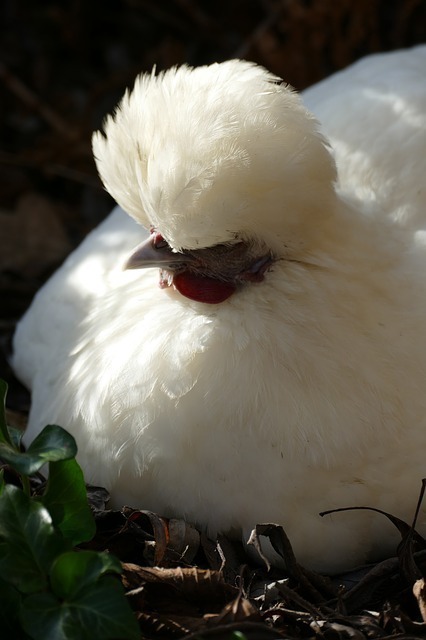
Not much of a view, but not bored yet…
Continue & Comment