
 Pride makes us artificial and humility makes us real.
Thomas Merton
Unexpected Fame
Fame is a chancy thing. It is well known for flitting off the second your back is turned (nothing so fickle as fame) but it is also fond of landing on people when they least expect it – or leaping out on them from an unanticipated direction.
 Of course, most of us will never be famous at all (there isn’t room) but some who become famous do so for entirely unanticipated reasons; reasons which sometimes eclipse a fame-worthy effort in another direction.
Take Margaret Mead for example. She is perhaps more widely known for the quote “Never doubt that a small group of thoughtful, committed citizens can change the world. Indeed, it is the only thing that ever has,” than for her work as a cultural anthropologist. This is almost painfully ironic, considering that there is no proof that she ever said or wrote it.
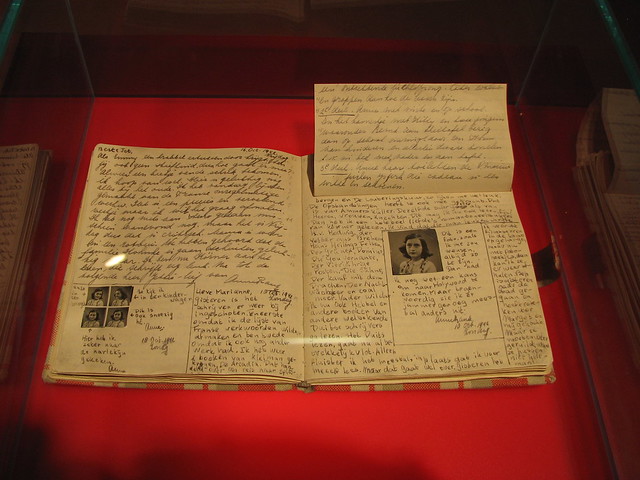
To take another example, from The Illustrated History of the Housewife by Una A. Robertson, “Scotland’s Lady Grisell Baillie, of Mellerstain, near Kelso, is now better known through her book of domestic accounts than for her childhood heroism in saving her father’s life.” Thus proving that even the most dramatic of acts can be overlooked in retrospect, particularly if you leave behind solid documentary evidence of something else. (Another good argument for keeping a diary: distracting posterity from those things you’d rather it forgot.) Indeed, it is possible to become famous simply because you kept a diary.
 Who knows? Perhaps Richard Dawkins may someday be remembered as the coiner of the word-of-the-age, ‘meme’ – meaning a cultural thing that is copied or transmitted in a similar way to biological data such as genes. He is, after all, a biologist – despite his outspoken opinions on other things, such as reading fairy tales to one’s children.
To be fair, while he initially said it was “pernicious to inculcate into a child a view of the world which includes supernaturalism,” he then decided that perhaps fairy tales encouraged the “spirit of scepticism” in children and were therefore permissible. This all comes rather oddly from someone who claims that “there is, at bottom, no design, no purpose, no evil, no good, nothing but pitiless indifference.” Pitiless he may or may not be, but he certainly doesn’t seem indifferent.
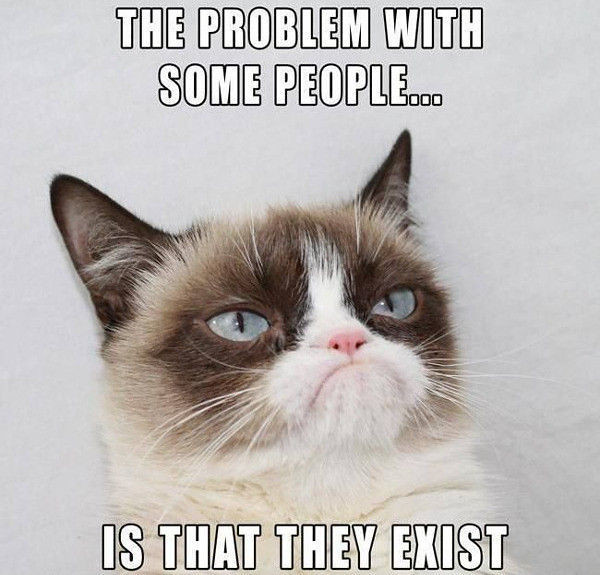
Dawkins has had some bad press in the past, so perhaps it would be only kind to begin associating him with that queen of memes, the captioned kitty. Considering his opinions on, for example, Down’s Syndrome, this would seem a good place to start:
 For another example of unintentional fame, take Edward Bulwer-Lytton. He might have thought he would achieve fame for his political achievements – he was Secretary of State for the Colonies at a time when Britain was by no means short of them – or for turning down the position of King of Greece. He probably dreaded the thought of becoming famous for inspiring Wilkie Collins’ novel The Woman in White, by having his (sane) wife committed to an insane asylum when she campaigned against his election to Parliament. He may have hoped that he would become famous for his novels, but probably not the way it happened: his fame has been almost entirely eclipsed by one of his opening lines.
It was a dark and stormy night… Of course, that isn’t so bad, if you’re the first to write it (which he was). If only he had left it at that, instead of extending the sentence to read “It was a dark and stormy night; the rain fell in torrents—except at occasional intervals, when it was checked by a violent gust of wind which swept up the streets (for it is in London that our scene lies), rattling along the housetops, and fiercely agitating the scanty flame of the lamps that struggled against the darkness.”
.jpg) This subsequently inspired some of the right-thinking sort to start a competition for execrable opening sentences: The Bulwer-Lytton Fiction Contest. This year’s submissions close next week (Thursday June 30th), so why not have a crack at it? If, like Edward B-L, you can become famous for a single line, why bother writing the rest of the novel?
This subsequently inspired some of the right-thinking sort to start a competition for execrable opening sentences: The Bulwer-Lytton Fiction Contest. This year’s submissions close next week (Thursday June 30th), so why not have a crack at it? If, like Edward B-L, you can become famous for a single line, why bother writing the rest of the novel?
The moral of the story (yes, sorry Mr Dawkins, this is one of those pernicious stories that have morals to them) is that it pays to be careful what you do, or write, or say, because you may become famous for something you didn’t mean to. Or something you didn’t even mean. Or even, like Margaret Mead, something you didn’t even say, but there is (alas!) not much you can do about that.
In Praise of Another Old Technology
How do I love thee? Let me count the ways… I love the hand-crank sewing machine, fountain pens and candle-lamp; I love the simple perfection of the stick that is the rimu nostepinne. And, it turns out, I love the typewriter.
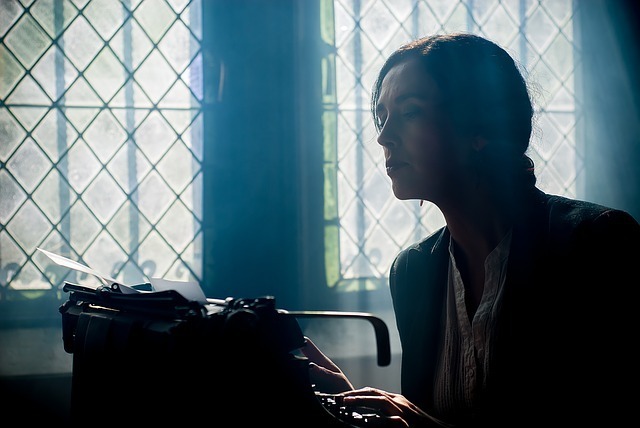 Proper manual typewriters, that is. None of this pansy give-me-electricity-or-give-me-death stuff. The whole point of the typewriter nowadays is the freedom it gives you: freedom from electricity, software upgrades (or crashes), printers, digital mass surveillance, illegible handwriting, planned obsolescence and blue-light-emitting screens – to name just a few.
And, of course, there’s the sound of typing. Tom Hanks says laptop typing sounds “mousy… cozy and small, like knitting needles creating a pair of socks. [Nothing wrong with knitting socks, Mr Hanks.] Everything you type on a typewriter sounds grand, the words forming in mini-explosions of SHOOK SHOOK SHOOK.”
I’ve been reading the book The Typewriter Revolution: A Typist’s Companion for the 21st Century by Richard Polt, a book packed full of history and helpful advice, along with a horde of fascinating snippets. For instance: the first documented user of a typewriter was a blind Italian countess (back in 1801); you should never use WD40 on a typewriter; and keychopping – the practice of cutting the keys off old typewriters to use for making jewellery – is like “declawing a cat and throwing away the cat.”

There’s also a discussion of different makes and models of typewriters, with mentions of the people who use/d them. Agatha Christie and George Orwell used Remingtons, as did George Bernard Shaw and Margaret Mitchell. e.e. cummings used a Smith-Corona portable (with, one is tempted to speculate, a broken shift). Nick Cave uses an Olivetti; as does Cormac McCarthy, who cannily sold his old one for over a quarter of a million dollars and then replaced it for under $20. Ho Chi Minh used a typewriter known as a Hermes Baby, which doesn’t exactly fit with the revolutionary image.
I myself have a powder-blue Brother De Luxe ultraportable typewriter, which weighs a smidgen over five kilos in its case. It is relatively young, having rolled off the production line in Nagoya in February 1969, and is still in very good working condition. A few days ago I took the outer cladding off to give it a good clean, but that was all it needed, besides perhaps a new ribbon in the near future. I didn’t pick it apart further, because a) I wasn’t entirely confident of my ability to put it back together properly, and b) whoever put those screws in wasn’t messing around (and I have a twisted screwdriver to prove it).
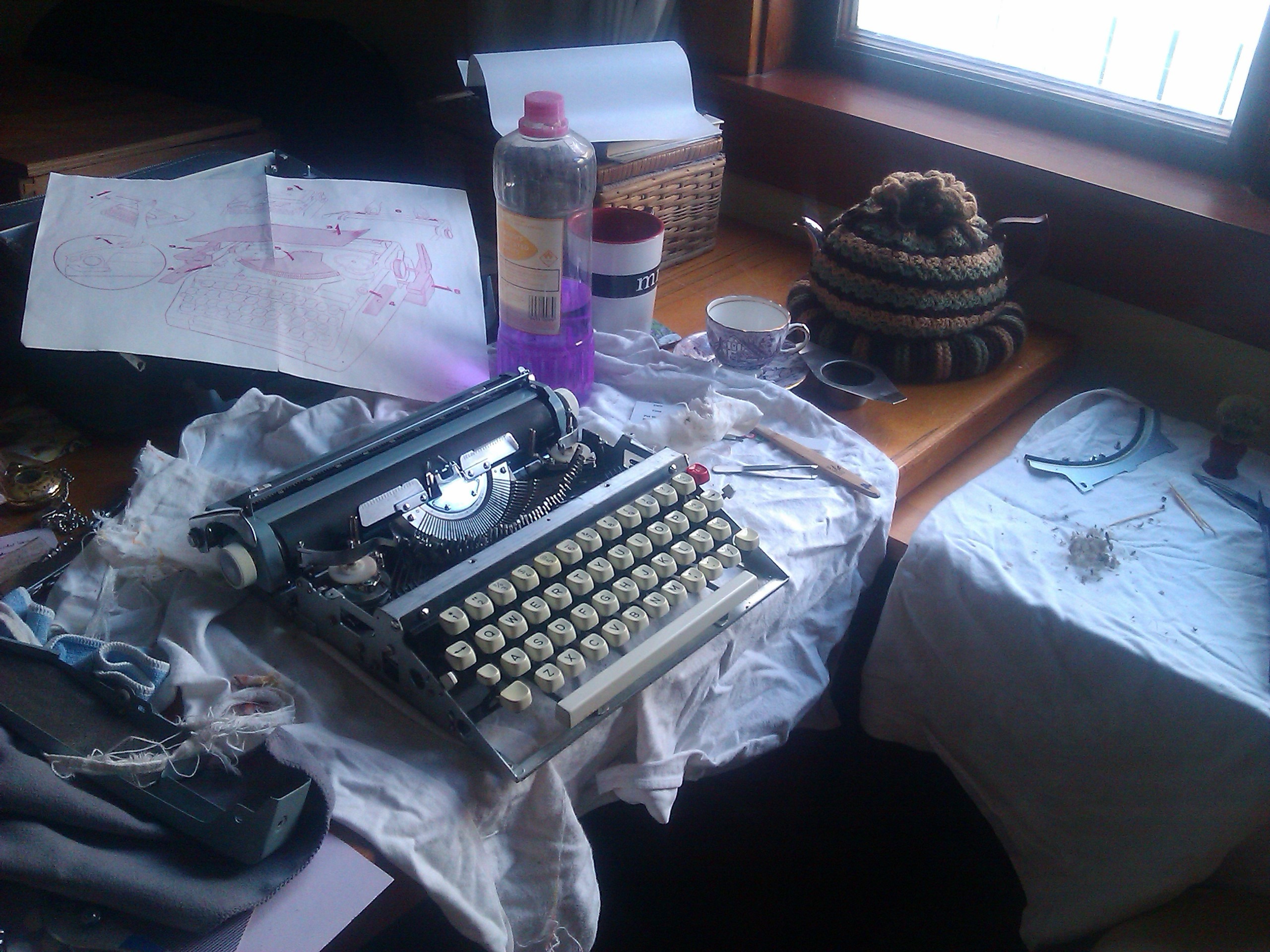
Nonetheless, there is something very capable-feeling about being able to take a machine at least partially apart and then successfully put it back together again (with some assistance from a spare pair of hands and the muscles attached to them). All the more so, as I am not naturally mechanically minded. All I found inside was some gunge and fluff – unlike others who, according to Polt, have found everything from a mummified mouse (minus head) to five hundred dollars to a wasps nest. I don’t know whether to be disappointed or relieved.
The point of a typewriter, of course, is to use it. It is no longer the most efficient way to produce text, but efficiency is seldom a guarantee of quality. Those of you who are au fait with the modern phenomenon known as NaNoWriMo may be interested to know that there is a group who knock out their 50,000 words on typewriters. One, Mike Clemens, says he’s heard the bell at the end of each line likened to a personal word-count cheerleader – and of course it always helps to be able to see your progress stacking up next to you. (On which note, bring back paperweights!)
 My own plan is to write – or at least draft – a novel or play on this typewriter. Not immediately, since I am at present in the midst of rewriting/edits which are best done on computer, but hopefully in the not too distant future. Because I have at last found another phrase to rival the beauty of piston-filling fountain pen: annotated typescript.