Certainly many of our most satisfying avocations today consist of making something by hand which machines can usually make more quickly and cheaply, and sometimes better. Nevertheless I must in fairness admit that in a different age the mere fashioning of a machine might have been an excellent hobby… Today the invention of a new machine, however noteworthy to industry, would, as a hobby, be trite stuff. Perhaps we have here the real inwardness of our own question: A hobby is a defiance of the contemporary.
 It is an assertion of those permanent values which the momentary eddies of social evolution have contravened or overlooked. If this is true, then we may also say that every hobbyist is inherently a radical, and that his tribe is inherently a minority.
Aldo Leopold, A Sand County Almanac
To Read or Not to Read?
There are (it has often been said) two kinds of people.

In this particular instance, there is the kind of person who loves reading up on their hobbies and interests, and there is the kind of person for whom this is a dreadful waste of good hobbying time (unless they are searching for specific information).
Which kind are you?
One Glove, Two Glove, Tight Glove, Loose Glove
Sometimes things work out just the way you planned them. Other things… not so much. Last summer I realized that I was down to only one pair of gloves (I’ve been moving my wardrobe in the direction of colours that actually suit me), and that pair were fingerless.
But it was summer! I had plenty of time to knit myself some full-fingered gloves, right? I cast on the first one the week before Christmas, and finished it before the summer ended, despite the inevitable fiddles of altering the pattern to fit. (I have small hands.) Autumn was interrupted by other knitting projects (with deadlines) and some knit-free weeks following eye surgery, and I was starting to feel the nip in the air.
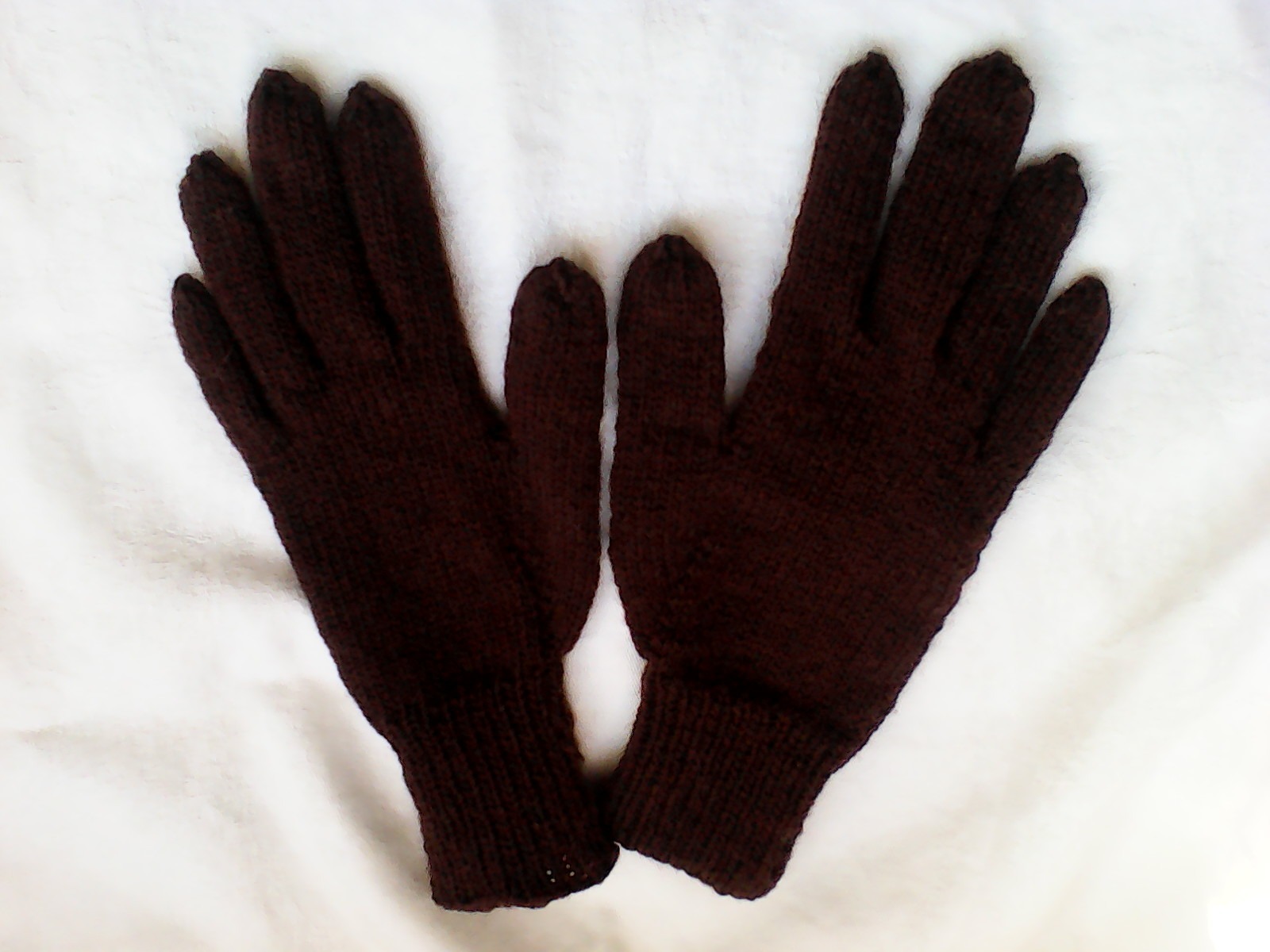
The second glove knit up in practically no time at all (for me) – only a few days. There was just one problem with it. It was really, really tight.
Same pattern, same needles, same stitch count, what appeared to be the same yarn – but was it? Closer inspection proved that I had inadvertently used the ‘just-in-case-there-isn’t-enough’ yarn for the body of the glove, and the proper yarn for the fingers. Of course, this was only detectable under a certain light, and at the right angle.
I pulled the whole thing to bits (quite fiddly with the fingers, it turns out) and started again, this time using the proper yarn. And the result? You could have knocked me down with a feather – it was still much smaller. Not, perhaps, quite as tiny as it had been, but still visibly smaller. Observe:
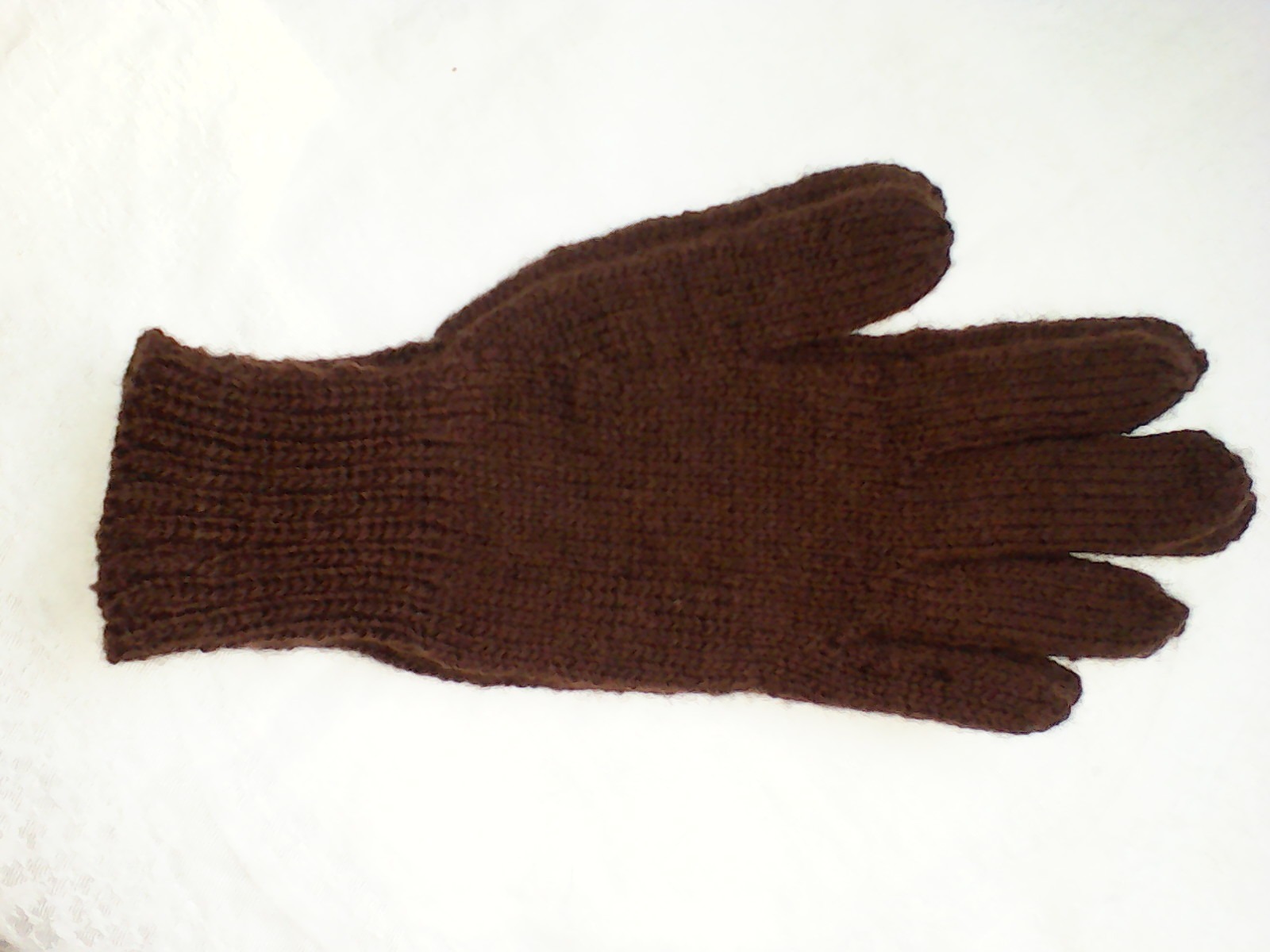
I was (and am) baffled. Same yarn, same needle, same pattern. Different size. And it’s not as though my hands are different sizes, either – at least as far as I can tell. The only possible explanation (all right, the only possible rational explanation) is that I was much tenser when knitting the second glove. It’s funny – I didn’t think I was that stressed, at least until the Tiny Glove Happening.
However, since the winter draws on apace (it was one degree Celsius the other morning) I have decided that It Will Do. But next time I knit gloves, I’m going to try knitting them both in the same season. I’ll just have to learn to knit faster.
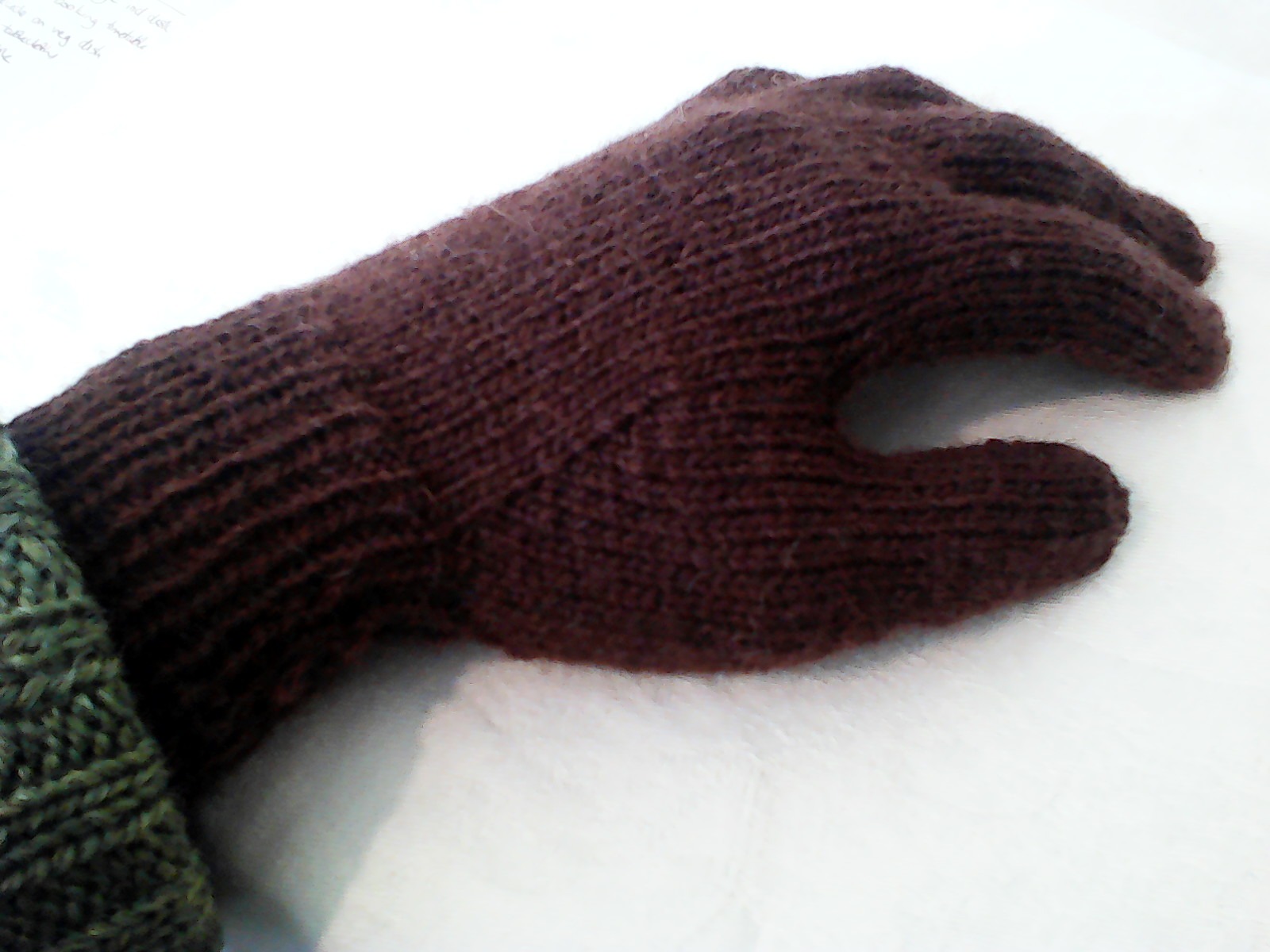
The original draft of this blog post – I usually write them ahead of time – ended here. Last night, however, as I was trimming away a little end that had come loose (you can just see it in the above photo, about halfway down the cuff below the thumb), I discovered that all was not well. Something more than a little end had come loose further along, and there was now a considerable hole in the almost-new glove.
I blamed it on the fact that the cuff of the Second Glove Mark II was knitted out of the fingers of the Second Glove Mark I – not a wise idea, in case anyone is ever thinking of doing it. You end up with a billion little ends to sew in, and the law of averages will soon result in your glove springing a leak. Take it from me…
The hole was beyond a mend: something more like surgery was required. I did my best to pick up stitches around the hand by where it met the cuff, and then carried on the unravelment from where the second hole had sprung up. Did I mention the second hole? It was right at the base of the thumb, practically.

At more than one stage in these proceedings, I considered wastefully chucking the whole thing and just knitting myself a new pair of gloves. Particularly at the point where I thought I’d only managed to pick up half the stitches, and the other half appeared to be laddering…
Mercifully, that proved not to be the case, and I managed to get all the stitches back onto needles, get a controlled unravel to even the round out, and then start knitting back out. Did I mention Second Glove Marks I & II had their cuff knit from the wrist out (hand started with provisional cast-on) because I was afraid of running out of yarn? I ended up using the reserve yarn for Second Glove Mark IIA (Cuff), since it was in bigger pieces than the twice-used ‘real’ yarn.
Alas, no photos were taken of the Franken-rescue process, as I was too busy panicking, picking up stitches, flinging off winter layers (I overheat when I panic), tap-dancing precariously along the outer edge of my abilities, knitting maniacally and then quivering gently as the adrenaline filtered away. Now all I have to do is sew the ends in, firmly this time. Because now, it’s winter.