A tiger, a sheep and a goat go shopping…

My pet theory (one of them – I keep a menagerie) is that there are two basic kinds of shopping: tiger shopping and sheep shopping.

Roncalli-tiger hg

The tiger knows just what she wants. She knows where such things are likely to be found. She stalks her prey, she selects the juiciest from the herd of possibilities and – she pounces!
Should the tiger’s preferred prey elude her, she will not waste her time running after something else. No. She will retire to her tree and sulk. And when she’s got over her sulk, she’ll go hunting again.
Tigers are also noted for teaching their offspring to hunt the same way.

In marked contrast to this is sheep shopping. The sheep prefers a more laid-back style of shopping – frequently as part of a sociable flock. The sheep mosey from place to place, having a nibble here and a nibble there. They graze as they wander along, stopping now and then to munch down a particularly tasty morsel. The sheep is not looking for anything in particular, she’s just seeing what catches her eye.
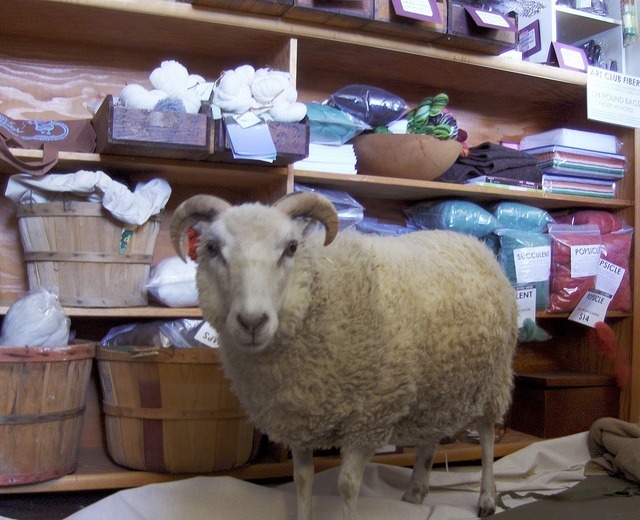
sheep

Both approaches have their good points and their bad points. Tiger-shoppers seldom waste money; but they sometimes use up a lot of time looking for just the right thing – especially since they don’t shop as often as sheep shoppers and don’t necessarily know what’s available where at the moment. This also means they’re less likely to own stuff they don’t really like.

Sheep-shoppers spend lots of time shopping as a matter of course, but don’t get stressed about it as they aren’t aiming for efficiency and are probably socializing as they go in any case. They do often waste money, though, because it’s quite hard to spend significant time shopping without buying anything. They are more likely to be dissatisfied with their purchase(s) once the “new thing!” buzz dies away.

If you carry sheep shopping to the extreme, you get goat shopping. Goats will go anywhere and consume anything, with a complete lack of discrimination.

Mombasa-goats eating posters

Goat shopping results in having too much stuff and not enough money. It is bad for you, the environment and everything in between. Do not act the goat.

And speaking of acting the goat, did you hear about William Windsor trying to headbutt a drummer during a Queen’s Birthday parade? True story!

Which kind of shopper are you? Tiger, sheep, goat, or a mix of all three? I prefer tiger-shopping myself, but I spend a lot of time sulking in my tree. And sometimes I make a baaaad decision (sorry!) and buy something that isn’t quite what I wanted, just because – unlike what I wanted – it was there.

Feeling the Urge to Purge

Funny people, the ancient Greeks: at least four words for love (storge, philia, eros & agapē), but they make one word serve for cleansing, purging, pruning and emotional release.
Katharsis.

It makes sense, though, when you think about it. The word ‘love’ is made to mean far too many things for people to be really certain of what anyone means when they use it; and the various meanings of katharsis do fit together with a certain neatness.

Katharsis (or catharsis as we spell it in English, presumably a thin attempt at covering up the theft) is generally agreed to be a pleasurable feeling. This is why we enjoy reading or watching stories which involve unenjoyable elements. Our emotions are taken out for a brisk airing and returned to their proper places with the warm glow of exercise. This is, incidentally, why we cry when we’re really happy: all the emotion needs to be purged, and tears is how we do it.

But it’s the cleansing/purging aspect of katharsis which I particularly want to look at. Because cleansing and purging are themselves cathartic. This is not to say that washing dishes comes with an automatic glow of satisfaction (if only!) but there is a certain pleasure to be had in pruning the unnecessary elements from one’s life, purging the unwanted stuff, and cleansing what remains. It’s refreshing.

Le faccende di casa by Adriano Cecioni 1869

I spent a while this afternoon cleaning and cleaning out the bathroom – with particular reference to the cupboards. A variety of items left the room for good, and what was left was vigorously reorganized. And I felt good. Unfortunately this took the form of making the Caped Gooseberry come and admire the results. (Patience: a highly underrated quality in a spouse.)

A word to the wise: don’t flush random medications down the loo. Sewage is generally treated before it’s released into the wild, but as far as I know they don’t have special filters for distilling medicaments from the surging tide. Drop them off at the nearest pharmacy/chemist instead.

But don’t worry. As far as I know the mutant-druggie-sewer-alligator is just an urban myth.

Albino Alligator mississippiensis

In Memoriam

London NHM 1100621

“Good stories have teeth.”
Elizabeth O’Connor, 1956-2014

Elizabeth O’Connor was a teacher of writing, a dramaturge, and the Literary Manager of the Court Theatre (among much else).

It was in the latter capacity that I met her, doing a week’s internship in her little office at the top of the Christchurch Arts Centre (now, alas, no more). My task was to make a dent in the two-foot-high stack of scripts on her desk that had been submitted for consideration. As a budding playwright myself (budding? I was barely a sprout) I found both the job and her company very instructive.

The above quote is something Elizabeth used when teaching writing to children. It’s a sort of visual rendition of the fortunately-unfortunately pattern of storytelling, with the ‘teeth’ becoming longer and pointier as the stakes rise and the reversals hurl the character from the heights to the depths and back again. (Children tend to enjoy things that involve big pointy teeth, as do those of us who spend much time in the company of our inner child.)

In 2010 Elizabeth invited me to be part of the Court’s Young Playwrights Initiative, where I developed Dead Man Talking – again, a hugely instructive time. Encouraging as she was, Elizabeth was not one to let you get away with doing less than your best – and she knew if she hadn’t got it.
She was also instrumental in bringing about DMT‘s subsequent performance as part of the Elmwood Players’ 3 Piece, Sweet!

In short, I owe her a lot. She was not only rich in knowledge and understanding of storytelling, theatre, and the theatrical world, but she shared that wealth. She not only welcomed newcomers to that world but elicited the best from them while helping them find their feet. The New Zealand theatre world is a good deal the poorer for her untimely loss, and she will be sorely missed.

The last communication I had from Elizabeth was an assessment of a play I had submitted for the Olga E Harding New New Zealand Playwriting Award. She wrote “should write more”.
I have. And I will.