What Does Clean Mean?

The bathroom, I have been told, is an excellent place to think.

toilet

I tend to find the cleaning of the bathroom is most conducive to reflective thought (something to do with the purgative aspect?) and today was no exception. I started to ponder the difference between people’s standards of cleanliness. Not changing standards of personal cleanliness throughout history (though I have read some fascinating books on the subject) but rather domestic cleanliness.

I think we all, consciously or unconsciously, have a gold standard of what constitutes cleanliness, without which a home cannot be considered a truly clean one, regardless of what else has been cleaned.
For some, it’s a clean sink, à la FlyLady. For others, it’s the dishes that get washed in said sink. Or swept/mopped/scrubbed/vacuumed floors. Or a clean fridge. I have a friend who feels it is important to dust the skirting boards.

I realized, as I worked away this morning, that for me, the most important thing is having a clean toilet and basin. If that is not done, the house is not clean. If that is done, the house is – well, not dirty.

Woman cleaning toilets

I think this probably stems from my childhood experience of Saturday cleaning. On which note, Saturday is the day for weekly housework. Five days shalt thou labour, on the sixth shalt thou do housework and on the seventh shalt thou rest. Of course, if thou dost not do the housework on the Sixth Day, thou dost not have to do it until next Saturday…

At the age of seven, I was started on bathroom cleaning and dishes – my parents being of the view that by the time you leave home you should know how to run one.
Dividing the bathroom territory up with my brother, I went for the smallest possible surface area and ended up with the basin and toilet. (To this day, I avoid bath-cleaning where possible.)
Many years of doing these two chores has ingrained in my mind the subconscious belief that once the toilet and basin are clean, my job is done.

A reclining lady with a fan by Eleuterio Pagliani (1826-1903)

Of course, this is no longer the case, so perhaps it would be as well if I got some sort of mental cleaning product and had a good scrub between the ears.

What’s your sine qua non of household cleanliness – and do you know why?

Guilt-Free!

They say that guilt is like pain: it’s there to tell you something’s wrong, so you can fix it. And this is true – or at least it can be. Sometimes, though, you feel guilty for something you really shouldn’t feel guilty for.

Eating, for example. Unless you’re eating in a self-destructive way, you shouldn’t feel guilty for eating. Eating food with more calories than celery is how you fuel your body, not a transgression that requires penitential exercise to exorcise. As it were.

Donut of DOOM

(Speaking of celery, I’ve heard that it takes more energy to consume than you actually receive from it; which suggests it’s only good for three things: carrying dip, making loud crunchy noises, or wearing on your lapel.)

Generally speaking, I avoid food that’s labelled “guilt-free!” because a) I don’t want to fund that kind of thinking, and b) they might as well label the food “taste was not our priority”.

I admit, eating is not something I tend to feel guilty about. But, as the Caped Gooseberry gently pointed out to me the other day, I do tend to set goals or targets for myself and then feel guilty if I don’t meet them.

As guilty, mark you, as I would feel if I had broken some more important rule, such as “Do Not Kick That Puppy”. Now there is nothing wrong with having a moral code (the puppies of the world thank you) but to put everything at the same level lacks perspective.

Weim Pups 001

On the other hand, setting goals can be good, and having targets is about the only way to reach them. The problem is when the goals become, as it were, a measuring stick to beat yourself with.

What to do?

I have set myself the goal of finishing the first full draft of my WIP by the end of the month. I’ve rearranged my daily round so I have two blocks of writing time each day: three hours in the morning and two hours in the afternoon; and this has definitely helped kick the productivity into high gear. But there’s still no guarantee that I will reach the end of the story by the end of the month.

So I have to keep reminding myself that it’s ok; that I will have made a huge and pleasing amount of progress even if I don’t write “The End” on the day I desire, and I do not need to feel guilty if I don’t.

The End Book

This goes hand in hand with reminding myself that I haven’t “failed” for the day – or the month – if I start a little late or don’t manage as many pages as the day before. Guilt can be crippling, and that leads to further failure – the genuine failure of giving up altogether.

It’s worth asking yourself, the next time you’re feeling guilty: have I really kicked a puppy? Or is this guilt a false friend who should be shown the door?

A tiger, a sheep and a goat go shopping…

My pet theory (one of them – I keep a menagerie) is that there are two basic kinds of shopping: tiger shopping and sheep shopping.

Roncalli-tiger hg

The tiger knows just what she wants. She knows where such things are likely to be found. She stalks her prey, she selects the juiciest from the herd of possibilities and – she pounces!
Should the tiger’s preferred prey elude her, she will not waste her time running after something else. No. She will retire to her tree and sulk. And when she’s got over her sulk, she’ll go hunting again.
Tigers are also noted for teaching their offspring to hunt the same way.

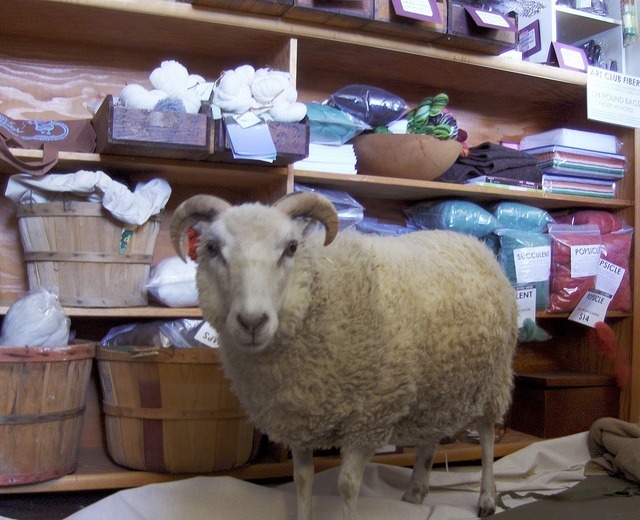
In marked contrast to this is sheep shopping. The sheep prefers a more laid-back style of shopping – frequently as part of a sociable flock. The sheep mosey from place to place, having a nibble here and a nibble there. They graze as they wander along, stopping now and then to munch down a particularly tasty morsel. The sheep is not looking for anything in particular, she’s just seeing what catches her eye.

sheep

Both approaches have their good points and their bad points. Tiger-shoppers seldom waste money; but they sometimes use up a lot of time looking for just the right thing – especially since they don’t shop as often as sheep shoppers and don’t necessarily know what’s available where at the moment. This also means they’re less likely to own stuff they don’t really like.

Sheep-shoppers spend lots of time shopping as a matter of course, but don’t get stressed about it as they aren’t aiming for efficiency and are probably socializing as they go in any case. They do often waste money, though, because it’s quite hard to spend significant time shopping without buying anything. They are more likely to be dissatisfied with their purchase(s) once the “new thing!” buzz dies away.

If you carry sheep shopping to the extreme, you get goat shopping. Goats will go anywhere and consume anything, with a complete lack of discrimination.

Mombasa-goats eating posters

Goat shopping results in having too much stuff and not enough money. It is bad for you, the environment and everything in between. Do not act the goat.

And speaking of acting the goat, did you hear about William Windsor trying to headbutt a drummer during a Queen’s Birthday parade? True story!

Which kind of shopper are you? Tiger, sheep, goat, or a mix of all three? I prefer tiger-shopping myself, but I spend a lot of time sulking in my tree. And sometimes I make a baaaad decision (sorry!) and buy something that isn’t quite what I wanted, just because – unlike what I wanted – it was there.