A Year In Recovery

What do you do when the number of people in your household not dealing with a debilitating chronic illness drops to zero? If you’re anything like me, the answer is Read A Book. The book in this case was The Fatigue Book by Lydia Rolley, who not only worked for many years in an NHS fatigue clinic, but had previously recovered from CFS herself, i.e. She Knows What She’s Talking About.

We decided to launch a Recovery Plan based on her advice. The key principles are simple – flatten out the rollercoaster of energy highs and lows by setting a baseline of activity which you can do on good days and bad without wearing yourself out. Not unlike Goldilocks, you’re looking for not too much and not too little. As your energy improves, you can gradually increase the baseline.
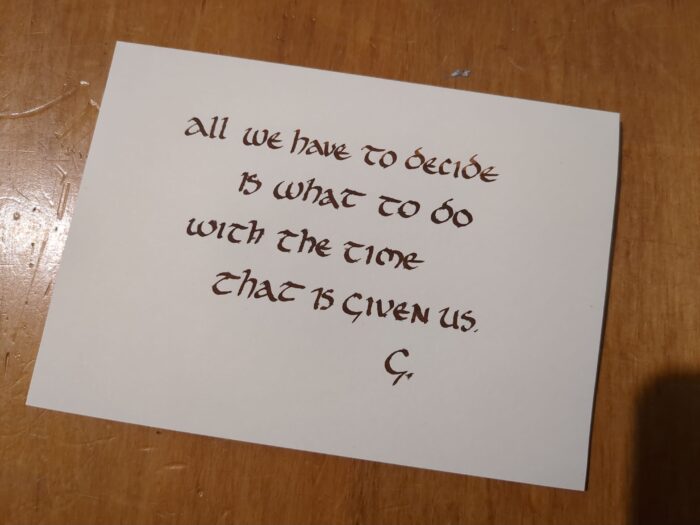
A sheet of paper on a wooden surface has uncial lettering in brown ink which reads "All we have to decide is what to do with the time that is given us. G."

But first we had to have our house mostly replumbed and rewired. (Long story; take my advice and be highly suspicious of any hissing noises in or near your walls.) In mid-May last year, we were finally able to begin resting. Which was absolute bliss, as long as you didn’t look too closely – or in some cases at all – at all the things which had to be set aside until baselines improved. (Set aside in the metaphorical sense. One cannot, alas, actually set aside an unvacuumed carpet, nor a thickly dustcoated windowsill.)

Continue & Comment
How to Live Without TV (a Past Post)

This post was originally published over five years ago, but it echoes a book I am currently reading (or possibly the book echoes the post – they were published in the same year). In Digital Minimalism, Cal Newport writes, “you’re more likely to succeed in reducing the role of digital tools in your life if you cultivate high-quality alternatives to the easy distraction they provide. For many people, their compulsive phone use papers over a void created by a lack of a well-developed leisure life.”
Oof.
I feel Past Me provided some good advice here for Present Me on how to not get sucked into the small screen. So, bearing in mind that we’re not just talking about TV here, how do you live without TV?

  1. Remove TV from house; delete all TV-related tabs, apps etc.
  2. Ta-da! You are living without TV.
black and white drawing of a TV dumped in a rubbish bin


Except what we really want to know is not how to live without TV, but how to thrive without TV. (Side note: if English was a more sensible language, that would have rhymed and been an all-around more catchy sentence.)

Continue & Comment

William Wilberforce’s Bucket List

The bucket list is a relatively recent concept, being invented by screenwriter Justin Zackham – first with “Justin’s List of Things to Do Before I Kick the Bucket” (1999), and subsequently with the film The Bucket List (2007). But the idea of having goals you want to achieve before you die – well, that has a longer history.

Consider William Wilberforce, for example. In 1787, at the age of about 28, he wrote in his journal that, “God Almighty has set before me two great objects: the suppression of the slave trade and the reformation of manners.” (By “manners” he didn’t mean etiquette, but rather the manner of living practiced by society at large – what we might call lifestyle or culture.)

Portrait of William Wilberforce sitting with quill pen in hand at a desk covered in books and papers.

None of this “I want to do a bungee jump, and skydive, and go snorkelling in a tropical resort” stuff for Wilberforce. No, he cut straight to the big stuff: destroy the unethical underpinnings of the global economy, and reform the whole culture he lived in. And having fixed his sights on those goals, he threw everything he had at them.

Continue & Comment