
A Year In Recovery

What do you do when the number of people in your household not dealing with a debilitating chronic illness drops to zero? If you’re anything like me, the answer is Read A Book. The book in this case was The Fatigue Book by Lydia Rolley, who not only worked for many years in an NHS fatigue clinic, but had previously recovered from CFS herself, i.e. She Knows What She’s Talking About.

We decided to launch a Recovery Plan based on her advice. The key principles are simple – flatten out the rollercoaster of energy highs and lows by setting a baseline of activity which you can do on good days and bad without wearing yourself out. Not unlike Goldilocks, you’re looking for not too much and not too little. As your energy improves, you can gradually increase the baseline.
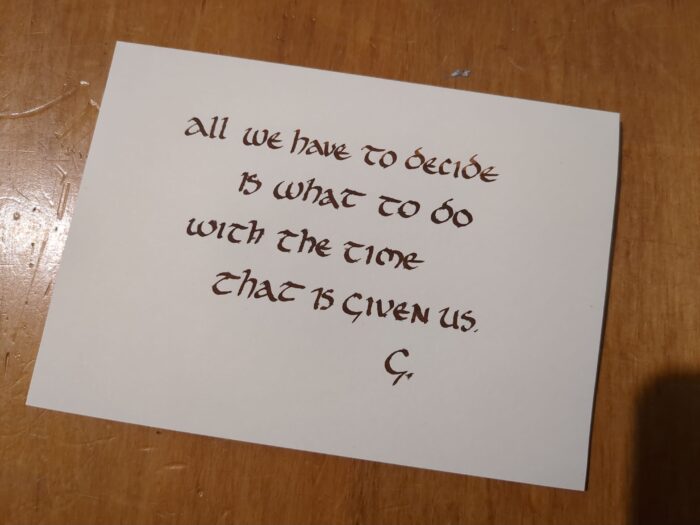
A sheet of paper on a wooden surface has uncial lettering in brown ink which reads "All we have to decide is what to do with the time that is given us. G."

But first we had to have our house mostly replumbed and rewired. (Long story; take my advice and be highly suspicious of any hissing noises in or near your walls.) In mid-May last year, we were finally able to begin resting. Which was absolute bliss, as long as you didn’t look too closely – or in some cases at all – at all the things which had to be set aside until baselines improved. (Set aside in the metaphorical sense. One cannot, alas, actually set aside an unvacuumed carpet, nor a thickly dustcoated windowsill.)

Continue & Comment
Ten First Flowers

I had a garden dream: an overflowing mass of flowering abundance, red and orange and yellow at one end of the front garden; blue and purple and white at the other.

But as the saying goes, the only place where success comes before work is the dictionary. At the end of autumn (i.e. May) I summoned my energies, such as they were, and built two garden beds in the front garden.

The results, it must be said, are not entirely what I had hoped for. For one thing, a heavy layer of cardboard and a few inches of garden mix were not enough to put off the weeds, which have grown back in profusion: creeping buttercup, convolvulus, dock…

But some plants did manage to make their presence felt despite the weeds. I therefore present you with the ten best blooms from late winter to early summer.

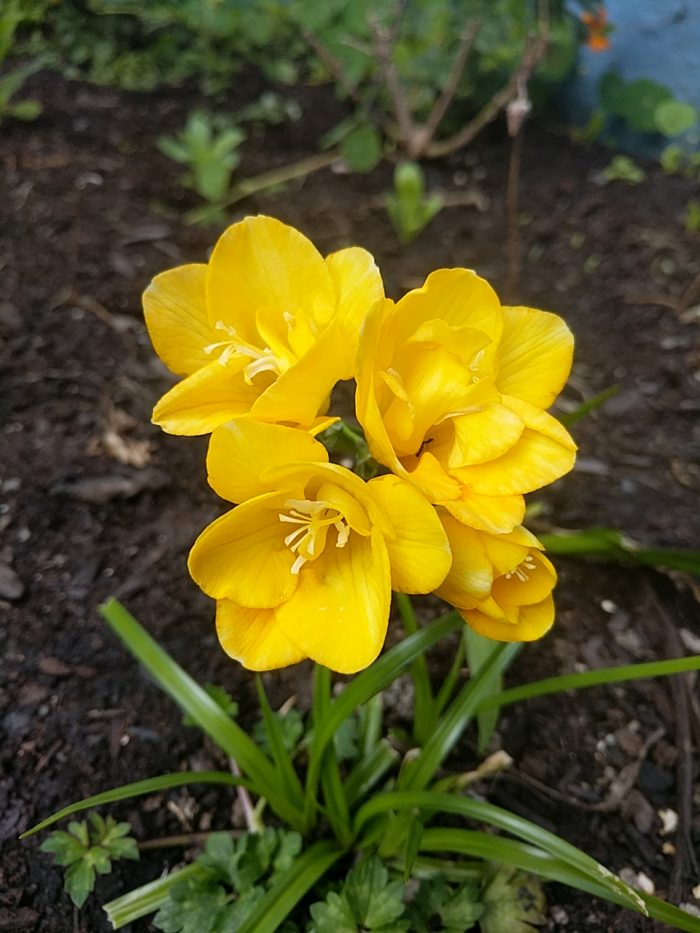
In the early days of expanses of bare soil relieved mostly by weeds it was a comfort to have the freesias (a thoughtful gift) spring up and give the impression this was actually a garden.

A cheerful cluster of small six-petalled yellow blooms rises above green foliage.
Freesia (Golden Giant? Golden Melody?)
Continue & Comment

Who Made This?

The nature of creativity has been given a bit of extra scrutiny lately, with the rise of AI art. Which (you may be relieved to hear) I do not propose to discuss. But the question of who is the creator of a work – or what involvement counts as creation – is one that isn’t limited to interactions with bots, algorithms, or any of that other techy stuff.

I read a book recently, about a garden called Federal Twist. James Golden, the man who wrote the book, lives in the house in the garden (at least part-time; I wasn’t sure if it’s just a weekend place or what), and designed the garden. And he identifies very closely with the garden. So much so that he says, “I am Federal Twist.” Well, he wouldn’t be the first human to identify with place, and he’ll be far from the last.

But.

Continue & Comment