The Artist's Way: A Sense of Catching Up

Covering July: a Sense of Connection, August: a Sense of Strength, and September: a Sense of Compassion.
Lightly covering – a crisp linen sheet, say, rather than a fat and puffy quilt.

July revealed such gems as “I believe I am getting better at socks” (knitting them, not the Pratchett kind) and “I feel more possible” (although the Caped Gooseberry assures me I am not only possible, but actual – I think my meaning may have escaped him).
Also “As a kid, we never had enough: books” (whether you can have enough books is debatable; our perceived lack drove me to read encyclopaedias and Agatha Christie at the age of six, so it’s not all bad).

Reading the encyclopedia

August asked me to complete this sentence: In a perfect world I would secretly love to be a…
All right, there’s not much secret about it, but I want to be a full-time writer.
In five years’ time, I’d like to be writing full time with one novel published and two plays produced.
What can I do now to help make that happen?
Write hard on Mondays. Make the most of morning spaces. Get to bed on time.

I was also invited to select a role model. The three women who sprang to mind are not only among my favourite writers (international women of mystery) but are also all three writers who balanced novels and the theatre in some way or another: Agatha Christie, Ngaio Marsh and Dorothy Sayers.
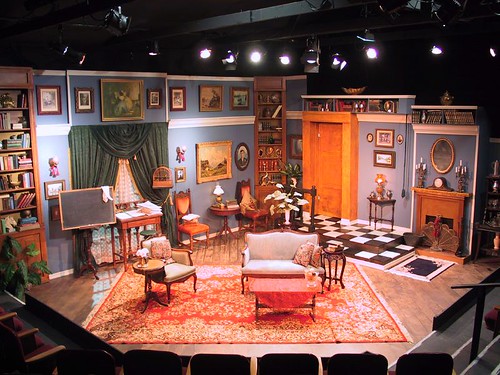
mystery of marie roget set

The one woman who sprang to mind whom I most certainly do not wish to take for my pattern is P.D. James – at least having a DDJ until reaching retirement age. In the areas of literary achievement, faith and perseverance (not to mention the life peerage) I’d be most happy to follow her example.

Also, if I was a colour, I’d be russet: colour of earth and blood, rich cloth and poor, and the bindings of old books. The colour of autumn leaves, the colour of rust.

September brought an insight – I should stop calling myself lazy. I wrote “you may be scared, self-doubting and self-flagellating, feeling tired, heartsick and guilty – but you are not lazy.”

Procrastination isn’t the result of laziness, Cameron says. It’s the result of fear.  “Fear is what blocks an artist. The fear of not being good enough. The fear of not finishing. The fear of failure and of success. The fear of beginning at all.” (p.152)
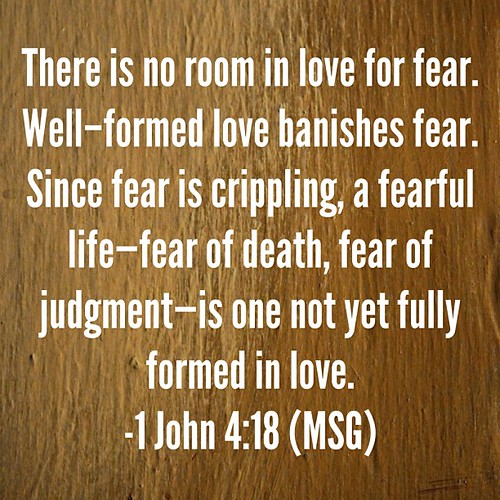
There's no fear in love.

Another insight: “Over any extended period of time, being an artist requires enthusiasm more than discipline. Enthusiasm is not an emotional state. It is a spiritual commitment…” (p.153).

Much like marriage: you can’t stay in the same emotional state for 50 years, you need commitment. But commitment shouldn’t be replaced by discipline (hug two three! kiss two three!) because discipline isn’t rooted in love – except perhaps in love with how wonderfully disciplined we are!

The trick is to find our enthusiasm for the task at hand – and how to find it quickly in the pre-dawn dark when getting out of the nice warm bed seems like a particularly sadistic rebirthing technique.

As always, your wisdom welcomed! Or witty folly (better a witty fool than a foolish wit) – we’re not fussy here!

Sinistra Inksteynehand250

Stress and Support Systems

This blog post is brought to you by the letter ‘S’!

As I mentioned last week, we are soon moving house. A week today, in fact. Seven days. In six days, the movers will be coming to pack everything up. Everything, that is, except the books, which we plan on packing ourselves.

So far I have managed to pack up the mystery collection (it has its own book case) which filled three wine boxes: Agatha Christie, Assorted Mystery, and Assorted Mystery: Paperback. Although to be honest with you, I think there’s some Christie in every box. An excellent vintage.

reading murder

They’re all packed and taped and labelled and this is all very satisfying to behold, until the sinking realization that there will be no more mystery-reading until we unpack at the new house.

No Miss Silver, no Poirot, no Miss Marple, no Tommy and Tuppence, no Cadfael, no Inspector Wexford. No Mma Ramotswe.
I am desolate.

You see, reading mysteries is one of my favourite ways of dealing with stress. (The wine boxes were empty when I got them.) I can comfortably read one in the morning, one in the afternoon, and (if circumstances are really dire) one in the evening as well, though headaches may threaten.

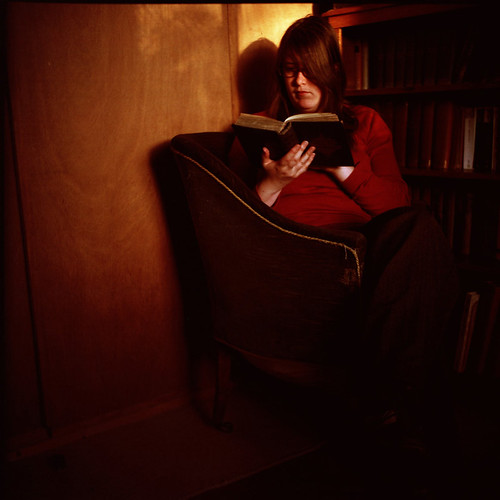
Nose in a book

In a mystery, as in life, there are things that go wrong, unfair actions and suspicions, confusion and uncertainty. Perhaps this is why I so much enjoy the old-fashioned detectives who give a full explanation in the last chapter: there are answers.
There will be answers.

But not today.

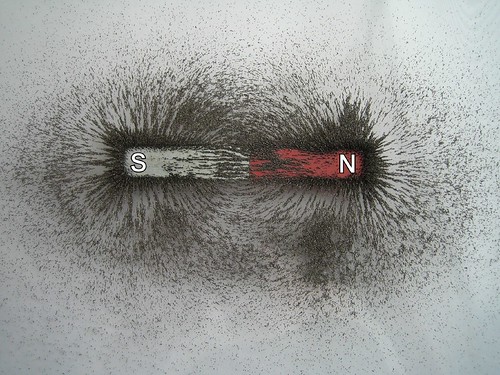
Has anyone else noticed that moving house is like a magnet in a field of iron filings, a lead weight on a rubber sheet covered in sand (or, again, iron filings)? It attracts other stressors.

iron filings tracing the magnetic field of a bar magnet

I went and had a look at the Holmes & Rahe stress scale, and I figured my score was around 271. “Risk of illness is moderate.”
What was I thinking, packing the mysteries a week out?

Of course, as the logically-minded (or anarchically-minded) among you will point out, if I get desperate I can always open one of the boxes. But this violates the cardinal law of successful moving:
That Which Has Been Packed Shall Not Be Unpacked.

Or at least not until you arrive at the other house. Then it’s a toss-up whether you go first for the bedding, the kettle, or the books. Or the cat.

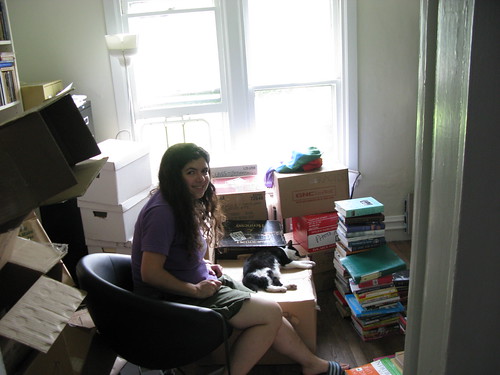
shira and zora unpacking

But I have still a secret weapon up my sleeve – or rather, in a tea tin. Just for a change, it’s not tea, delectably de-stressing as that excellent beverage is. It’s knitting.

When I am stressed, I knit. Last year, I knit my father a cardigan (it was quite a stressful year). Usually I go for smaller projects – hats, baby items (for charity – stressed enough without one of my own, thank you) and most recently, socks.

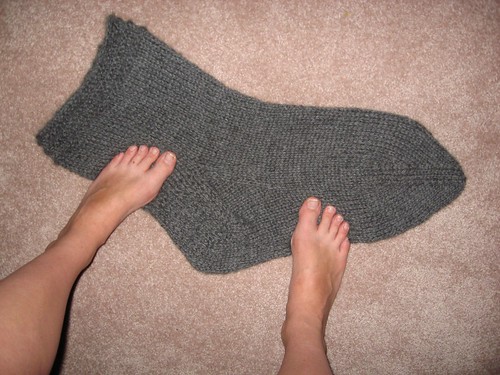
big foot

It took an embarrassingly long time for me to figure out how to turn a heel, but I am now working on my second pair of real, wearable socks (in recycled merino/possum blend – soft and fuzzy).

Although socks are less escapist, knitting has the advantage over novels in one respect: time. There is nothing more frustrating than just getting into a story when your ten minutes for tea expires and it’s back to work (all right, there is, but let’s not go there, I’m stressed enough already).

alarm clocks kill dreams

Mind you, I managed to read the unabridged Nicholas Nickleby entirely in breaks at work, so it’s not entirely unworkable. But mysteries should not be chopped into little pieces in such a way.

I would be delighted to hear your tips for handling stress (moving-related or otherwise); and do feel free to administer your own Holmes-Rahe test and leave your results in the comments.
(Highest score gets bragging rights and an ulcer; lowest score gets a smug sense of superiority and an unimpaired duodenum.)

And tell me: what would you unpack first?

Writing In Flow

:Keys to Enhanced Creativity
by Susan K Perry, Ph.D.

This book is based on the thesis which earned her that Ph.D. – hence the 8 page Appendix, 10 pages of biographical information on the writers who provided her research material (including Diana Gabaldon, Sue Grafton and Ursula K. LeGuin), 19 pages of notes and 12 pages of bibliographical references.

That said, it’s by no means a dry tome – Perry is primarily a writer, after all – and it holds the interest, whether you approach it from the academic level (what an intriguing phenomenon, I wonder how it works) or the personal (do others experience this the way I do and what can I pick up from them?

The “flow” referred to is that experience of losing awareness of the world around you, when the words just pour out of you, and time stops.

sorry but i lost track of time

The ‘sweet spot’, ‘the zone’ – whatever you call it, that’s what we’re talking about here. In great detail. Too much to cover here, so you’ll just have to read it yourself if you’re curious.

Chapters cover what flow is. How it happens. What it feels like. The keys to getting into flow – have a reason to write (“Don’t coerce yourself. Find your motivation.”), think like a writer, loosen up, focus in, balance among opposites. Writer’s block – the complete opposite of flow. And my personal favourite, Specific Techniques for Luring Flow.

These include: specific rituals or routines around writing, specific writing tools, time and space, music/silence/meditation, re-reading what you’ve written so far/reading others’ work to spark your creativity/stopping in the middle of something, eating/drinking/fasting, walking or jotting or knitting or doing physical work or tiring yourself out or climbing a tree or (like Colette), picking fleas off your cat.

Reading in Trees

Obviously, you can’t use all of these at once. (Picking fleas off a cat halfway up a tree while knitting? I think not.) But there’s plenty to play with here. Try something. See how you like it.
Try something else. Play with the combinations and wait for the tumblers to go click.

Peg and Bank Safe

Myself, I am drawn to the rituals/routines and the specific tools.

For example, I like to drink tea while I write. Actually, I like to drink tea most of the time, but I let myself have a lump of sugar in it if I’m writing. Perry notes, “As a writer who wishes to write regularly, you need to seek out ways to complexify your day to day life so that it remains fresh and inspiring to you,” but then, she is a full-time writer – a DDJ being more or less the antithesis of fresh and inspiring, yes?

As for writing tools, I believe I have mentioned before that I write with a Faber Castell fountain pen. It’s old enough that it uses actual ink from bottles, not plastic cartridges like my modern Parker does. I thought it used an Archimedes screw to draw up ink (how awesome would that be?) but apparently it doesn’t.

Archimedes screw

There is a screw-shaped bit, but it sucks up ink in the same way an eye-dropper sucks up eyedrops – it creates a vacuum, which nature abhors and therefore obligingly fills with ink.

Which is all to say that I will need to buy a bottle of ink sooner or later. Possibly later, given how long the ink lasts. For purposes of comparison, a disposable pen (ballpoint) contains between .27 and 2mL of ink. The smallest bottle of ink I’ve seen for sale contains 30mL.

At present I am using a fine blue ink bought for me (along with an elegant blue/green glass dip pen), by a friend visiting Venice. (Clearly, this is a Good Friend.) But what shall I use when the blue is finished?
When I started writing up notes for The Black Joke, I decided to use creamy paper (I bought a ream) and sepia ink from an old calligraphy kit, (the Made in China kind – bleeds like mad).

T on skin, ink bleeding

So when I read this book, two synapses touched, there was a minor explosion, and I thought ‘I could have a different colour ink for each Work In Progress – a thematic colour, as it were.’

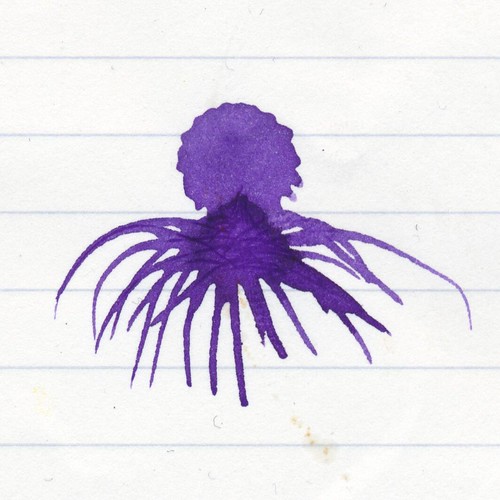
Hard upon that thought followed the question “I wonder what the thematic colour for Tsifira would be?” At the moment, I lean towards a sort of amethysty purple – bright enough to be light and sparkly, but dark enough to be actually readable. Preferably even by candlelight, for the winter dark comes on apace.

Purple ink octopus

I shall leave you with a final thought to chew on from Susan Perry’s book: “Your own preferred way of thinking about and describing flow is as unique to you as your writer’s imagination. Learn something about your creative process by taking a moment to consider your own sense of what flow is and how you get there… If you construct your life around words, the right metaphor can be critical.”

What is your metaphor? What is your method? I’d love to know.