
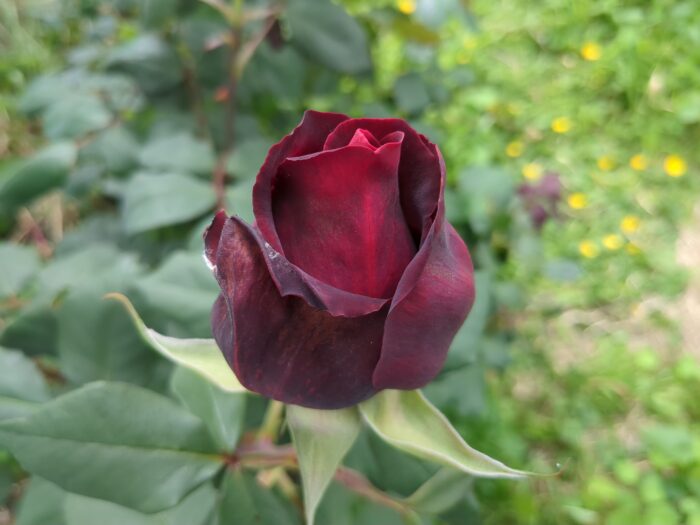
The Deep Secrets are beginning to open, thus continuing the accidental bloom succession begun by the kōwhai and continued by the crabapple. The Blue Moon is close behind (the buds are swelling but not quite open yet) and the Westerland has decided once again to concentrate on producing one very very tall stem to the exclusion of flowers. So far.
Interesting Times
For some reason, English uses the letters t and h next to each other to express the consonant that begins the word thorn. But it was not always so. We used to have a letter for that sound, and it was called…thorn. It looked like this: Þ
For some reason (which may or may not be the same reason) we use the same digraph (th) to express the sound which begins the word then. But it was not always so. We used to have a letter for that sound, and it was called…eth. It looked like this: ð and it was for some reason pronounced eÞ, not eð.
English being English (even back then) these two were each used to denote th and th, with blithe (or possibly blithe) disregard for consistency. No doubt there was some very reasonable reason to get rid of these two letters and replace them both with the same pair of letters, each of which individually had its own sound already (rolls eyes). Or perhaps not. Personally, I find the letter thorn very useful for writing abbreviated days of the week: M T W Þ F…
Nature’s Freaks, Fancies, and Fascinations
I had heard of coconut crabs. I think I vaguely assumed they were called that because they looked like coconuts. In fact, they are called that because they can OPEN coconuts. They’re actually a kind of hermit crab, but they give up the classic hiding in a shell thing when they become adults, because what do you have to be afraid of when you are a tree-climbing coconut-cracking crab a metre across and can lift seven times your own bodyweight? (28kg, in case you were wondering – 4kg bodyweight.) But don’t worry: if a coconut crab gets you in its clutches you can make it let go by tickling its tummy.
And Now For Someone Completely Different

“The proper, wise balancing of one’s whole life may depend upon the feasibility of a cup of tea at an unusual hour.”
Arnold Bennett
Latest Library Loot
Mortal Monarchs: 1,000 Years of Royal Deaths by Suzie Edge is a fascinating look at the cause of death for the English/British monarchs from Harold (did he get an arrow in the eye?) to Elizabeth II (turns out you can die at 96 and people will still complain if your death certificate says “old age”), taking in a few others along the way such as Mary Queen of Scots and the six wives of Henry VIII. Suzie Edge is in fact Dr Suzie Edge, and does not shy away from gory medical details, but it’s a very interesting read. You may be surprised to find out when the last regicide occurred.
An Excellent Mystery is another of Ellis Peters’ Cadfael books. A maimed Crusader returns from the East, releases his betrothed from their engagement, and becomes a monk. Three years later his squire goes to pay court to the young lady, only to find she became a nun three years ago, at a certain convent…which has just been destroyed in the Anarchy. Desperately seeking her among the scattered survivors, he discovers that the convent has never heard of her. This is indeed an excellent mystery, as well as a touching one.
While The Dish is not a book, it is something I borrowed from the library. It’s a fictionalized account of the Australian radio telescope (in real life, telescopes) which received the television footage from the first ever moonwalk. It’s a delightful film, which for some reason was rated M despite having no sex and no violence (though it does have a single use of the F word).
By My Own Hand Or None
For Your Consideration
If you found yourself confronting a full-size adult coconut crab, which of the following would you rather have?
a) a coconut to bribe or brain it with
b) a feather to tickle its tummy
c) a vat of melted butter
d) an enormous aquarium
e) a running start to the sea