I have been doing a bit of clothes shopping lately, and this has inspired a rant. Or, more accurately, a collection of related mini-rants, which – as I do not have a hotline to garment industrialists worldwide – I present here.
In the first place, there seems to be considerable confusion about the significance of length. If the wearer cannot bend over in a certain garment without flashing passersby, it is a top. Kindly stop charging extra for it under the pretence that it is a dress.
From an Autumn/Winter collection, believe it or not.
I had a garden dream: an overflowing mass of flowering abundance, red and orange and yellow at one end of the front garden; blue and purple and white at the other.
But as the saying goes, the only place where success comes before work is the dictionary. At the end of autumn (i.e. May) I summoned my energies, such as they were, and built two garden beds in the front garden.
The results, it must be said, are not entirely what I had hoped for. For one thing, a heavy layer of cardboard and a few inches of garden mix were not enough to put off the weeds, which have grown back in profusion: creeping buttercup, convolvulus, dock…
But some plants did manage to make their presence felt despite the weeds. I therefore present you with the ten best blooms from late winter to early summer.
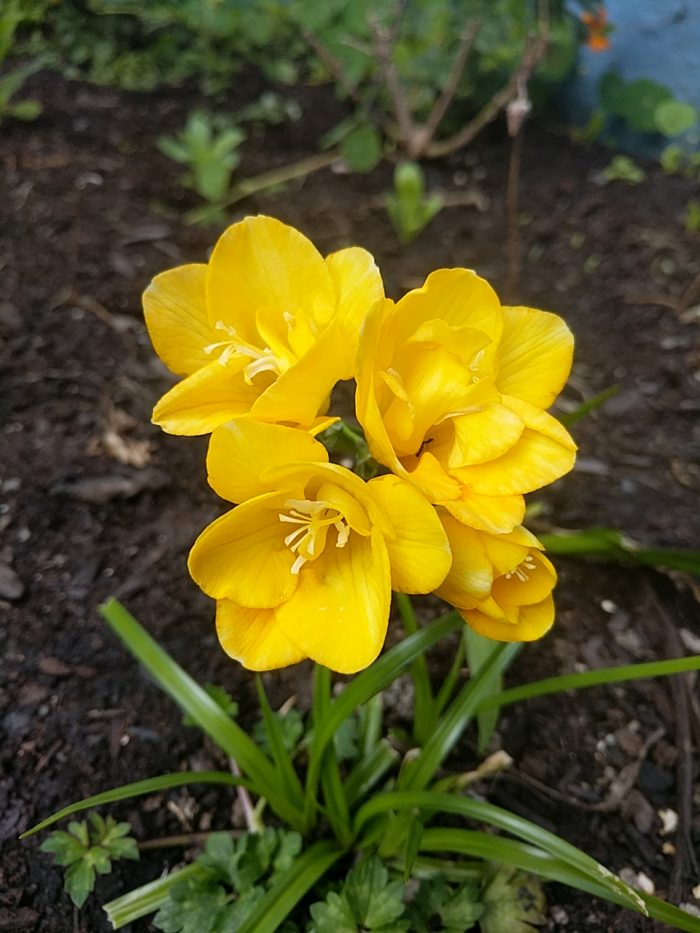
In the early days of expanses of bare soil relieved mostly by weeds it was a comfort to have the freesias (a thoughtful gift) spring up and give the impression this was actually a garden.
The French adjective biscornu means wonky, skewed, irregular, or – if taken literally – twice-horned. The English adjective biscornu doesn’t exist, because English is totally unreliable in its use of the vocabulary it has filched from other languages. Like an overconfident teenager with an unfamiliar appliance, we are certain we can get it to work somehow, without bothering to listen to the instructions from those who’ve been using it longer.
English uses biscornu as a noun, meaning a small pincushion made from two squares of material – or, according to Wikipedia, “the boundary of a unique convex polyhedron….a flattened square antiprism”. (And if you understand that, I’m very happy for you.)
They’re usually made from Aida cloth or embroidery linen, with a counted-thread design, but it turns out you can make them from two squares of ordinary cloth. This is a very useful time to employ what quilters call English Paper Piecing.
Cloth is not this compliant without paper underpinnings.