It turns out J.K. Rowling was right: sorting can be done by hat. While specialist sorting may require a specialist hat, all hats are useful for the sorting of people into three basic types.
The types are:
Those Who Wear Hats (subtypes range from Royal Ladies, to Australasians who Don’t Want Skin Cancer, to veritable Mad Hatters)
Those Who Do Not Wear Hats (subtypes include Hat Heretics and Those Who Are All About the Hair)
Those Who Do Not Wear Hats but Would Like To (subtypes including Those Who Lack Confidence and Those Whose Heads Defy the Average)
I don’t really go in for hero-worship, but there are always going to be those people who make me think “Gosh! What a life! I wish I was a bit more like them…”
Number one on the simplicity charts is Jesus Christ (also the exception to the hero-worship clause). Jesus had so little that he once pointed out to a would-be follower that he didn’t own so much as a place to lie down. Foxes have dens, birds have nests – but if you’re going to follow me, don’t plan on being as comfy as them. Famously, he was so poor that when he died they had to borrow a tomb to bury him in.
But he wasn’t a grim, joyless race-to-the-bottom kind of person either. He often got criticized by the establishment for going to parties (first miracle: turning about 600L of water into 600L of wine to spare some newlyweds the embarrassment of having under-catered their reception) and he once laid into his followers for lambasting a woman who poured a bottle of expensive perfume all over him. Thrifty it might not have been, but loving it was.
And while he might not have owned much but the clothes on his back, they weren’t the lowest rags available. He wore a seamless robe, which, as any weaver will tell you, is not the easiest thing in the world to make. Like the perfume, it was probably a gift. Medieval art suggests that it was made by Mary, although rather than getting into the technicalities of weaving, they just depicted her knitting in the round (using DPNs, not circulars).
I learned from his example that why is often at least as important as what; that good things are gifts to be enjoyed, but not expected; and that you should always give your grave back when you’re finished with it.
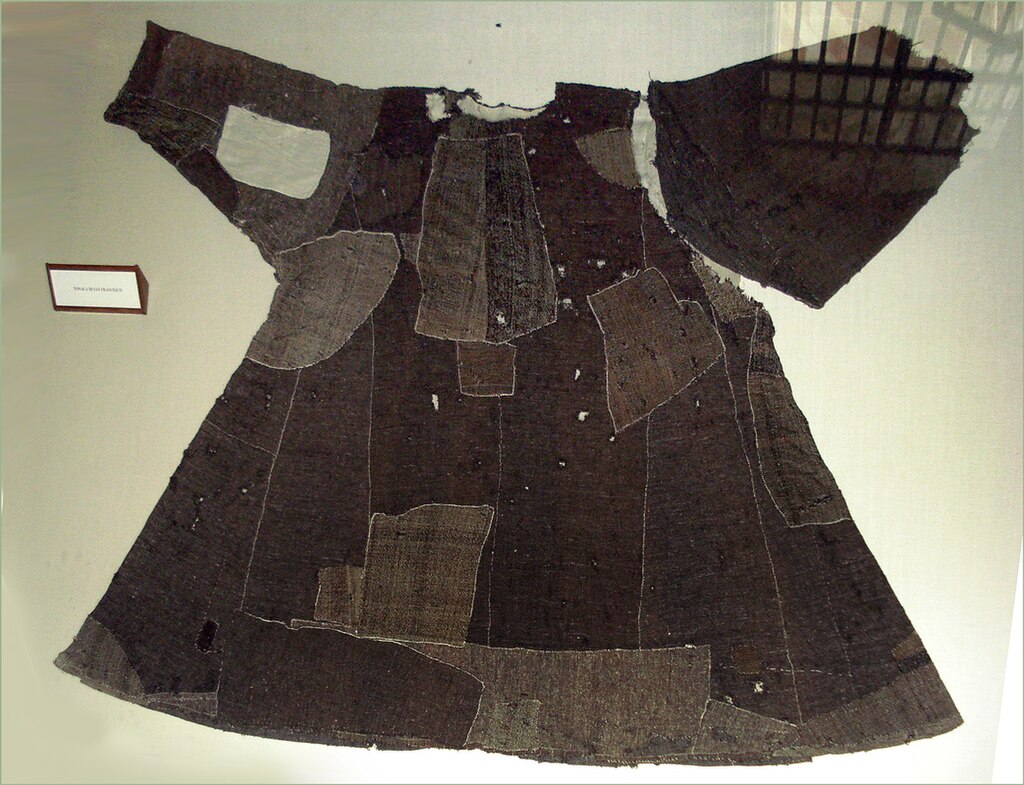
Fast-forward a millennium or thereabouts and you encounter Francesco Bernadone, better known these days as St. Francis of Assisi. Francis was crazy in love with “Lady Poverty” (his term) and hey, people in love do weird things. Francis took a vow to never refuse to give anything that was asked of him “for the love of God” and his followers had the greatest difficulty in persuading him not to give poor people the clothes off his back.
When he retired from leading the order, the new leadership made him promise not to give his clothes away any more – it looked bad, having your founder running about in his underwear – and Francis obediently promised. So the next time he encountered a beggar wearing less than him, he sorrowfully informed the fellow that he couldn’t give him his clothes – and then suggested the beggar should mug him. Possibly the first recorded instance of legalism being used in a good cause.
The poor didn’t want this one.
I learned from Francis that having little or nothing can be as full a life as having much – or even fuller. As he pointed out, as soon as you start having stuff, you start worrying about people nicking it. No stuff? No worries.
#3 on the list is a group rather than a person: the Quakers, a.k.a. the Society of Friends. (Mostly the historical Quakers. Richard Nixon, not so much.) Unlike #1 and #2, they didn’t generally divest themselves of all possessions, up to or including their clothing. They took a slightly different approach. Instead of reducing themselves to a level of poverty where they were dependent on the kindness of others, they aimed to be the ones whose kindness others could depend on.
In order to be able to be generous, they worked hard and developed businesses along sound ethical lines. Many were wealthy – bankers, manufacturers – but unlike the wealthy of today, they shunned luxury and conspicuous consumption, believing that no one was superior to anyone else and it was shameful to act (or dress) as though you were. Instead, they poured their time and resources into social justice causes, such as the reform of inhumane conditions in prisons and – famously – the abolition of slavery.
However plain – or rather, Plain Quakers were, they weren’t against the good things of life (apart from being teetotal). They were industry leaders in the chocolate business – need I say more? Plainness was a hallmark of the Quaker, yes, but so was quality. A Quaker would, for example, infinitely prefer to wear the same plain, good quality garment for years, than to have a never-ceasing cycle of cheap fashionable tat filling their wardrobe.
The point for the Quakers was not that it was wrong to spend money, or even to spend money on things for yourself. The point was that it was wrong to spend money on things for yourself that you didn’t need, when others didn’t have the things that they needed.
I learned from the Quakers that #1’s command to “Love others as you love yourself” can be taken as a practical instruction for living; that living simply so that others can simply live really does make a difference; and that being thought odd is no barrier to making change in your world.
History bears witness that their simplicity brought great good to many. I hope that one day that can be said of me.
When it comes to seeking simplicity in life, where do you find inspiration? Whose example influences you? A person, a group, a movement, an aesthetic? Spread the inspiration below!

.jpg)