What Happened Next?

It occurred to me today that while I bring up a lot of subjects on this blog, I seldom revisit them. While I know what happened next, I don’t often share that with the rest of the world.
How has it been since I cut my hair short? Have I actually done any of the exercise I praised, fun or otherwise? Have all my screeds over the years on the subject of decluttering had any measurable effects in real life? Or was it all just talk?

Well…

1815 Isabey Portrait Katharina Pawlowna von Russland anagoria

My hair is still short, and definitely curly. On a good morning, there’s a vague resemblance to Helena Bonham Carter; on a bad morning, the resemblance is more to Edward Scissorhands – and a lot stronger. I’m planning to grow it out as winter approaches – partly for warmth and partly just to see what happens!

As for exercise, I mentioned that my exercise goals included buying a skipping rope, and learning to dance the galliard (aka the cinquepace). I have indeed bought a skipping rope, and have even skipped with it – mostly outside on the grass for the sake of my joints. It’s harder than it was when I was little, though I have not yet tried any fancy touches like the Inverse Toad.

Woodcut Galliard

When it comes to the galliard, however, I have met with less success. Apart from the useful information that one could dance the galliard to the tune of God Save the Queen (perhaps why the dance was so popular with Queen Elizabeth I, who danced six or seven of a morning by way of exercise), I have got nowhere. As wonderful as our local library is, it is singularly lacking in books on how to dance the dances of history. I shall have to keep looking. Next stop: the great wide web.

I have also acquired a new swimming-suit (of which more hereafter) and gone to a swimming-pool for the first time in a long time. (Years.) I happily paddled and splashed about, enjoying the absence of large waves trying to give me a forcible sinus rinse, and even essayed a few lengths, with variable success. Running your head into the wall while swimming on your back: not success.

0ld keyboards

On the same day as we went to the pool, we took a quantity of e-waste to the safe-disposal-of-electronic-waste people. I was very happy to see the back of it. As well as safely breaking down the parts of things no longer functional (recycling), they also fix things where possible (reuse) or turn them into other things (repurpose) – all very good for the planet, as well as those not able (or not willing) to buy their belongings new.

Since I last wrote about tidying, decluttering and purging, I have also gone through the bathroom cupboards like a dose of salts (pun intended – please forgive me) as well as the pantry cupboard and the shelves in the hallway.

I’m also sleeping better. I stopped worrying about it, and that seemed to help, although I’m inclined to give the recent sudden arrival of autumn a bit of credit too – no more waking up overheated. Now I sleep like a hibernating dormouse, although happily I don’t snore like one.

Glis glis (edible dormouse) in winter sleep

What have I missed? Is there anything I mentioned once and never got back to you about? Let me know in the comments!

The Life-Changing Magic of Tidying

Hear me out: it’s the title of a book by Marie Kondo, a Japanese “expert declutterer and professional cleaner” – a book which I have recently read.
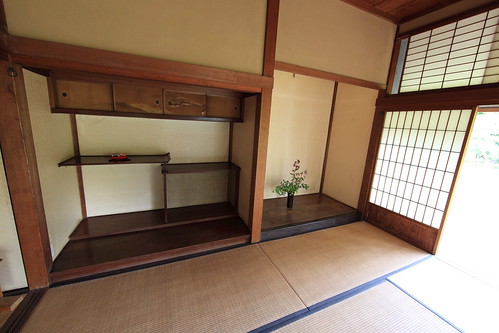
Japanese traditional style SAMURAI house / 稲葉家下屋敷(いなばけ しもやしき)

It’s quite different to the usual run of (Western) decluttering books. For a start, there’s her belief that a seven-tatami-mat room (3m/10ft by 4m/13ft) is ample living & storage space for a single person; her habit of greeting the house and thanking her belongings for their service; her almost religious devotion to folding clothes; and of course, the idea that decluttering your house is best done all in one go.

What? I hear you cry. All in one go? Does she not realize how much stuff I have?

On which note, it turns out that Japanese people are not entirely immune from hoarding, despite the overall population density and corresponding lack of space. Examples given include sixty toothbrushes, eighty rolls of toilet paper, and a hundred boxes of cotton buds – with 200 buds in each.

Toiletpaper stilllife

So rest assured, she doesn’t mean that you should sort out everything you own in one day. (Phew!) Six months is more her estimation, starting with easy things like clothes and working your way up to difficult things like photos and keepsakes.

The idea is to sort everything by type, and not put, say, your clothes away – any of them – until you have sorted out absolutely all of them. This makes sense, when you realize that there’s no point organizing how you’re going to store a certain class of object until you know how big that class is going to be.

And here’s the really surprising bit of her claim: she says that if you go through the process properly, imagining how you want your home to be and delving deep into your motivation before sorting it all out, you will never regress. It will be a once-in-a-lifetime purge. Because once you’ve got it the way you want it, you will have the motivation to keep it that way, one presumes.
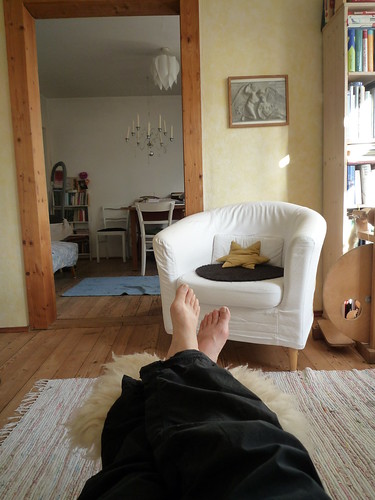
That's me right now

The thing I really like about her system is the measure for deciding what to keep: does it bring me joy? If not, out it goes. Except tax papers and the like, which, alas, have to be kept regardless of the feelings they inspire.

What do you think? Could you commit to a season of purging the dross from your life – and never look back? What does your ideal feel like – and how does that look?

For myself, I’d like my living environment to be one of simplicity, spaciousness and peace; where both focus and relaxation are possible without the distraction of unfinished jobs, unnecessary items, and unimportant decisions.
As to whether I am prepared to spend the next six months ruthlessly purging all my belongings (my books!) – well, I know better than to sign up for the long term at short notice. But I am certainly considering it.