
Clothing Budget: Lessons Learned

Having a clothing budget is more useful than I’d realized. It doesn’t just keep your spending in check, it helps you spend more wisely, too. Not solely because your spending is limited, but because keeping records of your incomings and outgoings allows you to look back and see which buys turned out to be the good ones, and which didn’t.

Fresco showing a woman so-called Sappho holding writing implements, from Pompeii, Naples National Archaeological Museum (14842101892) restored
I’ve had a clothing budget for just over three years now – $25 a month ($18 US), which covers pretty much everything but shoes. Each month I keep a record of what I spent, and – most importantly – on what. Brace yourself: things are about to get statistical.

In the three years I looked at, I spent $860 on clothes. (That’s about $625 US.) Which, frankly, seems like a massive amount! I made a list of each item I bought over the three years (divided by year), what I paid for it, whether it was new or second-hand, and whether I still wear the item or not – and if not, why.

I spent $40 on clothes which I am already no longer wearing. Actually, there’s another dress I’ve only worn once, but it’s a special occasion dress, so the verdict is still out on whether I’m avoiding it or just haven’t had many suitable occasions yet. If it turns out I am avoiding it, that’s $60 total I’m not wearing any more.
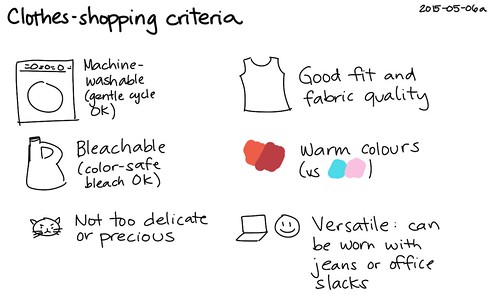
2015-05-06a Clothes-shopping criteria -- index card #shopping

Most common reasons for not wearing something any more? It doesn’t fit, or it doesn’t suit. That seems reasonable. Then I looked at the breakdown of new versus second-hand. It turns out that fully half of the second-hand items I bought in those three years I no longer wear (five of ten). But I’m still wearing 13 of the 15 new items I bought.

Why? My guess is that I’m a lot less picky when it comes to second-hand clothing, because it’s so much cheaper. But if I’m going to spend good money on something, it better be worth it! The decision-making process increases in length proportional to the price of the item.

In support of this theory, I note that the two new items I’m not wearing any more were a super-cheap t-shirt (this was before I started shopping ethically) and a zip for a second-hand skirt. Total cost, $6.60. In fact, the average price of the garments I’m not wearing any more is less than $7. Shocking.

Macke - Modegeschäft
Where things really got interesting was when I started comparing how many items I bought in each year, and how much I spent on average per item. Remember, it’s just this last year I’ve been making an effort to shop ethically.

In 2015 I bought 11 items at an average of about $28 each. (Buying a swimsuit pushed the average much higher than it would otherwise have been.)
In 2016 I was still in the red from the expenditures of the previous year, so I only bought six items – average about $38.
In 2017 I started shopping ethically, and here’s where you’d expect the prices to skyrocket, right? I bought eight items, for an average of about $40.

Overall, I did spend more in 2017 than in the preceding years, but that was still less than $20 over what I spent in 2015.

To be honest, the real cost to me in shopping more ethically hasn’t been the financial cost. It’s been the cost of planning, the cost of avoiding the easy buy and taking the time to find ethical options.

"Mrs. America buys clothes with care" - NARA - 515034
Side note: if anyone’s interested in encouraging the ethical shopping habits of Australasians, what would be really helpful is a guide to what can be bought where. Don’t just tell me XYZ has an A rating, tell me where’s good for buying pajamas, or socks, or collared shirts…

So those are the lessons my clothing budget has taught me so far: it’s worth taking the time to be sure about an item before buying it – no “close enough is good enough” buys; and shopping ethically isn’t that much more expensive.

Will I keep on with this? You bet! For one thing, in the next few years I’ll be getting some valuable data on how long various garments last. Because no matter how much I expect my clothes to be immune to the ravages of time, nothing lasts forever.

William-Adolphe Bouguereau (1825-1905) - A Calling (1896)
Especially socks.

You Gotta Be Hardy

Old woman in sunbonnet by Doris Ulmann
Oh, lots of things happen to folks. Sickness or being poor and hungry, being old and a-feared to die. That’s the way it is, cradle to grave, and you can stand it. There’s just one way: you gotta be hardy. You gotta be. You can’t deserve the sweet and tender in life unless’n you’re tough.
Aunt Eller from Oklahoma!

Favourite Princesses of Fact and Fiction

Three historical princesses and six fictional ones, in no other order!

Elizaveta romanova
First up, Princess Elisabeth of Hesse and by Rhine, subsequently Grand Duchess Elizabeth Feodorovna, subsequently (posthumously) Holy Martyr Elizabeth Feodorovna Romanova.
Born a princess in humble circumstances (inasmuch as a princess can be in humble circumstances), she married a Russian Grand Duke, forgave the man who assassinated him, sold all she owned to found a convent of nuns dedicated to serving the poor, and was then assassinated by the Bolsheviks. A remarkable woman.

But if you think her life is remarkable, consider her niece (and god-daughter), Princess Alice of Battenberg.
Laszlo - Princess Andrew of Greece
Born deaf, she was polylingual despite having to lip-read. Born a princess, married a prince, served as a nurse in the Balkan Wars, went into exile following World War I, had five children, sheltered Jewish refugees during World War II, struggled with mental health problems, served the poor, became a nun, and became mother-in-law to Princess Elizabeth (now Queen Elizabeth II).

Agnes of Bohemia was born to be a pawn, a useful nugget of negotiation to be married off in whatever way her father found most profitable. First she was engaged to the son of the Holy Roman Emperor (she was eight, he was ten). Six years later the engagement was dissolved and her father planned to marry her off to Henry III of England – but the Emperor refused to allow it, as he wanted to marry her himself. Yes, the same Emperor whose son she’d been engaged to.
Anezka Vaclavske namestie
But Agnes had other plans: she flatly refused to marry anyone at all. This could have been war – in fact, she had to call on the pope to back her up. But the Emperor caved: “If she had left me for a mortal man, I would have taken vengeance with the sword, but I cannot take offence because in preference to me she has chosen the King of Heaven.” She went on to found a double monastery and hospital providing free care for the poor – work she did with her own royal hands.

Éowyn is the first of our fictional princesses, first introduced in The Two Towers. She is a shieldmaiden and for a time Regent of Rohan, thanks to Háma who points out that the king has a second surviving relative and “she is fearless and high-hearted. All love her. Let her be as lord”. She also goes defiantly into battle (despite her uncle’s objections), defending said uncle from the Witch-King of Angmar. “You stand between me and my lord and kin. Begone, if you be not deathless! For living or dark undead, I will smite you, if you touch him.” (Hear, hear!) After recovering from her war-wounds she retires from shieldmaidening and marries Faramir, becoming Lady of Ithilien.

Peter Nicolai Arbo-Hervors dødRoyesse Iselle is the second-in-line to the throne of Chalion in The Curse of Chalion (top on my list of I Wish I’d Written That), behind her older half-brother the roya (i.e. king) and her younger brother the royse (i.e. prince). She too lives with the threat of a most unwelcome arranged marriage, but with the aid of those loyal to her and her own indomitable spirit, she decides her own path.

Princess Ben (from the book of the same name by Catherine Gilbert Murdock), or, to give her her full name, Princess Benevolence, is a lonely orphan being raised by a most controlling aunt. She finds a chance to learn magic – and sooner or later you know she’s going to end up saving the world. But she’s a nice, sensible, relatable princess, for all that, with a witty tongue in her head, for all she daren’t use it.

Speaking of relatable princesses, there is the Little Princess, Sara Crewe. Not, perhaps, strictly speaking, a real princess, but it takes a lot of inner strength to carry on living up to the standards of princesshood when you don’t enjoy any of the advantages, which makes her a princess for the unroyal of us. As Julie Andrews said, “Behaving like a princess is work. It’s not just about looking beautiful or wearing a crown. It’s more about how you are inside.”
A Month's Darning MET ap66.240
Diana Wynne Jones’ novel Castle in the Air is replete with princesses – dozens of them – but my favourite has to be Princess Beatrice. She’s a brisk and hearty princess, a natural leader, but prouder of her practical skills such as darning socks and even mending boots. She runs away to avoid a political marriage, but the book ends with her marrying herself off – for her own ends.

Last – and I’m sure this is no surprise – is Princess Lily of Arcelia. Like Éowyn, Ben and Sara, she is an orphan, and like Ben, she has a rather controlling aunt who has very definite ideas about what kind of young lady she ought to be. Driven by a genuine passion for her land and its people, Lily follows her duty even when it leads to rebellion. Running away from home at the tender age of eighteen-next-week, Lily has to grow up fast. I must admit to being rather fond of Lily. Despite her mistakes – and she makes some so bad I flinch for her – she perseveres, she does her best, and she learns.

Alexandra Nikolaievna of Russia by C.Robertson (1840, Hermitage)Who is your favourite princess – real or imaginary? Tell us all about her in the comments!