Miss Silver’s Wardrobe Precepts

Have you ever wanted a simple, sane, reliable wardrobe that lets you be you and just works?
So have I – and then I found someone who has one: Miss Maud Silver, from the novels of Patricia Wentworth.
I carefully scrutinized how she did it, and here are the results: ten precepts to guide you toward a wardrobe that works for you.Edwardian lady writing (6908558900)Precept the First: Do not be limited by fashion.
Choose clothes that you like, that suit you and work for your life, and pay no heed to whether they are in fashion or not.
Furthermore, if such clothes are not readily available, feel free to alter what is available to suit yourself.
Miss Silver, for example, prefers a high neck, and has her dresses adapted accordingly.

Precept the Second: To thine own self be true.
Never use clothing as a way to pretend to be someone or something you’re not.
Do not be embarrassed to be seen repeatedly in the same clothes; nor ashamed to be seen in old clothes, if well cared for.
Miss Silver would certainly agree that “no one can make you feel inferior without your consent,” as Eleanor Roosevelt is said to have said.

A Working Class Family in Wartime- Every Day Life With the Suter Family in London, 1940 D788Precept the Third: Choose quality.
Don’t shop needlessly, but when you must buy, buy the best you can afford. To buy an inferior garment which won’t last is a false economy.
And naturally, having bought good quality, you will want to take good care of it, with appropriate washing, pressing, mending and so forth.

Precept the Fourth: Have a line of succession.
In due course of wear your once-new “best” will be relegated to “second best” and so forth, down the line of wear, and a new “best” will be acquired.
This policy works in many different areas of the wardrobe, although the time involved may be different for different areas.
Miss Silver buys a new summer and winter dress every year, but new hats are acquired much less often.

A customer tries on a new hat in the millinery department of Bourne and Hollingsworth on London's Oxford Street in 1942. D6596
Precept the Fifth: Buy flexible clothing.
Look for clothes which work for more than one level of formality. Miss Silver wears last year’s summer silk dress for evening-wear, for example.
There’s no point in buying, say, a special-occasions-only dress which becomes entirely useless once it’s worn enough to no longer be suitable for special occasions.

Precept the Sixth: Coordinate accessories.
Miss Silver has her hats, coat, shoes, stockings, gloves and handbag in black. These coordinate with each other and with all her dresses, and she is thus spared the need to buy and maintain multiple sets of everything.
Of course, you needn’t choose black, nor all matching, but make sure everything works together.

Teacher in a Negro grammar school in her bedroom at home. 8d20236vPrecept the Seventh: Be selective in ornamentation.
Choose a few favourite ornaments. You need no others.
(This doesn’t include any family heirlooms you do not wear yourself but are waiting to pass down to younger members of the family.)
Miss Silver has a string of gold filigree beads, a locket with her late parents’ initials, and three brooches (one of which carries her pince-nez). Note: she doesn’t wear them all at once.

Precept the Eighth: Make use of trimmings.
A plain hat, for example, can be varied from year to year by altering the trimmings (which can themselves be recycled).
Trimmings can also be removed from worn-out garments and attached to the new, as Miss Silver does with the trim on her dressing-gown.
One can also choose to trim the clothing no one sees. (Miss Silver has three rows of crocheted lace trimming on her knicker legs.)
Detalj, pipkrage - Livrustkammaren - 68113Precept the Ninth: Make it yourself.
Miss Silver not only crocheted the aforementioned trimming, she designed it herself.
She also knits an endless series of garments (although generally they are for friends and family, rather than herself).
Making things yourself allows for endless customization. Quite literally, suit yourself.

Precept the Tenth: Always have a handkerchief.
Clean, plain, and of a sensible size. You never know when they will come in handy – nor for what.

Literary Handwork

Reading and handwork make a perfect pair, in my opinion: the two things I enjoy doing most, miraculously combined. Sometimes I even enjoy the reading more than actually doing the thing itself. And on those occasions when a project outlasts enthusiasm, what better to rekindle the fires than finding the same spark in a book?
Albert Anker - Strickendes Mädchen beim lesen (1907)
Happily, literature is full of examples of hand-workers – particularly in those classics which were written in the days when handwork for women was just ‘work’ and everyone (unless a gentleman of the purely decorative class) was expected to keep themselves busy.

So it is with the Dashwood girls in Sense and Sensibility. “Sir John Middleton, who called on them every day for the first fortnight, and who was not in the habit of seeing much occupation at home, could not conceal his amazement on finding them always employed.”

Or take Mansfield Park, also by Jane Austen. One of her more underrated books, I feel, with one of her more underrated heroines. Fanny is always busy with handwork: her own, or someone else’s. Helping Aunt Bertram the indolent, or being press-ganged into the thrifty machinations of Aunt Norris. And unlike her cousins, she does work of a high calibre.

Mp-Brock-10Then there are the March girls in Little Women, who ” adopted Jo’s plan of dividing the long seams [of sheets] into four parts, and calling the quarters Europe, Asia, Africa, and America, and in that way got on capitally, especially when they talked about the different countries as they stitched their way through them.” The book also includes knitting, dressmaking (for humans and dolls), and the embroidering of a pair of slippers (“grave yet cheerful pansies on a deeper purple ground”).

Not all literary hand-workers are enthusiastic. Catherine, from Catherine, Called Birdy by Karen Cushman, is continually being nagged by her old nurse Morwenna to work on her spinning, sewing, embroidery and the like, when she would rather be running wild outside. “They found the remains of several spindles, many skeins of wool, and an unfinished tapestry in the muck from the privy. Why is everyone so certain they are mine?”
Reine Berthe et les fileueses, 1888
Other fictional handworkers include Miss Silver, who is always knitting something, usually for her great-niece or great-nephews, and who designs and executes her own crochet trimmings to boot. Miss Marple also knits, but in less detail. Devotées (or, indeed, devotés) of quilting can enjoy the works of Jennifer Chiaverini and Earlene Fowler. Embroiderers, or those considering taking up embroidery, should make a beeline for Embroidery Mary.

On the non-fiction side, there are plenty of books about the history and practice of various crafts, and then there are books of craft humour. Stephanie Pearl-McPhee is an outstanding outlier in this field.

For those who are passionate about both literature and craft, there are books of crafts inspired by books, which you can add another layer to by making the crafts from the books of crafts inspired by books. While reading the originatory books, if you want to complete the circle and you have the much-desired (by me at least) ability of reading while working with your hands.

Meyer von Bremen Strickendes lesendes Mädchen 1863Alternatively, you can follow the grand old tradition of having one person read while everyone else handworks; or its modern, more solitary equivalent: the audio book.

What are some of your favourite handworky books? Recommendations eagerly sought!

Necessity is the Mother of Design

Scroll down for link to pattern pdf.

Some people speak the language of gifts with flair and elegance. I am not one of those people. (I could go into a discussion of love languages, but that’s probably a post all of its own.) While I am always delighted when I can think of exactly the right gift for someone – and find it in order to give it to them – it doesn’t often happen, and giving a ‘meh’ gift is irksome. (So is receiving it, probably, but all my friends and family have decent enough manners not to say so.)

Facepalm (4254919655)So I have been known, on more than one occasion, to fall back on the scheme of offering to knit someone something. That way they get to choose something they like – assuming it’s within my capabilities – and I get to give them something they will enjoy without having to go into the mall. Win-win.

And then a friend of mine said she’d really like a hooded scarf for her present – and helpfully sent me some pictures so I knew the kind of thing she was thinking of. I went hunting for patterns and – nothing. OK, not nothing. There were cutesy patterns with little animal ears – or paws (not all of them for kids); there were complexly cabled ones (no can do, although I’m hoping to learn this winter); there were fancy lacy ones and ones where the scarf element appeared more like chin ties. There were some in the finest of yarns (my friend wanted something warm, verging on chunky) and some which used so much yarn it would wipe out my entire craft budget for the year.

Ramona and my small stash of yarn :) (81/365)I did find one pattern, however, which looked like what my friend wanted. In fact, it was one of the pictures she’d sent me. It was also, alas, a crochet pattern. And while I can, technically, crochet, the results are not the sort of thing I would inflict on a friend. Certainly not a friend I wanted to keep.

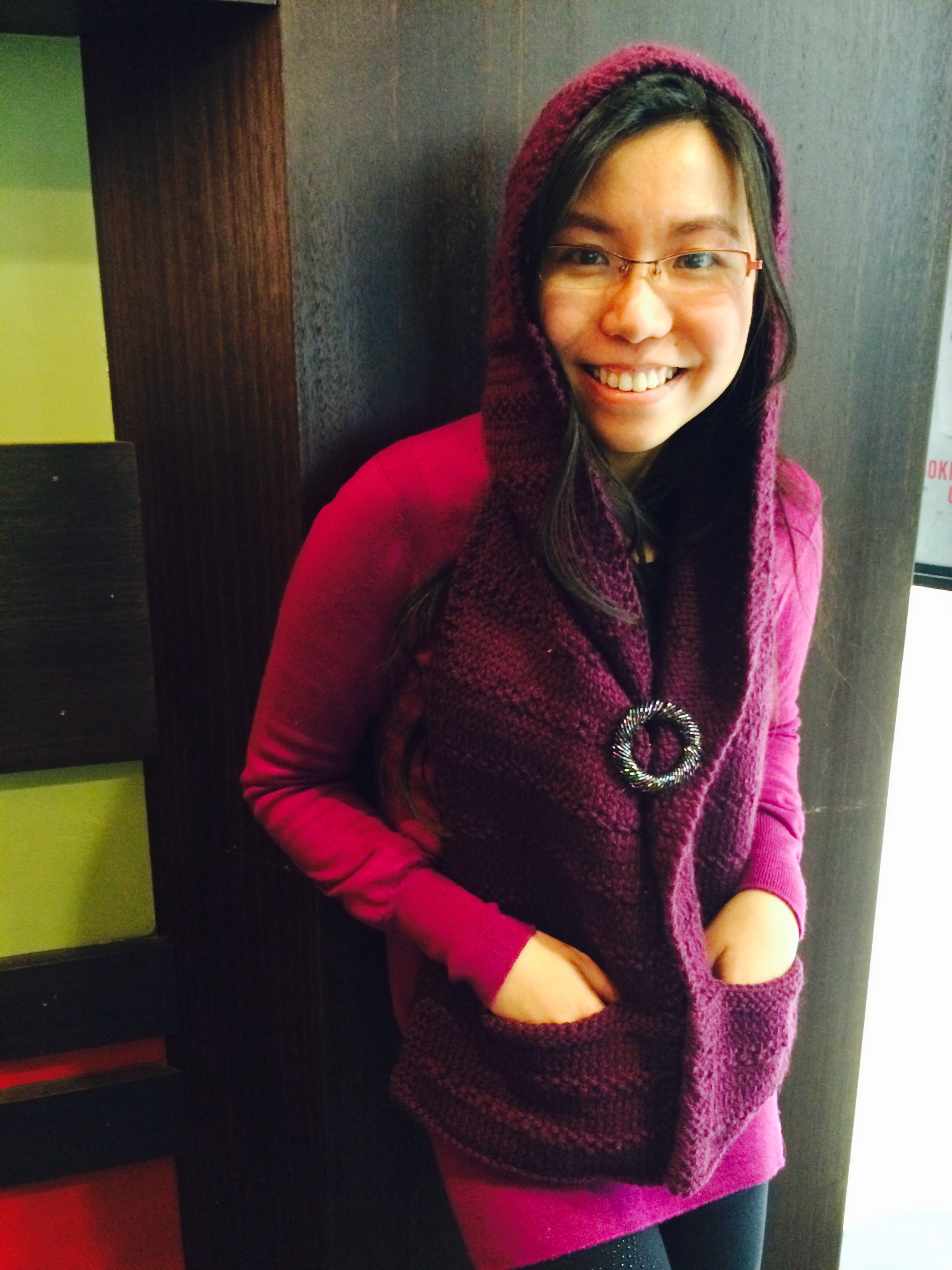
So I decided to branch out, to stretch myself, and to do something I’d never done before. I designed a pattern for a hooded scarf: simple enough for my skills, thick enough to be warm, using little enough wool not to bankrupt me, and creating the look my friend was looking for. With pockets, because there are not enough pockets in this world. Plus it gives you somewhere to keep your hands warm.

And it really is a simple pattern: all you need to know how to do is knit, purl, cast on and cast off. Plus very basic sewing skills (attach A to B, using needle and yarn) and, yes, it helps if you can count. (Embarrassing personal side note: I once applied for a job where the few requirements included being able to read and count. I didn’t get it. I didn’t even get an interview. I’d like to say this was when I was a child, but I was 24 and had a brand-new Master’s degree at the time.) You don’t even need to worry about gauge for this pattern, which means there’s no need to swatch.

19 Jan
In the spirit of sharing which makes this world what it is, I am making the pattern freely available here on the blog (assuming I can figure out the technicalities) and also on Ravelry and OpenRavel. As with everything else on the blog, it’s under a Creative Commons Attribution Share-Alike license. This means that you are free to copy the pattern, reuse it, adapt it, sell what you knit from it – anything you like, really, as long as you credit me as the designer and share your derivative works just as freely.

So here it is: the Simple Hooded Scarf with Pockets! (click on underlined text for pattern file). Not the catchiest name, I know, but at least you know what you’re getting. Truth in advertising, et cetera.

If you use this pattern, I’d love to see what you do with it! Feel free to leave a link in the comments, and if you’re on Ravelry or a similar craft site, link your project to the pattern for others to see. Have fun!

left

Note: the pattern calls for 12-ply yarn, but the yarn I used – while saying 12-ply on the label – knits up more like a 10-ply. For the level of drape shown, go for something around 8wpi; or go thicker for a chunkier scarf.