Is Handwriting Obsolete?

Do you remember that era of uncertainty, back around the end of high school, when you were trying to figure out what to do with your life? Hoping that the right answer would magically appear before me, I took a test which promised a list of possible careers based on my primary and secondary traits.

For my blend of opposites (artistic and analytical), there were only two suggestions: fur designer – I think we have already established that I am probably not Cruella de Vil – and graphologist. I had to look the latter up: it means a person who practices the art of handwriting analysis.

Not the kind where you give evidence in court that the purported suicide note was written not by the lord of the manor but by the devious machinating butler (that’s graphanalysis, part of the science of Questioned Document Examination) but the fortunetelling sort, where you inspect a piece of someone’s handwriting and tell them what kind of person they are.

Jehan Georges Vibert --The Fortune Teller, private collection
Your handwriting suggests that you are credulous and easily taken in.

(Note: if you want to find out what kind of person you are, examining yourself will get you further than getting a stranger to examine your handwriting.)

I found the idea interesting, read a book or two about it, and then lost interest when I found it was considered a pseudoscience. But my interest in handwriting remained, and to this day I get irritated by people who proclaim that there’s no need to teach children to write by hand as in the future everyone will be using digital devices for everything and no-one will need to write anything by hand ever again.

Note: predicting the future is also a pseudoscience. Unless it’s either very short-range, or admitting a wide margin of error, or both. Refusing to teach children a practical skill because they might not need it is not responsible educating. That’s like abolishing driver’s ed because someone’s invented driverless cars. Yes, there are many ways in which inputting data into a digital device can replace writing things by hand. There are also many ways in which it can’t.

George Baxter- The Lover’s Letter Box
No one ever thinks of looking through a tree’s Sent folder

For example, people are more likely to remember things that they have written out by hand, because forming the letters and the words is a more interactive experience than pressing a series of keys or tapping a series of places on a screen. Paper and pen/cil are a lot more durable than an electronic device, don’t require ongoing access to electricity and don’t cost so much to produce.

They’re also a lot more flexible. If you want to do something different with your pen/cil and paper, you don’t have to wait for someone to write a program or app for you. You just do it. And while there are still language barriers, format is less of an issue. No one has ever had their love-letter returned by the postal service because their beloved’s letterbox couldn’t open that filetype.

Nor is paper subject to attacks from malware, or disappearances due to bugs in the system (although some kinds of insects do like to eat paper). Nor do you have to worry about Big Brother reading everything you write and taking notes. Nor do you have to buy a new one every five minutes because this kind of paper is totally two years ago and your pen won’t write on it any more.
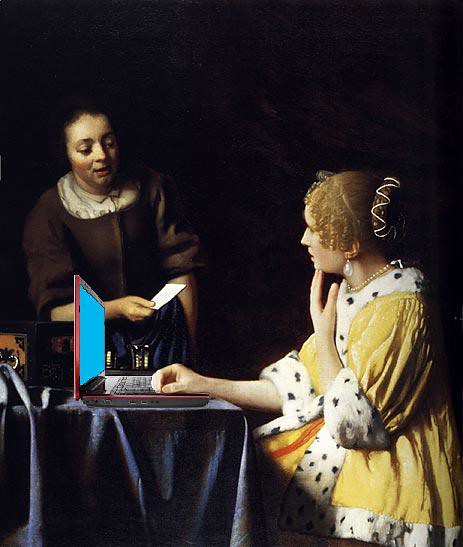
Lady Blogger with Her Maid, after Vermeer
I am not a Luddite – not really. I welcome the recent suggestion that New Zealand school children should be taught to code. I think it’s an excellent idea to actually teach children to master the ways of the digital world, instead of being passive consumers. But that should be in addition to teaching them to write with their hands, not instead of. Just as radio, film and TV have not replaced books, nor e-books their physical counterparts, typing and tapping have not replaced handwriting – and until they do, it’s robbing children of a skill not to teach them how.

Of course, one can go too far the other way. I see no reason to force children to learn an elaborate cursive with letters that bear no resemblance to their usual appearance (looking at you, D’Nealian upper and lower case Zs). While a certain aesthetic quality is a bonus, the main thing is to be clearly legible. I can still remember the terror of some of my contemporaries at university on being told that if the lecturer could not decipher their exam papers, they would be failed.

Some might argue that the natural solution is to allow everyone to write their exams on a computer, but that massively increases the opportunities for cheating, and the corresponding efforts to prevent it. And what if some innocent student is busily typing away and the power goes out? Or the connection fails? Or a glitch destroys all their work?

girl-1064659_640

Pen and paper are one kind of technology; digital devices are another. As is so often the case, the wisest course (it seems to me) is not to blindly promote one technology and deride or ignore the other, but to use each in the ways that it best suits, thus getting the best of both worlds in the strengths of each. It doesn’t have to be either/or.

How Do You Like Your Hand?

Insomniac notes
Not the complicated thingy on the end of your wrist, nor yet anything you may have been dealt, but your handwriting. Love it? Loathe it? Secretly proud of the fact that no one can read it but you, and sometimes not even then?

The Home of Enoughness

A face, Loretta Young said, “is like the outside of a house, and most faces, like most houses, give us an idea of what we can expect to find inside.” Our house is 74 years old, built during the Second World War as state housing: good quality housing for the working class. It’s still a good quality house. Rimu doors, matai floors, cupboards that don’t fly open in earthquakes…

State houses at Arapuni Hydro Works
A house is the embodiment of the culture which built it, but New Zealand culture has changed. As Bill McKay and Andrea Stevens noted in their book on the New Zealand state house, past and present (Beyond the State: New Zealand State Houses from Modest to Modern), most ex-state houses have been adapted, extended, enlarged. But not all. To quote: “Having lived in the house now for several years, Aaron [Kreisler, ex-state-houseowner] feels he has grown into it. Instead of adapting the house, he has adapted to it.”

There is a fascinating depth to that idea which I would like to delve into. The idea of cutting your coat to suit your cloth is quite passé, but why? What is the allure of indebting yourself in order to increase your space beyond what you actually need? First you spend money on stuff, and then you spend more on enlarging your house to fit it. Why not instead take the house as it is, as your ally in living a life of enoughness?

I feel particularly blessed in that regard, as my house seems to have been neatly designed for enoughness. It’s not an ornate and draughty Victorian behemoth, or an eighties temple to overconsumption, or even a modern there-is-a-house-somewhere-behind-this-garage architectural ode to our cultural dependence on personal vehicular transport. It’s a 1940s row house/terraced house, with a slightly cottagey aesthetic.

A Day in the Life of a Wartime Housewife- Everyday Life in London, England, 1941 D2358
One can imagine the first occupants moving into it with the precious furniture that their family managed to hold on to through the Depression, each item carefully tended and given its own place. If there’s one thing that this house would not have seen a lot of in its early days, it’s clutter. Its ‘face’ suggests an interior of comfortable simplicity, an efficiency without sterility, a warm and unpretentious home. Slick modern luxury? No.

McKay and Stevens describe the ex-state house bathroom as “a surprisingly perfunctory space. It is tiny and speaks of a very different attitude to what is seen nowadays as an indulgent daily ritual.” Our very typical bathroom contains a bath, a basin (no stand, it’s attached to the wall) and a toilet, with the sum total of storage provided by a small medicine cabinet set into the wall. If you want to avoid accumulating clutter, the ex-state house bathroom is your friend, the tough no-nonsense kind of friend who will chuck your extra conditioner bottles out the window if you overcrowd the sill.
VIEW OF INTERIOR BATHROOM, FACING WEST - 1019 East Fourteenth Avenue (House), 1019 East Fourteenth Avenue, Tampa, Hillsborough County, FL HABS FL-557-13
Storage becomes a bit of a theme in McKay and Stevens’ description. “But the thing you really notice when visiting these houses is how little storage space they had compared with today’s homes. We don’t take up more space, but our stuff seems to; indeed, quite significantly more. A standard-issue wardrobe for these times was about a metre wide. With all the consumer temptations thrown at us today, this would barely be enough for a coat collection.”

On reading this, I immediately thought of what could be construed as my coat collection. I have one winter coat of wool, one jacket ditto, one alleged raincoat (showercoat, more like), and one red velvet coat, plus one large cloak. This seems to me like a lot, but I can assure you, it doesn’t take up half of the wardrobe space which the 1940s have bestowed upon me. Six dresses hang in the same wardrobe, along with a collared shirt, two skirts, my evening wear, an off-season dressing-gown and my wedding dress. And a hanging doohicky which holds scarves, hats, kerchiefs, belts etc. And that’s just the rail. What more do I need?

Second floor, northwest wall of northwest bedroom - Jacob Crow Farm, House, Crow Creek Road, 1 mile south of intersection of Routes 15 and 28, Cameron, Marshall County, WV HABS WVA,26-CAM,1A-17
“’There’s this fascination now for people making their mark with these über-sized houses,’ reflects Aaron, ‘where your kitchen has to be a chef’s kitchen and your bathroom a large walk-in space. [I am happy to say that I have yet to see a bathroom into which one cannot walk. Possibly he is conflating the idea of the large en-suite bathroom and the walk-in wardrobe?] The addiction to spending is huge. We are the generation that is allowed to carry large amounts of debt. And so the state house presents a different set of attitudes about ownership.”

Perhaps that’s something we can use to help ourselves, as our culture careers down the slope of constant-growth consumerism like an out-of-control shopping trolley toward the muddy ditch of debt and buyer’s remorse. If a house speaks to us of the culture that produced it, perhaps we can use the house as a way to reach back to that culture, or rather, a way for that culture to reach out to us.

I can’t help feeling, though, that the past is most likely to reach out and smack us round the head, shouting “what on earth do you need that many clothes for? How many bodies have you got? And what do you mean, his and hers bathrooms? Haven’t you got any bladder control?”

double-sink-1416377_640My house is 74, after all, and at that age you’ve got past any awkwardness about asking people embarrassing questions.

How old is your house? And what might it say to you?