- 50,000 words is a lot.
- I can do it.
- It isn’t easy.
- 7.8 is a really big earthquake (big enough to have its own Wikipedia page).
- I can’t produce creative writing on three hours’ broken sleep.
- Strangely, I can write scene outlines and blog posts in those conditions.
- A supportive spouse is worth their weight in gold.
- Rewards are good.
- The right rules can help.
- Sometimes you’ve just got to stop bashing your head against the wall and read.

50,000 words is a lot. I don’t know why exactly the NaNo people picked that exact number, but I went along with it. My final word count – well, that depends. (Lesson #11: I am better at writing than maths.) I made a note at the end of each session of how much I had written, and at the end of each day I added them up and then added them to my running total.
So far, so good. But here’s where it gets weird. Adding those daily totals together in a spreadsheet produced a different total to the running total in the planning document. Thinking myself terribly clever, I cunningly checked them against the actual number of words in the text, only to discover that that was a different total again.
So, the final word count is somewhere between 51,244 and 51,445, neither of which is shown in the chart below. (Chart made with LibreOffice and technical helpdeskry from the Caped Gooseberry.)
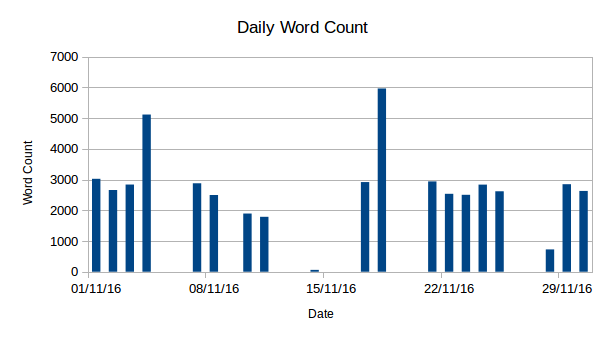
Not exactly the steady progress of the professional writer, is it? Allow me to decode.
First week: all went well. Knitting-in-order-to-think is a lifesaver. That spike on day four is largely due to the fact that I was editing a scene I pulled from the first draft, rather than writing a new scene altogether. It helps.
Second week: lower totals, but hanging in there. By this time, the Caped Gooseberry’s bronchitis was in full swing, and the completely missing day mid-week may not have been totally unrelated to a certain large country’s election results coming in.
Third week: Well. You see that tiny little snibbin of a blue dash, just above the 15? That’s Monday the 14th. 61 words. In my defence, I was shelled out of my bed just after midnight by a 7.8 earthquake and didn’t manage to doze off again until after dawn (for an hour or two). Despite the ongoing aftershocks, I decided I had to get some work done. 61 words was all I managed.
![In Case of Earthquake, Do Not Tweet [cartoon]](https://c8.staticflickr.com/7/6063/6074010519_a70cc8c520_b.jpg) You might charitably suppose that the total emptiness of the following two days was due to ongoing aftershocks, but not really. Tuesday I spent in preparation for Wednesday, when I drove the Caped Gooseberry down the recently-reopened motorway to have his wisdom teeth out. (OK, I spent part of Tuesday in preparation. The rest was spent keeping an eye on earthquake updates.)
You might charitably suppose that the total emptiness of the following two days was due to ongoing aftershocks, but not really. Tuesday I spent in preparation for Wednesday, when I drove the Caped Gooseberry down the recently-reopened motorway to have his wisdom teeth out. (OK, I spent part of Tuesday in preparation. The rest was spent keeping an eye on earthquake updates.)
By Thursday of week 3 I was about 7,000 words behind, and starting to panic. I managed to write a reasonable amount in between changing the ice-packs on my dearly beloved’s distorted face and bringing him soft things to eat. Mercifully, on Friday I was able to use another section of the first draft (suitably rewritten) which did a great deal for the health of the word count.
From there it was just a matter of steadily trudging on, scene after scene, one bite at a time. What happened on Monday 28th I don’t know. It was a beautiful day, I felt good about the story, it was gathering momentum – and I just couldn’t get going. I scraped through 761 words in the morning, had other commitments in the afternoon, and spent the evening in that unpleasant condition where you know you should be doing something but you’re too tired and the more you fret about it the more tired you get. (And then you go to bed and lie awake for hours.)
 Of course, I had a scheme of rewards planned out to boost the motivation: settling down with a book once I’d hit the word-count for the day (but not before); and three chocolate mint biscuits for each 10,000 word milestone. I also had three rules: make a pot of tea, commit the work to God, and think before writing. (I arranged for some plain knitting to facilitate this, resulting in approximately 4,737 stitches knit, though not all during thinking-time.)
Committing the work to God was a big one for me. I have been trying to make a habit of finishing what I start, and writing is an area where that wasn’t happening, despite my assurance that this is what God wants me to be doing. So for me, this was not just a test to see if I could do it, or a natty way of breaking the back of the second draft. It was an act of obedience. And as is so often the case with obedience, productivity results.
I am glad to find that I can be this productive, and I have every intention of carrying on with it. Not, perhaps, to the same extent (reaching 2,500 words per day involved a certain amount of robbing Peter to pay Paul) but something close. Maybe 1,800 words per day, or 2,000. The point is to be making steady progress (Exhibit A: Week 4, above).
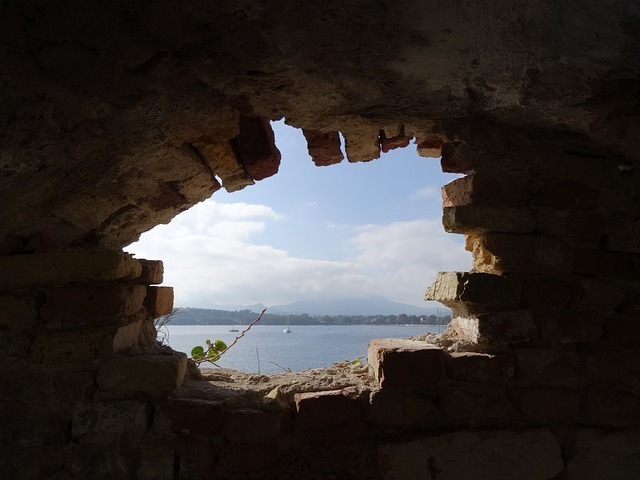 I would like to leave you with these words from Randy Pausch’s book The Last Lecture: “The brick walls are there for a reason. The brick walls are not there to keep us out. The brick walls are there to give us a chance to show how badly we want something.”