Upskilly & Stuff 7: The Measurements

Seventeen measurements, to be precise (dictated by Pattern Drafting for Dressmaking). The full panoply of which (good word, panoply) gives you enough information to create a pattern which fits you perfectly. The measurements include everything from your widest point or ‘seat’, to the distance from your neck to your waist at front and back, to the circumference of said neck at the base.
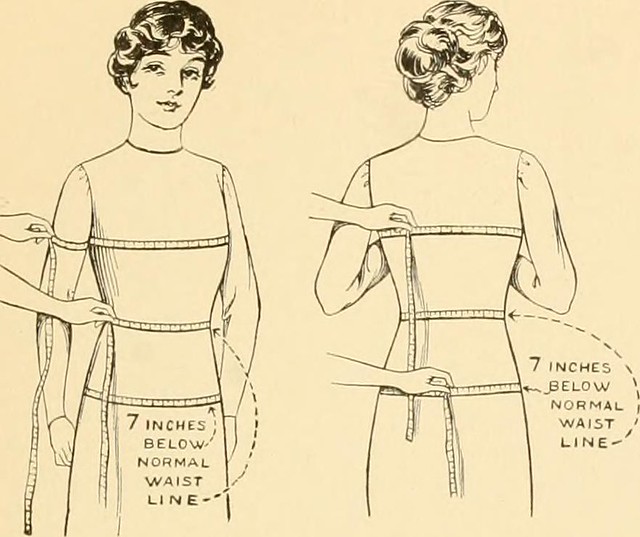
Image from page 14 of "The new dressmaker; with complete and fully illustrated instructions on every point connected with sewing, dressmaking and tailoring, from the actual stitches to the cutting, making, altering, mending, and cleaning of clothes for la

Obviously, these are very difficult measurements to take by yourself, particularly if you want any degree of accuracy (which you do). Unlike the woman in the pictures above, who has either the help of two people, or the help of one freak with two left hands, I had the help of the Caped Gooseberry (CG: where is the base of your neck? me: where those two little knobbles are).

So all I had to do was stand there and help figure out what the descriptions meant. (I think we still got at least one of them wrong.) Seems simple enough, you would think. But now for the hitch in Deborah’s character, to steal (and alter) a line from Jane Eyre.

Continue & Comment

Body Numbers

What’s your pick?

  1. a bathroom scale (for weighing yourself)
  2. a tape measure (for measuring yourself)
  3. both – knowledge is power!
  4. neither – such data is irrelevant (or, if pedantic, such data are irrelevant).

Continue & Comment

How To Live In Your Favourite Book

Not, I hasten to add, in a cheesy cheap merchandise kind of way, but in a altogether richer, more creative and satisfying way.


“We don’t just read a great book, we inhabit it.” So begins Novel Interiors: Living in Enchanted Rooms Inspired By Literature, by Lisa Borgnes Giramonti. She identifies six sorts of literary decor:
cottage cosy (Austen, Dickens, Alcott…),
classic elegance (Thackeray, Waugh, Wharton…),
earthy & natural (Brontë, L. M. Montgomery, Thoreau…),
modern glamour (Fitzgerald, Hemingway, Maugham…),
bohemian chaos (Durrells, Mansfield, Woolf…)
and fantasticated (Colette, Proust, Wilde…).

But what if your style doesn’t fall neatly into one of those mentioned – or any of them at all? Fear not: there is a way.

Continue & Comment