It is possible (I hear) to write a book entirely digitally, from inkling (inklessling?) to final draft. But if you’re a lover of stationery such as myself, such a prospect rather chills than cheers. This list is for you.
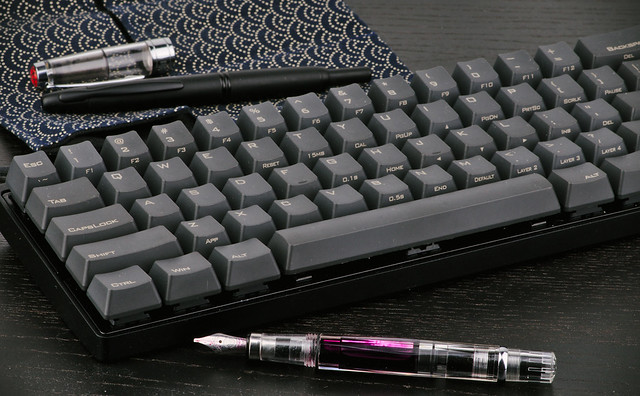
The first requirement of writing a book is, of course, a Pen. Now, you could use an endless supply of disposables, but it would be much more ecologically friendly – as well as more pleasant and aesthetically pleasing – to use a fountain pen. I wrote the first draft of Restoration Day with an old green Faber-Castell, and then bought myself a TWSBI Diamond Mini to celebrate. It is this latter that I shall be using for the first draft of the new book.
A pen is, of course, of little use without Ink (except in case of emergency tracheotomy; do not try this at home). Here is where the fountain pen really comes into its own: you can have pretty much any colour you choose – and some even come with scents. I picked Diamine Majestic Purple as the thematic colour for Restoration Day, and over 160,000 words later, I’ve only used about 2/3 of the 30mL bottle. For this new book (I really must come up with a good working title) I shall be using Diamine Kensington Blue.

It is true that ink comes in cartridges as well as bottles, but I say leave ink cartridges to printers. A cartridge is, after all, just a way to throw out part of your pen instead of all of it. And if you are worried about needing to refill on the go, get a TWSBI pen with one of their plug-in ink bottles. All the convenience, none of the mess, and it looks great on your desk. (No affiliation, just a satisfied customer.)
Having sorted out your basic writing implement, the next thing you need is something to write on. I would suggest – particularly if you are not yet sure whether your idea has what is known as “legs” – that you do not launch straight into a proper book. Instead, have a Noodling Notebook. This can be as flash or as plain as you like: I used a 3B1 with an evocative pattern glued to the cover.
Fleshing out your idea – what a grotesque expression; let us depart from it – exploring and filling out your idea in your noodling notebook will either fill you with such enthusiasm that it is clear a larger book will be required; or make you realize that as fun as the idea was, it isn’t enough to carry a book. In which case you at least have the consolation that you haven’t wasted your stationery treasure on a few scant pages of notes.
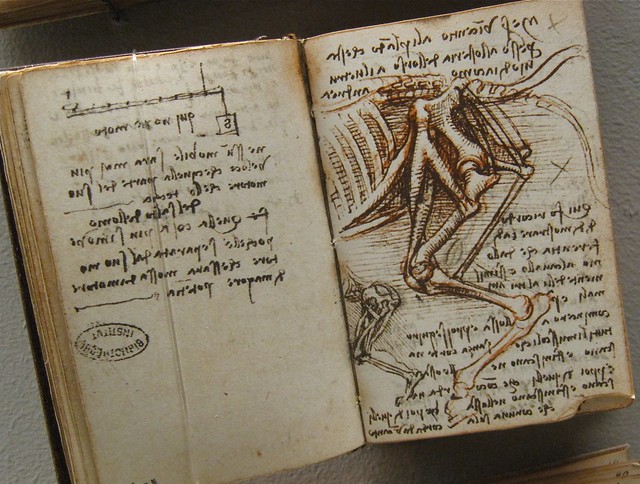
Once you get to the point that your noodling is starting to slop over the edges and grow right out of your notebook, you may think that it is time to take to the proper book. You would be wrong. Don’t believe me? Write down all the juicy little scene ideas which have sprouted out of your noodling on to Index Cards. (Note: not every idea constitutes a scene.) Then lay them out in the order indicated (a pinboard avec pins may assist with this, unless you have a large flat surface which is not otherwise encumbered with meals, cats, sewing etc).
According to Larry Brooks, a novel has, at a rough estimate, about 60 scenes. Do you have 60 cards with scene ideas on them? Alack! It is not so. This can be a rather depressing moment, when you realize that your lofty dreams are in fact exceedingly vague in the middle, but it is better to realize this now than after you have written 30,000 words and realize it’s not going anywhere. (Take it from someone who knows.)
Hence the cards. They also constitute a significantly easier to re-engineer form of your novel than an actual manuscript; but they’re easier to take in at a glance than a page of notes on a screen. Plus there is the possibility of colour-coding!
Finally, you are ready to write the book itself. What do you choose? Some may like to work their way through a ream of paper (one word of advice: paperweights), while others use what for want of a better term I will call Exercise Books. I wrote Restoration Day in eight large ugly ring-bound books – left pages only as I am left-handed when writing and it is exceedingly uncomfortable as well as messy to write with your hand resting on a large metal spiral.
For the new book, I have decided to treat myself. I purchased two Paper Lane A4 80gsm 240-page 7mm-ruled FSC hardback “journals” in blue (and on sale, yay!). The pen loop is rather too small for the TWSBI (another point in favour of fountain pens as opposed to disposable ball-points: you aren’t gripping a tiny barrel for hours on end); but I expect the storage pocket will come in handy.
Which brings me to the last of the six sorts of stationery: the classic Bits of Paper. Yes, you could just use odd bits of whatever comes to hand – old envelopes, receipts, the back of an unwary piece of A4 that strayed on to your desk – but you are much less likely to lose your thoughts, notes, lists etc if they are on pieces of paper which are unequivocally To Do With This. (This also avoids the drama of losing yesterday’s notes and ransacking your desk, only to find that they are on the reverse of today’s notes.)
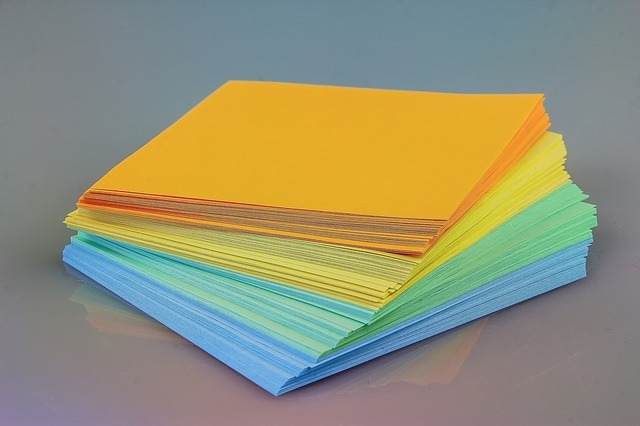
I like to make a quick précis of what’s going to happen next when I break off for the day, so as to jog my memory quickly back into the flow the next day. Also useful for figuring out exchanges in the right order, diagrams, and a myriad other uses. Consider getting a memo cube or scribble pad in your thematic colour, to be used only for that project. That way, when you see a piece of it floating around your desk, you’ll know what project it belongs to – and when you’re missing a note it’ll be easier to find.
Those are, of course, merely the basics. Truly dedicated stationery-lovers will no doubt find a dozen other openings for stationery in the process of writing a book. Suggestions?