Brain Status: Updates Complete

They say the brain is like a computer. They never mentioned that it was one of those annoying ones that is always needing updates, but doesn’t do them automatically.

Henry Markram: Brain research & ICT futures

No, the brain needs to be updated by the old-fashioned method of knowledge acquisition we call learning. If you stop learning, your brain gets obsolete and will eventually crash. Of course, when updating one’s brain it is important not to allow in any malware or viruses, but that’s another post.

I am both a good student and a bad one. Good, in that I like to collect information, always learning something new; and bad, in that if I don’t master something at my first try I am liable to give up. Seriously. There is only one subject I took all the way through high school: English, a.k.a. my mother-tongue.

So obviously I have a lot to learn, both in terms of facts/skills and character, and I like to think that knitting is helping with this. Apparently knitting can delay the onset of Alzheimers, basically because it’s exercise for the brain, using a variety of different areas and making them work together. Sounds good to me.

Хруцкий Старуха вяжущая чулок(1838)

Knitting is also developing my character, because it forces me to persevere when I don’t get it right first time: witness the number of unsuccessful attempts before I learned to turn a heel. It is helping me develop that difficult virtue: patience, in a relatively pain-free way.

I haven’t knitted socks in a couple of years, but just lately, I have returned to them, after diverging through various scarves, a balaclava and a stegosaurus, among other things. This time, I’m trying the socks from the toe up. As Joe Blomfield said, “There’s a great deal of engineering in a gentleman’s sock, I’ll have you know.” Ditto for ladies, or even, heaven help us, people whose feet are so small they don’t even walk on them, viz. babies.

Toe-up has a distinct advantage over cuff-down, namely that you don’t have to guess when you’re going to need to start the heel in order to have enough yarn left to finish the foot – risking ending up with no toes. You just keep going up the leg until you don’t want the sock to be any longer, or you run out of yarn, whichever comes first.
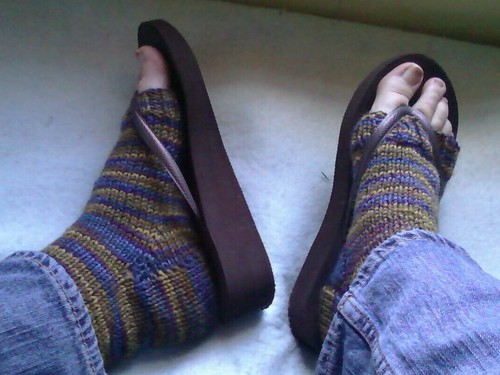
FO: Pedi socks

The difficult bit is that you don’t start with a nice simple tube: you start in one of a variety of ways, all of which are mind-bogglingly complex in description, not much better in diagram, and only somewhat confusing in video, because the knitter demonstrating the technique may well be knitting a different method or style from you.

I have, however, learned (and by learned I mean got it wrong a couple of times and then got it right) Judy Becker’s Magic Cast-On – it’s not the cast-on called for in the pattern, but I’m not going to let that stop me. The pattern is also for stripy socks, and I’m just using one variegated yarn.

Knitting, you see, is like cooking: adapting the recipe and substituting your own ingredients are expected – so much so that a lot of patterns don’t even bother giving instructions for the interchangeable parts, they just tell you to start with your favourite cast-on, and then use your preferred heel here, and so on.
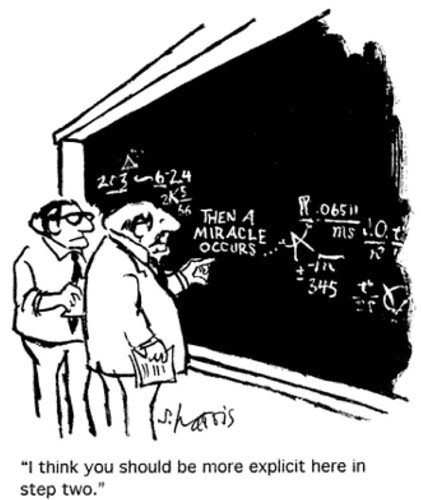
And then a miracle occurs.

Speaking of preferred heels, I have also knit my first short-row heel – the pattern fortunately gave detailed instructions (which is why I chose it) and I watched a video of someone demonstrating the technique as well, which helped. Some things do not make sense in description until you actually know how to do them, which rather defeats the point.

Having tried this method of heel construction, I think I can honestly say that I will quite likely never knit a heel-flap-pick-up-stitches-along-the-side sock again. I loathe picking up stitches. Maybe it’s just the difference between my row gauge and stitch gauge, but I always seem to end up with a gap.

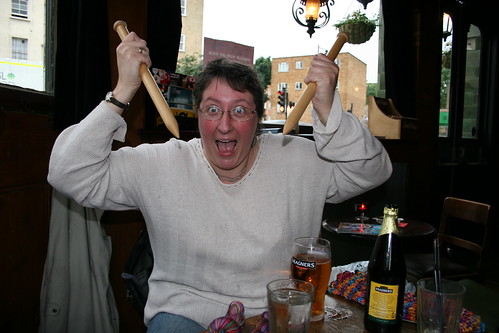
I also recently learned the “Magic Loop” method of knitting in the round, which may one day be of use in sock knitting. Unfortunately, my smallest circular needle has a diameter of 2.75mm (US#2), and the sock patterns I’ve seen generally call for 2mm (US#0) or sometimes even smaller. The ones I’m using now are 2mm bamboo needles, which flex slightly as you handle them. It’s rather like knitting with extra-long toothpicks.
But I’m learning.

What have you learned lately – skill, fact, or otherwise? Share the learning, share the love!

Why I Wear A Padlock Around My Neck

I wear a padlock on a chain around my neck. Not just any padlock, mind you. I do have my standards. This is a 20mm solid brass three-wheel combination lock.

combination lock

Sitting on the couch knitting one day (as you do), I looked down and realized I was wearing a lump of green and white plastic around my neck. And I thought: why? I don’t even like plastic, why am I wearing it like a treasure round my neck? At this point, logical brain kicked in and reminded me that I needed this lump of green and white plastic to keep track of what row of my knitting pattern I was on. (Why logical brain can’t make itself useful and keep track of these things itself, I don’t know, but there it is.)

Row counters have been around for a while, but most of what’s available these days is either a) a lump of plastic or b) a braceletty chainy thing which requires you to count along to figure out which loop you’re in, so you know which row you’re on. The former is practical but ugly; the latter is aesthetically pleasing but requires more mental effort than I am prepared to expend. (In my defence, I am generally doing something else besides knitting at the same time, and there’s only so much brain to go around.)

Beaded row counter

Then I found out that there’s a woman who makes sterling silver row counter rings, which are both practical and beautiful. There are only two downsides: they’re expensive (sterling silver, after all) and they’re not available.

So I carried on with my knitting and my lump of plastic, fulminating against the knitting world that apparently couldn’t combine aesthetics and practicality – and if anyone could, you would think it would be knitters, yes?

And then I had my brainwave: combination lock. Of course, the first combination lock that came to mind is the one I already possess: my bicycle lock from high school. A moment’s reflection ruled this out, however, as the numbers only go up to six and it will be a cold day in hell before I start trying to knit in base six. That way madness lies.

Next thought: padlock. A quick online survey of hardware stores suggested that for a modest outlay, a small brass combination lock could be mine. The first one I went to only had the lock in the slightly-larger-but-twice-as-heavy size, so I went on to the second one. (And that was a mission in itself, having only a rough idea of where it was, and no map. On which subject, Libraries: Not Just Good for Books.)

The second store had the lock in the size I wanted, but only in aluminium. It’s a step up from plastic, true, but if other women can make a fuss about whether gold or silver is more becoming to their colouring, I figure I can make a fuss about brass and aluminium. I went home and ordered it online.

It arrived a few days later. It was aluminium. A few days (and apologetic emails) after that, I went back to the store to exchange the aluminium padlock for a brass one, ordered in from another branch – which turned out to be the larger size. The very helpful man at the locks desk hunted up the supplier’s brochure for me, which showed only aluminium locks made in the desired size.

By now, of course, this was beginning to take on the dimensions of a full-blown quest.

Honoré Daumier 017 (Don Quixote)

Having found exactly what I wanted, I was reluctant to give in, just because it didn’t seem to exist. Perhaps the 30mm lock would do. 80 grams isn’t that much, is it? Could I bear to have that weight around my neck for hours at a time? I decided to find out. I took the sturdiest chain from my jewellery box and weighed it with my heaviest glass pendant. And a large ring-shaped coin. And a rhodonite cocktail ring. And a large rhodonite brooch. Together, they weighed 80g.

It was bearable. Just. Then the Caped Gooseberry (bless his wooly socks) suggested that just because a manufacturer does not make a product available in one part of the world, doesn’t mean it’s unavailable in other areas. (Why this is, I couldn’t tell you. You would think they would want as big a potential market as possible.)

So I went a-hunting on the internet (not as quest-worthy as hunting through a dark forest, but the potential for getting confused and wandering off is similar). I discovered a few very interesting facts.

Gustave Doré - Dante Alighieri - Inferno - Plate 1 (I found myself within a forest dark...)

1) The padlock I wanted was apparently no longer being manufactured.
2) The padlock I wanted was, however, still being sold.
3) But only in the E.U.

Amazon would send me one from the UK for what seemed an excessive quantity of money (more than twice the price of the aluminium one in the local stores, though obviously postage has something to do with that). E-bay might possibly sell & send me one for less, but details as to whether the seller would ship outside their part of the world would not be forthcoming unless I signed up for an account with them. (Side note: if companies make their terms & conditions and privacy policy that long, one suspects they are hoping people will not go to the trouble of reading them.)

There were, of course, many companies with an online presence who were selling these padlocks for less than they’d cost here. But they either refused to post outside the EU (I hear the sailing ships take months to reach the Antipodes) or else they were more than happy to do so! Shipping will be calculated on checkout page: €100. ONE HUNDRED EURO!

screaming-146426_640

So, obviously, that wasn’t going to happen. As I was getting overwrought, the Caped Gooseberry once more came to the rescue and suggested I sleep on it. (Figuratively. One does not recommend sleeping on an actual combination lock: they are hard and knobbly.)

The next morning I decided that while the price quoted by Amazon was quite remarkably expensive for a small padlock, it wasn’t that bad for a combination of practicality and symbolism, and I bought it.

I bought it not only to replace my lump of plastic, but also to replace the little gilt cross I used to wear about my neck until the gilt wore off. Which is why I wanted this 20mm brass 3-wheel combination lock, and not another: because this one has the word Master engraved in it, to remind me of the Master whose way I follow.

Eccentric, ethic & æsthetic, all in one useful pendant. What more could one ask?

Am I An Addict? In Which I Try Some Amateur Psychological Self-Diagnosis

I asked you all the other day whether you are (or have been) an addict – but it can be hard to tell. I didn’t find out I was addicted to tea until I had to give it up temporarily for health reasons (the tannin in tea lowers the absorption of iron) and found that hot water was not an adequate replacement. I went cold turkey, and these days I can get along just fine without tea if life happens that way – providing I drink a sufficient quantity of other liquids.

Female drinking tea

So how do you tell? Stephanie Pearl-McPhee, a.k.a. the Yarn Harlot did the sensible thing when accused of being a knitting addict and consulted the Diagnostic and Statistical Manual of Mental Disorders (fourth edition) a.k.a. DSM-IV.

“I flip through the pages looking for addiction, substance abuse, dependency, all the keywords. I find out that “substance dependence” (which seems about right for someone who wigged when she couldn’t get her yarn) is defined as an individual showing any three or more specific criteria within a year.”

Knitting Perfection

While I have been known to knit obsessively under stress (I knit so I don’t stab people – it’s too hard to get blood out of the yarn), I don’t think I’m addicted to knitting. But I have a sneaking feeling that I may be addicted to reading. It’s how I relax, especially when times are rough. (Escapism?)

Feel free to substitute your own substance of preference and tally along.
Here are the criteria:

(1) Tolerance, as defined by either of the following: (a) A need for markedly increased amounts of the substance to achieve intoxication or desired effect. (b) Markedly diminished effect with continued use of the same amount of the substance.

Not guilty, m’lud. Reading is reading, and the effect is constant and unvariable, providing the material is of sufficient quality.

(2) Withdrawal, as defined by either of the following: (a) The characteristic withdrawal syndrome for the substance. (b) The same (or a closely related) substance is taken to relieve or avoid withdrawal symptoms.

Pieter Huys - Woman Enraged

Well, I don’t know what “the characteristic withdrawal syndrome” is for reading, but the one time I abstained from reading the difference was *cough* noticeable. Strike One: I

(3) The substance is often taken in larger amounts or over a longer period than was intended.

Yes, yes, all right! Books do not come with clocks attached. Possibly this is part of their appeal. Strike Two: II

(4) There is a persistent desire or unsuccessful efforts to cut down or control substance use.

Ha! That’ll be the day.

(5) A great deal of time is spent in activities to obtain the substance (e.g. visiting multiple doctors or driving long distances), use the substance (e.g. chain smoking), or recover from its effects.

Carl Spitzweg 021

Reading doesn’t really have the sort of effects you need to recover from, but I will admit to a weekly library visit, and a fairish amount of time spent reading (obviously; otherwise the library visit would be wasted time).

(6) Important social, occupational, or recreational activities are given up or reduced because of substance use.

Define “important”. I don’t get out much, it is true, but I don’t think I’d get out much more if there were no books. (Hideous thought.) As far as occupational activities go, reading is mandatory for writers. So there.

(7) The substance use is continued despite knowledge of having a persistent or recurrent physical or psychological problem that is likely to been caused or exacerbated by the substance (e.g. current cocaine use despite recognition of cocaine-induced depression or continued drinking despite recognition that an ulcer was made worse by alcohol consumption).

Alfred Stevens La myope 1903

Reports vary as to whether bad eyes are caused (or exacerbated) by reading, but since my optometrist says my eyes have been stable for the last couple of years – and I definitely haven’t given up reading – I’m going to count that as a win. Reading is not bad for me.

Final score (by my count, anyway!): II: Not An Addict.

As to whether Stephanie Pearl-McPhee is indeed a knitting addict, you’ll just have to read the chapter entitled “Knit Junkie” in her book All Wound Up – a hilarious read for anyone, but especially for those of us who knit.

Just as I was congratulating myself on my official non-addict status, I came across this simpler (albeit less scientific) diagnostic test from Gail Carriger: “I suspect it may be like the difference between a drinker and an alcoholic; the one merely reads books, the other needs books to make it through the day.”

Woman reading a book (3588551767)

That one lands a little too close to home. A wise man once wrote: “Don’t you realize that you become the slave of whatever you choose to obey?”
I mastered reading long ago; it shall not master me.