How is a Novel Like a Sock?

They both have heels? No?

I was re-reading some old posts the other day and rediscovered my Master Metaphor: knitting a sock. The big long-running effort in my life at the moment is finishing the accidentally-epic first draft of my current Work In Progress, working title Tsifira. So naturally, my mind turned to considering it as a sock. A purple sock, of course.

Marknadsföringsbild för utställningen Under ytan på Hallwyl 2013 - Hallwylska museet - 91265

Writing a sock is actually a lot like knitting a novel. Getting started is fiddly, and sometimes takes more than one attempt. After that you seem to be just going around in circles for a very long time. Then it gets more complicated.

There’s a lot of going back and forth, the pattern changes, and what used to be sideways becomes up, and vice versa. You have to pick up a number of threads you thought you’d finished with, and then you’re going in circles again. It’s not til you look back you realize that you’ve turned the heel.

Then, just when you’re thinking there will never be an end to this interminable circling, you realize you’ve got so far that it’ll be too long if you don’t start tapering toward the end.

This is where I am at with Tsifira at the moment: shaping everything in to the end. And once that’s done, there’s only a bit of grafting the loose ends together and it will be finished.

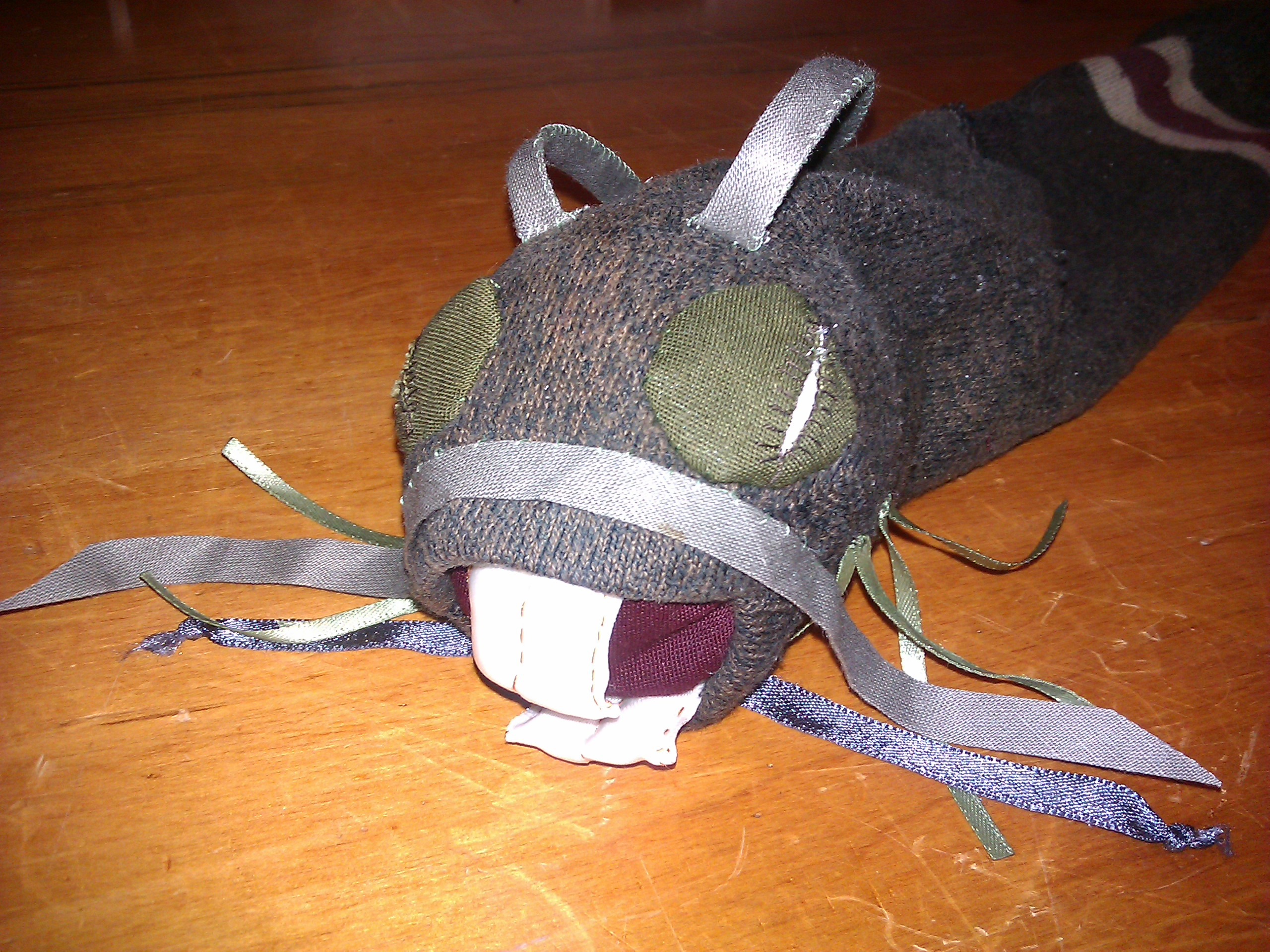
Jabberwocky-sock
Not quite how I expected my sock to end.

Of course, this is a first draft, so there are all kinds of mistakes I don’t even know how to make with a sock: surplus beginnings, several heels (and quite a few turns!), extra length where not required (okay, I definitely know how to do that one) and the toe shaping could well turn out too pointy or too blunt.

But that’s a first draft for you: messy as, and looking like nothing on earth. And this is where the sock metaphor falls down a bit (hur hur), because it’s really very hard to rewrite a sock. Either you undo the whole thing and start over (not recommended) or you cut and paste (definitely not recommended).

The point of the master metaphor is not, of course, that one thing is analogous to another, but that having done one thing that seemed difficult or impossible, it is possible to do another. And so with this.

A great deal of rewriting lies ahead, no doubt, but one day I shall hold my finished sock novel in my hot little hands, and that will be awesome, even if it doesn’t keep my feet warm.

Albert Anker - Strickendes Mädchen beim lesen (1907)

Now if you’ll excuse me, I have some toe-shaping to do.

What’s your Master Metaphor? Know any good metaphors for rewriting? How is a raven like a writing desk?

Relax!

It is one of the interesting variations between humans that we find different ways to relax – or perhaps more precisely, that we relax in different ways. What produces the effect of relaxation in one person will have a completely different effect on another.

Case in point: the Caped Gooseberry finds strategy games a fun unwinding leisure-form, while I can feel my blood pressure rising just thinking about them.

Playing go

Contrariwise, I find few things more relaxing than curling up on the couch watching a DVD, but for the Caped Gooseberry it’s more an energy-user than an energy-giver. And so it goes.

When we were preparing to marry, our minister suggested that we might need to put some effort into finding ‘mutually enjoyable leisure activities’, and how truly she spoke.

This is one of the reasons why we so often read aloud to each other: it’s a leisure activity we both enjoy. This works in well with another favourite form of relaxation for me: handwork (as long as it’s going well and I don’t have a deadline hanging over my head). It is particularly handy as I am not yet skilled enough to knit and read at the same time.

Albert Anker - Strickendes Mädchen beim lesen (1907)

My favourite form of relaxation, however, is strictly solitaire: chain-reading. Generally I chain-read books I’ve read before, or books of a genre I am familiar with – nothing that requires too much focus. I do of course read mentally stimulating books, but not when I’m tired and stressed. Then I read to relax: Christie, Marsh, Wentworth, Sayers et cetera.

When I’m really stressed, I can feel the itch to sit down with a book almost as a physical symptom – unfortunate if the stress is due to the old problem of So Much To Do, So Little Time. Addict? Perhaps.

Isaac Israels meisje lezend op de divan 1920

Perhaps I should consider other ways we can combine our relaxations. The pair in the first photo inspired me to consider strategy drinking games – tea drinking of course. Except the Caped Gooseberry doesn’t care for tea at the best of times, and adding the bitter taste of defeat would probably not improve the flavour in his eyes.

Who am I kidding? The game would probably end with him triumphing by strategy while I drown my sorrows in tea, as yet untasted by the gentleman in question.

Any other ideas? And how do you relax?

Those Darned Socks!

Following on from what to do with a single ugly sock, today we have what to do with a matching pair of much-loved or simply useful socks which have holes in them: Darning. More traditional than ‘wocksidermy but less dramatic.

In honour of Lost Sock Memorial Day (May 9th) I decided to finally get around to darning my out-of-action bed/boot socks. (One of the downsides of having small feet is having to wear thick socks to make your boots fit – I refuse to wear children’s boots. The other downside is the pascals.)

Darning is a grand old tradition in the spirit of “use it up, wear it out, make it do, or do without” – or possibly the spirit of “I spent ages knitting those socks, I’m not going to get rid of them just because there’s a worn bit!” (Full disclosure: these particular socks are machine-made; there hasn’t been enough time for me to wear out a pair since I finally learned how to knit them.)

I was, however, somewhat hampered by not having one of these:

Stopfei

They’re stone darning eggs (although I suspect the one on the right of having at some point in history been part of a tree). I don’t have a darning mushroom, either, although most of the ones I’ve come across seem suited for Big Manly Feet – i.e. would stretch my socks out of all proportion.

The Internet contains a variety of suggestions as to what one could substitute for a darning egg or mushroom. These include a baseball bat (don’t have one), a lightbulb (don’t have the nerve), a lemon (don’t really need a sewn-in deodorizer that size) or a plastic Easter egg (what’s the point of an Easter egg that isn’t made of chocolate?).

So instead of an egg, I used an egg timer in the shape of a chicken. Darning is one of the few areas in which I think we can be certain the egg came before the chicken. Darning aside, I usually fall on the chicken side of the debate, because if the egg came first, who would incubate it?

I used two different sorts of darning – one traditional, one not – but I will spare you the sight of the results. There’s enough ugliness in the world as it is. Instead, have a gratuitous cat picture.

Well, not quite gratuitous – this is a leading cause of a) missing sock syndrome and b) holes in socks, after all.

On the sock which actually had a hole in it, I used the traditional cross-hatching darn, something like this:
Fig. 41. Linen darning

Not that neat and tidy, obviously, particularly considering I was using it on a knitted item.
Verdict: time-consuming and boring to do, but durable and uses relatively little yarn. Also less obvious as a mend – assuming you use a yarn that matches (I didn’t).

I had seen a mention somewhere of a crocheted darn for socks which doubles as reinforcement. I can’t crochet (yet) so on the other sock, which was merely working up to having a hole, I did a running stitch around the worn patch and then used that as a base for blanket stitch. Around and around I went until the stitches were close enough to meet.
Verdict: uses a lot of yarn, but less time than traditional darning. More fun to do but, I suspect, less durable. Also it’s hard to hide what appears to be a very dense spiderweb slowly devouring your foot (especially if, like me, you use a contrasting yarn).

So there you have it. Go forth and love thy socks, single or paired, and don’t let a lack of actual knowledge, skill or practice put you off doing a mend on a much-loved pair you aren’t ready to let go of yet.

Colourful socks