The Thing Itself

It’s one of the great mysteries of the universe: has anyone, ever, managed to get a rubber ducky to float the right way up? Apart from Florentijn Hofman, obviously, and even he’s had trouble, what with deflations, explosions, and midnight vandals. (Another of the great mysteries of the universe: what kind of person stabs a giant rubber ducky forty-two times?)

I can’t even remember the last time my rubber ducky floated the right way up. Obviously, it must be a specialist Diving Duck.

Mallard duck diving

It’s got a recess at the bottom into which, the ancestral wisdom informed me, one could glue a fifty-cent coin and thus ballasted, the ducky would float the right way up. I have been carting a fifty-cent coin around lo these many years – long after the coins were changed to smaller editions – but correctly floating ducky there has been none.

The glue was too weak, or the coin wasn’t heavy enough, or the glue gave way in the bath – or, more unnervingly, when the duck was just sitting on the shelf. You’d hear this “clonk” and put your head into the bathroom to find no one there, just a ducky staring blankly at you out of it’s rat-chewed face. (Rats have remarkably experimental tastes, considering their inability to vomit.)

rubber ducks in courtyard
Ain’t nobody here but us duckies.

But it was my ducky. Even though I seldom had baths, and even when I did they’d only be graced by the ducky for about as long as it took for it to keel over on its face and start taking on water: i.e. about two seconds, and then I’d fish it out with a sigh, put it to drain on the side of the bath, and replace it on the windowsill until the next time came to dust it off.

I don’t need to do this any more. It suddenly came to me one day. I don’t need the duck. The duck doesn’t need me. And even without it I wouldn’t be leading a duck-free life, as the Caped Gooseberry still has five ducks (which we also don’t use as there isn’t really room in the bath).

I decided to let the duck go, along with the religiously transported 50c coin (once I find it). While I was decluttering the bathroom, I decided to get rid of an old white comb while I was at it. The comb used to live at my grandmother’s house, along with several matching ones in different colours for her assorted granddaughters.

The Combing of Granddaughter

I picked it up, and I could suddenly see the ceramic bowl on the dressing table that they used to sit in; and turning in my mind’s eye, I looked out the window into my grandmother’s back yard, past the washing-line and the swing set to the fence that marked off her resplendent kitchen garden (now, alas, underneath a new house). I remembered the sights, the scents, the voices.

But I’m still getting rid of the comb. Because I don’t actually need the comb to recall those memories. For one thing, imagining the comb is sufficient, and for another I already have a ‘madeleine’ for remembering my grandmother’s house: a bar of the coal-tar soap she always had in the bathroom.

Ah, the memories.

pruning shears and gloves

My purging list for August isn’t very impressive:
one rubber duck (with munted face, therefore unsuitable for donation)
one old fifty-cent coin (probably no longer legal tender)
and one plastic comb.

These things tend to be cyclical, mind you, and I’m hoping September will prove more fruitful on the purging front. How was your August purge-wise?

Dr. Jeeves and Mr. Hyde Wooster

We are all, to some extent, Jekyll and Hyde. I don’t mean to suggest that we all make & take potions and turn into insane murderers (I feel sure I would have noticed), but we all have different sides to our selves. Not good vs evil necessarily, but, say, left-brain vs. right-brain.

Left hemisphere throbbing

The writing teacher Dorothea Brande suggests that in order to make the best use of these different elements of ourselves – she is speaking of the creative and critical functions – it is best to consider and develop them separately.

“By isolating as far as possible the functions of these two sides of the mind, even by considering them not merely as aspects of the same mind but as separate personalities, we can arrive at a kind of working metaphor, impossible to confuse with reality, but infinitely helpful in self-education.”

To arrive at the working metaphor: that was my goal. As I have mentioned before, there are few things I enjoy more than a really good metaphor.
Left brain / right brain, however, isn’t much of a metaphor, and it’s hard to visualize for someone who has never seen her brain (and doesn’t much want to).

inner child

The next classic metaphor is the “inner child” – which didn’t really work for me. While my creative side is frequently childlike, it isn’t like a child – and my “adult” self is frequently less than adult!

The thing is, in order to make the best use of the two sides, they need to work together; there needs to be a kind of equality between them. Adult/child is not a relationship of equality.

Yes, the creative side needs to submit to the ordered side’s discipline, or nothing would ever be achieved; but the ordered side’s authority is exercised solely to create the best conditions for the creative side. (Or at least it should be.)

I started considering relationships where this is the case.

Edwardian lady writing (6908558900)

The Governess, I decided, was an excellent metaphor for the ordered side: she governs, she educates, she assesses, she provides encouragement and rebuke as necessary, and she wields her authority for the good of her charge.

The only downside is that governesses do all this for children, and my inner self, etc etc. I suppose it is possible to have a governess for a lunatic (seems like something Chesterton would write) but I’m not sure that I’m that far gone.

Then I had a brain-wave: Jeeves and Wooster. Bertram Wilberforce Wooster is the immature undisciplined creative all-over-the-place person par excellence, and Jeeves’ whole raison d’être is to provide for his every need (if not want) and keep him out of prison, matrimony, and unsuitable apparel.

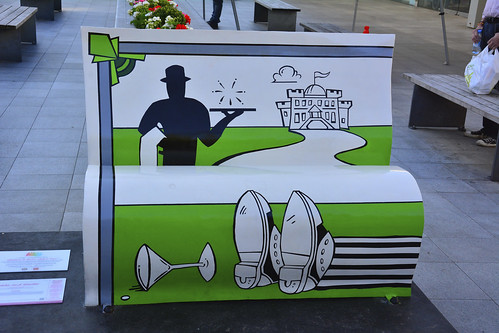
Books About Town, Book Benches, Jeeves And Wooster Stories

As mentally satisfying as that metaphor was, it still wasn’t quite ‘me’. My ordered side is more a Miss Silver than a Jeeves, and I’d like to think my creative side is less clueless than a Wooster. The Great Metaphor Hunt went on.

Eventually I realized that the metaphors for the two sides don’t have to ‘belong’ together, as satisfying as it would be if they did. I could pair the Governess metaphor with a non-child metaphor. But what?

The creative side really was much harder to pin down, which is fitting, I suppose. After some thought, I settled on the Jester – one of those simple souls who capers about singing songs of joy or sorrow and saying the sorts of things that reasonable people get their heads chopped off for. This is the side of me that laughs at toilet humour and howls at the moon. (I think it is best for everybody if I don’t sing.)

Decamps Les danseurs albanais

Interestingly, I’ve noticed a difference in what I like to wear, depending on which aspect is in the ascendant, or in use, whichever way you like to look at it.
The Governess side of me likes to wear 1930s style clothes: tailored, smart and tidy. The Jester, on the other hand, has a more medieval aesthetic: flowing garments one can move freely in, preferably topped with a funny hat of some sort (with or without bells).

Perhaps I can use that as a way to toggle the two sides. The Governess makes the plans for the day’s work, and then on go the ancestral dressing-gown and the funny hat, and the Jester comes out to play. When it comes time to review and edit, off with the funny hat.

John Ellys Hester Booth as a female Harlequin VA

Do you have recognized sides to your self? Do you have metaphors for them? I’d love to know!