Writing In Flow

:Keys to Enhanced Creativity
by Susan K Perry, Ph.D.

This book is based on the thesis which earned her that Ph.D. – hence the 8 page Appendix, 10 pages of biographical information on the writers who provided her research material (including Diana Gabaldon, Sue Grafton and Ursula K. LeGuin), 19 pages of notes and 12 pages of bibliographical references.

That said, it’s by no means a dry tome – Perry is primarily a writer, after all – and it holds the interest, whether you approach it from the academic level (what an intriguing phenomenon, I wonder how it works) or the personal (do others experience this the way I do and what can I pick up from them?

The “flow” referred to is that experience of losing awareness of the world around you, when the words just pour out of you, and time stops.
sorry but i lost track of time

The ‘sweet spot’, ‘the zone’ – whatever you call it, that’s what we’re talking about here. In great detail. Too much to cover here, so you’ll just have to read it yourself if you’re curious.

Chapters cover what flow is. How it happens. What it feels like. The keys to getting into flow – have a reason to write (“Don’t coerce yourself. Find your motivation.”), think like a writer, loosen up, focus in, balance among opposites. Writer’s block – the complete opposite of flow. And my personal favourite, Specific Techniques for Luring Flow.

These include: specific rituals or routines around writing, specific writing tools, time and space, music/silence/meditation, re-reading what you’ve written so far/reading others’ work to spark your creativity/stopping in the middle of something, eating/drinking/fasting, walking or jotting or knitting or doing physical work or tiring yourself out or climbing a tree or (like Colette), picking fleas off your cat.
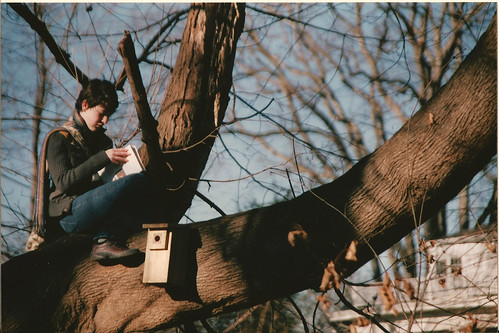
Reading in Trees

Obviously, you can’t use all of these at once. (Picking fleas off a cat halfway up a tree while knitting? I think not.) But there’s plenty to play with here. Try something. See how you like it.
Try something else. Play with the combinations and wait for the tumblers to go click.
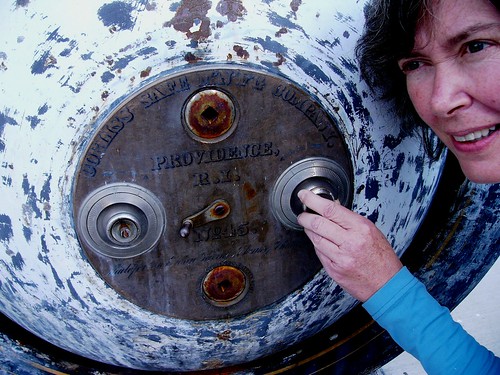
Peg and Bank Safe

Myself, I am drawn to the rituals/routines and the specific tools.

For example, I like to drink tea while I write. Actually, I like to drink tea most of the time, but I let myself have a lump of sugar in it if I’m writing. Perry notes, “As a writer who wishes to write regularly, you need to seek out ways to complexify your day to day life so that it remains fresh and inspiring to you,” but then, she is a full-time writer – a DDJ being more or less the antithesis of fresh and inspiring, yes?

As for writing tools, I believe I have mentioned before that I write with a Faber Castell fountain pen. It’s old enough that it uses actual ink from bottles, not plastic cartridges like my modern Parker does. I thought it used an Archimedes screw to draw up ink (how awesome would that be?) but apparently it doesn’t.

Archimedes screw

There is a screw-shaped bit, but it sucks up ink in the same way an eye-dropper sucks up eyedrops – it creates a vacuum, which nature abhors and therefore obligingly fills with ink.

Which is all to say that I will need to buy a bottle of ink sooner or later. Possibly later, given how long the ink lasts. For purposes of comparison, a disposable pen (ballpoint) contains between .27 and 2mL of ink. The smallest bottle of ink I’ve seen for sale contains 30mL.

At present I am using a fine blue ink bought for me (along with an elegant blue/green glass dip pen), by a friend visiting Venice. (Clearly, this is a Good Friend.) But what shall I use when the blue is finished?
When I started writing up notes for The Black Joke, I decided to use creamy paper (I bought a ream) and sepia ink from an old calligraphy kit, (the Made in China kind – bleeds like mad).

T on skin, ink bleeding

So when I read this book, two synapses touched, there was a minor explosion, and I thought ‘I could have a different colour ink for each Work In Progress – a thematic colour, as it were.’

Hard upon that thought followed the question “I wonder what the thematic colour for Tsifira would be?” At the moment, I lean towards a sort of amethysty purple – bright enough to be light and sparkly, but dark enough to be actually readable. Preferably even by candlelight, for the winter dark comes on apace.
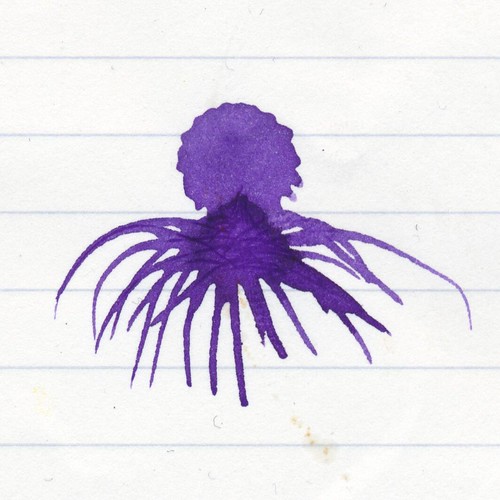
Purple ink octopus

I shall leave you with a final thought to chew on from Susan Perry’s book: “Your own preferred way of thinking about and describing flow is as unique to you as your writer’s imagination. Learn something about your creative process by taking a moment to consider your own sense of what flow is and how you get there… If you construct your life around words, the right metaphor can be critical.”

What is your metaphor? What is your method? I’d love to know.

Reading Deprivation

I can’t believe I’m saying this, but this week I am trying to take Elle MacPherson’s advice on reading: “I don’t think you should read what you haven’t written.”

Elle Macpherson at Myer 17 Sept 2011

Julia Cameron often includes an exercise in the body of the chapter, in addition to the Tasks enumerated at the end. Usually they’re mildly interesting and you glide over them without too much time or effort required. Remembering your favourite things as a child, for example. That sort of thing.
This month: go a week without reading.

Er – what?

GO A WEEK WITHOUT READING!!!

Admittedly, I am presently nearing 19 hours into the reading deprivation, which may account for the edge of hysteria in my tone, but really!

Those close to me may wish to verify this, but I don’t believe I’ve gone that long without reading since I was three. And couldn’t read.

333/365

In the years since, I have gone to quite some lengths to avoid running out of reading material.
I would read the encyclopedia, or failing that, the dictionary. (The telephone directory was one A4 sheet, so not worth the trouble.)
At the age of six and a half, I ran through all my books on a family holiday and embarked upon my mother’s Agatha Christie.

This is a little more complicated than just not reading, though.
There are nuances.

The idea is to minimise input – especially in the form of words – so as to hear what is actually going on in our inner silence. Or something like that. I was too busy panicking to take in the delicate details.

Cameron makes an exception for her own book (gotta do those exercises!), and I intend to make an exception for reading Scripture – a girl’s gotta eat, after all.

However, since the aim is to drain out the words rushing in, that means no being read to (one of my favourite pastimes), no movies, no television, no radio. Silence.
I make another exception for conversation, since a) I am not a Trappist, and b) I have to talk at the Dreaded Day Job and if I don’t get to talk at home as well I Will Go Mad. Ditto for emails.

Madeleine L’Engle says “It’s a good thing to have all the props pulled out from under us occasionally. It gives us some sense of what is rock under our feet, and what is sand.”

The Ruined Castle

I think I am coming to realise just how much of a prop reading is to me.

When I’m stressed, I read. When I’m curious, I read. When I want to relax, I read. When I find a fascinating little morsel on the library catalogue, I READ IT!
Take away reading and being read to, and you have most of my week’s leisure time accounted for. Take away television as well, and you have the half hour that was left.

So what am I going to do this week?

Lots of sewing, knitting and mending – although I will miss being able to do this while listening to the Caped Gooseberry read. Say what you like, re-elasticising old jammie trousers is not sufficiently mentally taxing to hold the mind in thrall.

(Plus the CG has a really nice reading voice. He starts reading aloud, and catweasel #2 will appear out of nowhere to curl up on his lap and gaze at him adoringly. I find this annoying, possibly on the grounds that we despise most in others the weaknesses we see in ourselves.)

120301 Day 255 adoring

Sleeping – not much point staying up late to finish the book you aren’t reading. Ditto TV, although I don’t bother staying up late for that anyway.

And hopefully writing. These are the only words that are not only permitted, but encouraged. I shall write blog posts. I shall write journal entries. I shall write morning pages. I shall try to write as much as possible on my Work In Progress.

The clock stops at midnight next Sunday.
There are two possible scenarios at that point:
One, I am so thoroughly purged of the babbling detritus of modern existence that I glide serenely through life, possibly emitting a faint humming noise, and not even noticing that the reading ban is over, so enlightened am I.

holy glow

Two, I stay up late in order to feast my starved eyes on the fat deliciousness that is The Book. (Touch the book. Smell the book. Kiss the book. Read the book Read The Book READ THE BOOK!)
Brand me a pessimist if you must, but I believe the second scenario to be somewhat more likely.

Did I mention that due to the national commemoration of the war dead (i.e. ANZAC Day) I will have a whole extra day at home this week?

Did I mention how many books I have at home? (Hundreds. Over a thousand, I think. I haven’t had time to count them in the last few years. Possibly something else that can be done while Not Reading, if you’ve always wondered what it would be like to be Tantalus.)

Tantalus Gioacchino Assereto circa1640s

Did I mention that I bought an 878-page book online last week, and it arrived today?

My timing is impeccable.
All inquiries care of the Nut House.

Great Expectations

Not the book. Or even one of the dozen and a half films, TV movies and mini-series listed on IMDB under that title. (Why so popular, I wonder? Myself, I much prefer Nicholas Nickleby and A Tale of Two Cities. “It was the best of times, it was the worst of times.” Genius.)

No, I refer to the expectations we have of ourselves, as writers, and as doers generally. We will work so many hours per week. We will keep our houses in such a state of cleanliness. We will maintain so many relationships to such a degree. We will have hobbies. We will read. And we will write.

As previously mentioned, there are 168 hours in a week. One can only do so much, and if you pack each minute ’til its sides bulge like a spring-loaded suitcase, sooner or later you will wear down, and go splat.

13/365 - Splat!

So Sensible Expectations are key, if not so much of a runaway best-seller.

But how do you know what are sensible expectations to have of yourself? No two people are exactly alike, nor do they live the same lives, so you can’t really base your expectations of yourself on what someone else is able to achieve. They’re not you. You can’t compare.

Trial and error? That sounds sensible (if time-consuming) but we are in a constant state of change, are we not? What tired me yesterday when I did it for the first time may well be manageable today, and even easy tomorrow.

So do our expectations of ourselves need to be continually adapting to our changing circumstances and changing selves? And if so, how do you maintain them as an expectation?

If the standard can be flexed indefinitely, does it still constitute a standard? Does ‘getting out of bed at 6:30am’ count as a standard if it can be adapted to the circumstance of ‘being tired’ which results, in point of fact, in ‘not getting out of bed at 6:30am’?

Bed Time!

Do you see what I mean? And better yet, do you have any nuggets of relevant wisdom you have distilled over a long life? (Or a short life – the indigent mendicants not being noted for their selective abilities.)

This is an issue I have been mulling over a good deal lately, with regards to many aspects of my life, but the only definite conclusion I have come to concerns my Word Count.

I have decided to revise my target from 500 words a day, 6 days a week (a total of 3,000 words a week) to 400 words a day, 5 days a week (a total of 2,000 words a week) – effective 14th April.

To be sure, targets are set to be aimed at, but there is something rather depressing to the spirits about mostly missing, even if you expect to. If you don’t believe me, read an ‘aspirational’ women’s magazine (making sure to look at all the pictures), and see how you feel at the end.

Michelle Moore, America's Perfect Woman 2011

(Unless you happen to be of the male persuasion, in which case think of a situation in which you fork out your hard-earned to have someone point out how perfect you and your life aren’t, and suggest all the self-improvement (and purchasing) you ought to be doing, in order to be as much like the perfection you aren’t as possible. Then let me know what that situation is, I’ve always wondered.)

400 words a day. Five days a week. That’s my Sensible Expectation. For now.