HSM'15: Behold the Balaclava

There’s a saying floating round the internet: on a scale of one to ‘invade Russia in the winter’, how bad is your idea? Declaring war on Russia in autumn is definitely up the top end of the scale, which made it a fitting beginning for the Crimean War, a campaign so disastrous that a century and a half later it is still a byword for really poor decision-making. (Theirs not to reason why, theirs but to do and die…)

Museo Torre di San Martino della Battaglia - affresco 04

The Crimean War began when the Ottoman Empire declared war on Russia in October 1853 – the Ottoman Empire was weakening, and Russia thought this was an excellent opportunity to expand its borders, beginning by invading Ukraine. (Who says history never repeats?)

Other nations then joined in because – well, lots of reasons, mostly to do with not wanting Russia to get more powerful, or not wanting to lose face. (Oh, the countless deaths in wars fought because of What People Might Think.) Naturally, these were not the reasons given at the time. They seldom are, mostly because if you tell your troops they’re dying for the good of your reputation, they’re unlikely to join in with any enthusiasm.

Florence Nightingale. Coloured wood engraving, 1855. Wellcome V0004316

It was the Crimean War which gave us the Charge of the Light Brigade (which was, remarkably, successful – or would have been if their backups the Heavy Brigade hadn’t realised they were galloping into a deathtrap and retreated) as well as Florence Nightingale (before whose arrival troops were ten times more likely to die of disease than wounds) and the balaclava (named after the Battle of Balaclava, where the aforementioned Charge took place).

Following the Crimean War, the balaclava became a standard part of military headgear, particularly for use in cold climates. During the World Wars, demand exploded, and women were encouraged to knit for the troops. “Knit for Victory”, the World War I campaign exhorted, and by the Second World War, knitting was recognized as an important contribution to the Home Front.

Leisure and Entertainment during the Second World War D173

Women knitted at home, during breaks at work, in groups, or even in air-raid shelters, while waiting for the All Clear. The Anglican Church is said to have issued a ruling allowing women to knit during church services (something I still do, as I find keeping my hands busy helps me concentrate).

Socks were particularly in demand – they wore out quickly and needed to be changed more often than most knitted items – but scarves, gloves and balaclavas were also required. Naturally, the only colours allowed were khaki ‘drab’, or two kinds of blue (Navy & Air Force) – which soon lost their appeal for the knitters.

Newtown Women's Institute knitting comforts for the troops (4346388180)

Patterns were issued, including this one – for original visuals, click here and scroll along. (Thanks to the V&A Museum for making these available.)

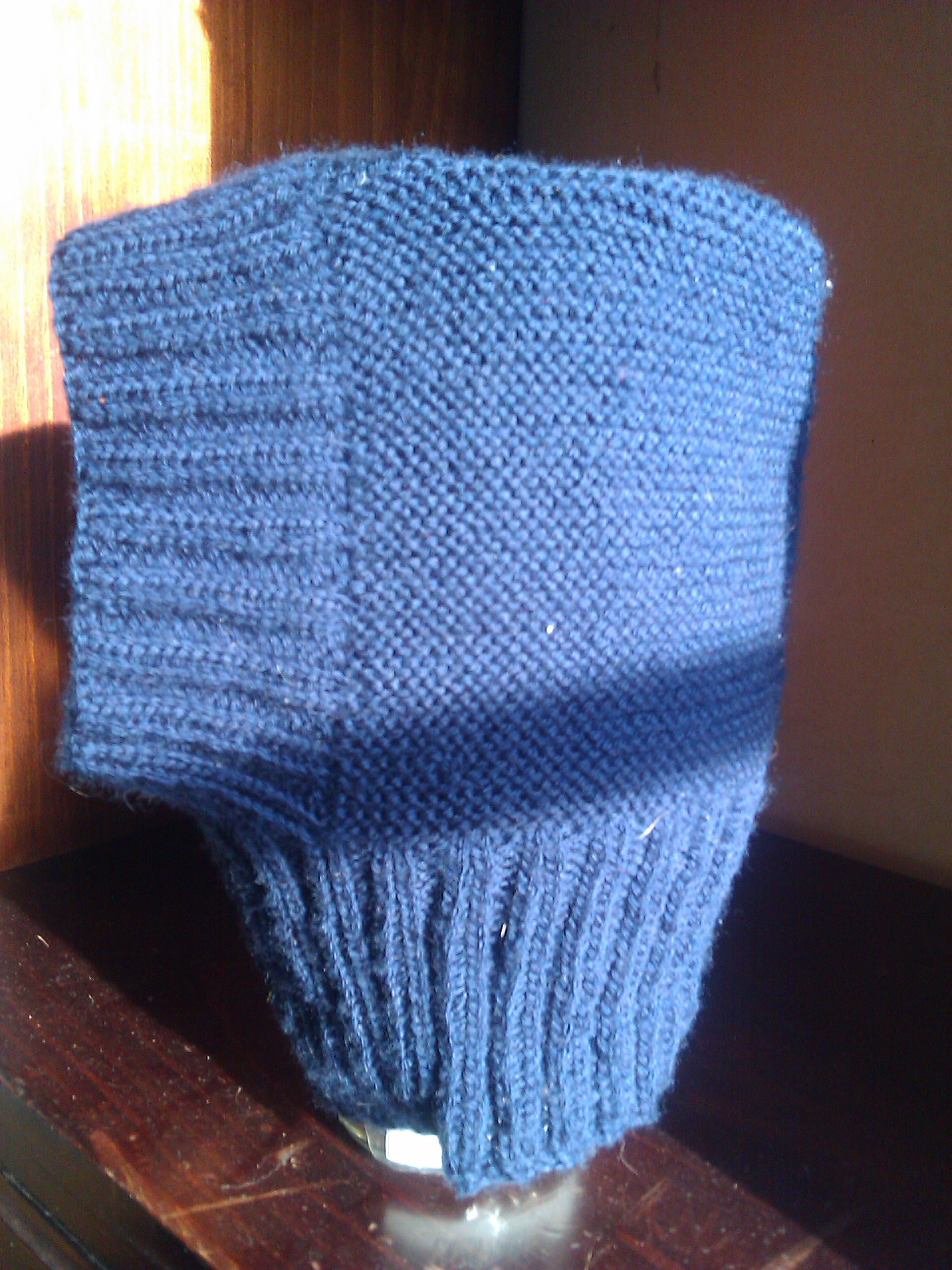
This was the pattern I used – adapted to a more classic balaclava style by eliminating the front and back flaps which tucked into the uniform, as well as the ear-flaps.

I didn’t take any pictures of the construction, but if you want to visualize it, think of it as an upside-down sock: a section of rib to grip the neck (leg), a section of garter-stitch, then turn the parietal (heel). Except of course no-one needs a toe in their face, so the head-sock finishes with another section of rib around the face (mid-foot).
balaclava side view

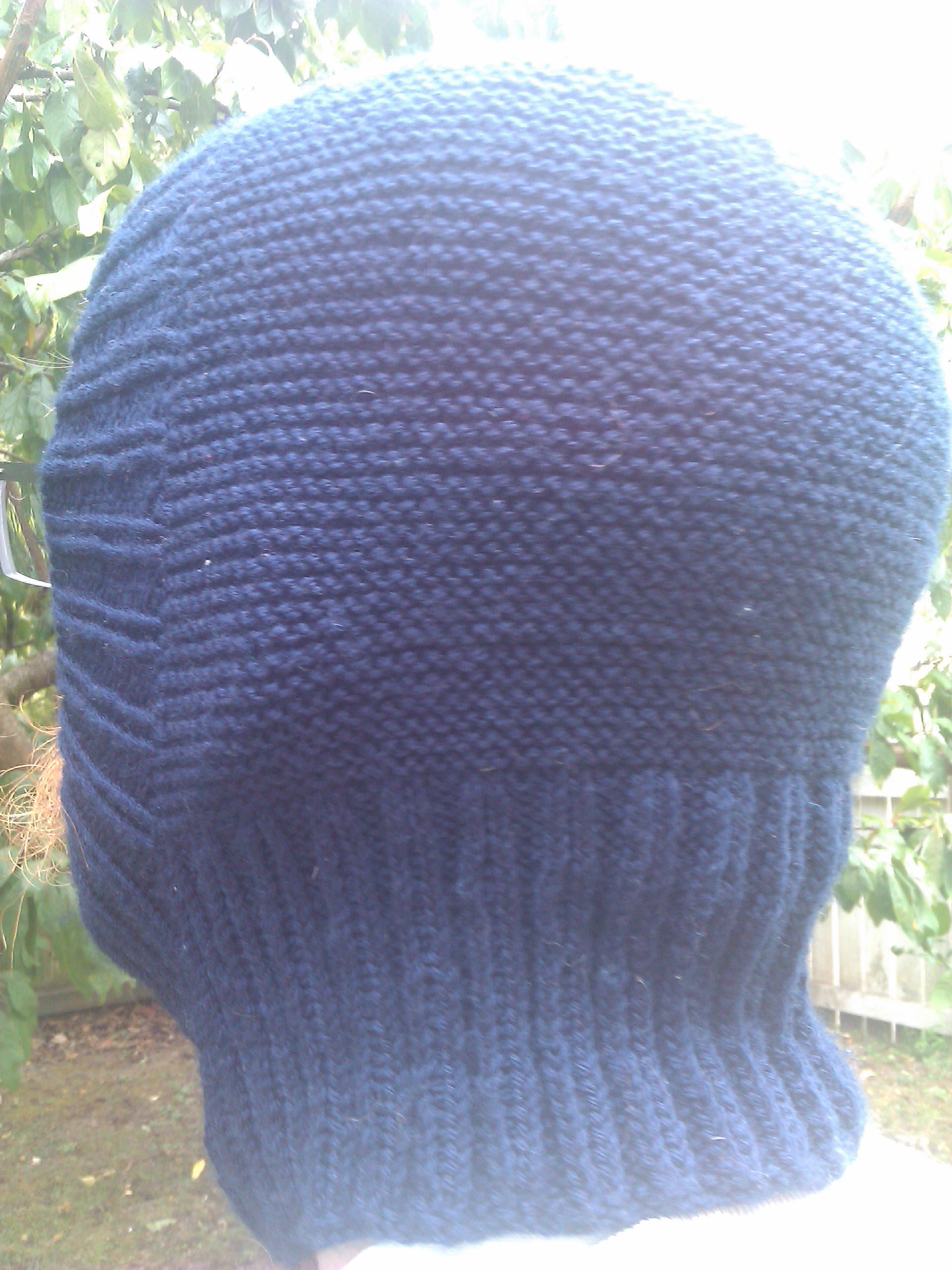
So this is my latest entry for the Historical Sew Monthly: the Blue Balaclava.

The Challenge(s): Blue and War & Peace

Fabric: dark blue merino 4-ply (Ashford MacKenzie, if you want the details)

Pattern: The Balaclava Helmet from Essentials for the Forces: Jaeger Hand-Knit Series no. 44, courtesy of the V&A.

Year: first half of the 1940s

Notions: none. knitted on circular needles in widths of 3.25mm & 2.75mm, because that’s what I had

How historically accurate is it?: well, I fiddled the pattern, but I’m pretty confident balaclavas in this style (minus ear-flaps and tuck-ins) would have been around at the time – this one, for example.
blue balaclava

Hours to complete: I never know. Maybe ten, at a wild guess? When I knit I’m either relaxing, or doing it as a background to something else (reading, DVD, sermon…) so I never watch the clock.

First worn: in March, a day or two after it was finished. It was rather warm on the day itself – definitely too warm for balaclavas. But autumn is now here, and it’s getting a bit more wear.

Total cost: from stash, so officially none. It was part of a ball I’d used for a couple of other small projects. A whole ball (100g) is currently NZD16 – a bit over USD12. Alas, wool is no longer ninepence an ounce as specified in the pattern!

Part of what the Historical Sew Monthly is about is gaining a better understanding of the lives of those who lived before, and in this I cannot help but feel that I have failed. Unlike most if not all of the WWII knitters, I was knitting in peace and comfort, without being plagued by fear for a loved one’s safety, or grief for a loved one lost. Nor was I being bombed.

Air Raid Precautions at Kingston House, Knightsbridge, London, England, C 1940 D57

That’s the sort of thing you really can’t understand unless you experience it, and thank God, I haven’t. I knit my balaclava for a husband who is safely at home, and the cold it will protect him from is the nippy wind of a Wellington winter, not the bone-chilling frozenness of a battlefield (although to be fair, if we’d lived seventy years ago I’m pretty sure he would have been a much-maligned ‘conchie’ – a conscientious objector).

But if reading about the Crimean War and the women left behind in the World Wars has taught me anything, it’s to value peace. Because peace is a lot like breathing freely: you take it for granted – until you get a head-cold. And then you can’t think about anything else, and you’ll do anything that looks like it might help, and you swear you’ll never forget how glorious a thing it is, this breathing freely, this freedom, this peace.
But you do. You forget. We forget. And we mustn’t.

Ve Day Celebrations in London, 8 May 1945 HU41808

What's For Dinner?

Back when I was a whiny little tyke, I used to annoy my parents by continually asking what was for dinner. (Not repeatedly on the same day – I may have been whiny but I wasn’t stupid.)
“What’s for tea?” the little Deborah would inquire, a glitter in her childish eye, and her parents, sensing an imminent chapter from that well-known collection of essays, Things I Do Not Like to Eat, would fall back on that stand-by of parents through the ages: “Wait and see.”

Nicolaes Maes 007

It has become generally accepted to blame the problems of one’s adult life upon one’s upbringing, and it has just occurred to me that this three word refrain might be to blame for my lack of organization when it comes to figuring out what the evening meal will be. Because deep deep down, my sub-conscious thinks that you don’t know what’s for dinner until dinnertime arrives. This may explain the scrambled egg incident.

Of course, this theory only danced across my mind for a handful of moments before the hound of reality came galloping after and savaged the poor little thing to shreds. Because I was still by all measures a child when my parents started me learning to cook the evening meal, which includes planning ahead and getting something out of the freezer in time for it to defrost.

Meal planning suggestions from 'Family meals and catering' Wellcome L0072310

Mind you, I grew up a handful of degrees south of the Equator, where meat could be removed from the freezer at lunch-time and be completely thawed by five o’clock. (I was thirteen before I encountered butter that had been left out of the fridge overnight, but was still too cold to spread, and I didn’t know what to do with it.) I now live closer to 42 degrees south, and lunch-time doesn’t cut it as far as defrosting goes, particularly in winter. Breakfast-time is more like it, and if it’s something large, better make it breakfast-time the day before.

One could of course use a microwave to defrost food, but the results are unsatisfactorily uneven, and in any case why pay for electricity to do what time and nature will do for free? This is not to say that the microwave plays no part in defrosting: we use it all the time. As a cat-proof meat safe.

cats-meat-609216

I am sure I am not the only one who has struggled with the daily task of organizing food on the table. It was worse when I was still working at the DDJ, leaving the house before I was fully awake and returning when I was tired and the need for dinner was imminent. The Caped Gooseberry did his best, but multi-variable decision-making and chronic fatigue do not mix.
We ate some very simple meals in those days. As Julia Child said, “Good French cooking cannot be produced by a zombie cook.”

But rejoice! there is still hope for us. Some time ago (on the website of the Daily Connoisseur, I think) I came across the idea of the capsule menu. Some of you may be familiar with the idea of the capsule wardobe: a small but effective collection of clothes that you can just wear without having to spend ages thinking about what to wear or what goes with what.

Walk In Closet - Expandable Closet Rod and Shelf

The capsule menu is similar. Basically it’s a schedule of what you’re going to eat on what day. You shop accordingly and voilà, the decision is already made and you don’t have to spend ages figuring out what you have and what you can make out of it. Bliss.

If you have a high boredom threshold, you can have the same menu every week. We have a two-week cycle, which includes such gems as “home-made curry” “spaghetti bolognese” “something eggy” “something from a cookbook” (variety: the spice of life) and a couple of nights where we get takeaways: a curry, or the traditional NZ fish & chips.

A particular favourite of mine is the four days we spend working our way through a roast or a corned beef. We buy whatever’s cheap at the supermarket (oddly, roasts are frequently as cheap or cheaper than even mince), cook it up, and then have the leftovers in various ways until they are all gone. What could be nicer than a chicken roasted with homemade stuffing, or a shoulder of pork with rosemary crackling? Served (of course) with roasted potatoes and lashings of flavourful gravy.

Roasted Chicken Dinner Plate, Broccoli, Demi Glace

Planning ahead also means that you can make sure you are going to get a balanced diet, time constraints are taken into account, and everyone in the house can be assured that their favourite foods will appear regularly. (If it was up to the Caped Gooseberry, we’d have rice nearly every night.)

Have you tried a capsule menu? Did it work for you? What dishes did you decide to have? And what’s for dinner?

Question: Zombie Cookery

Not how do you cook a zombie (that’s unhygienic) but when you feel like a zombie, what do you cook?
Everybody has that go-to recipe that’s so familiar you can make it even when your brain has fallen out the back of your head and is slopping miserably across the kitchen floor.

Contemplative Chef Zombie

When in dire mental straits I tend to resort to scrambled eggs on toast. In fact, I was on one occasion so tired, stressed and disorganized (combination of new job, moving house, planning wedding etc etc) that when my dearly beloved came round for dinner on his usual evening, all I could manage to feed him was scrambled egg in a cup. Because I had run out of things that could be toasted, e.g. bread. (And he still married me!)

What’s your emergency brain-out-fallen recipe? Share below!