Not for All the Jewels in the Crown

I’m having trouble sleeping. (Sleep? Sleep? I couldn’t sleep tonight…)

Württembergische Königskrone-MFr-3

I could have danced all night – the cinquepace, perhaps, although the mazurka somehow seems more appropriate for midnight dashings – but I am afraid the crashing noises would keep more than myself awake.

The problem isn’t so much that I don’t sleep. The problem is more that my brain doesn’t flick the on/off switch – which is to say the un/conscious switch – until I’ve been lying in bed for an hour or two*. Which is a waste of perfectly good consciousness.

After taking the questionnaire which recommended a 12:30 a.m. bedtime, I had the brainwave of spending that hour or two reading or knitting.

For each solution, a new problem. I have yet to master either reading or knitting in the dark, and keeping the light on kept the Caped Gooseberry awake – and no-one is recommending a 12:30 a.m. bedtime for him.
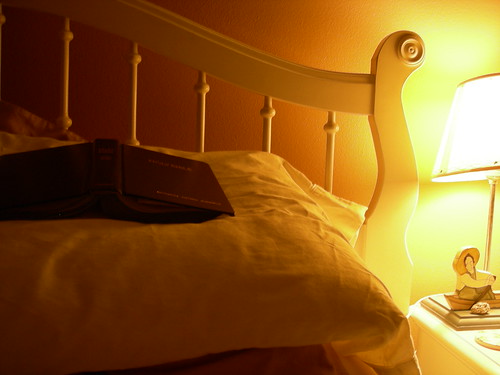
not yet read

For each problem, a new solution. I used the candle-lamp of my ancestors, which provides enough light for me to read or knit by, but little enough that the Caped Gooseberry can go to sleep.

And this is where my dastardly brain pulled the ace out of its sleeve: I don’t go to sleep until an hour or two after the light is out.

It doesn’t matter how deliciously sleepy I get with the candlelight flickering on the page, how about-to-lose-consciousness I feel, once I take off my glasses and blow out the candle, my mind knuckles down to the serious business of the night: Think About All The Things!

Well played, brain. The ball is in my court, and… I got nothin’. I already refrain from drinking tea after mid-afternoon, I have a milky drink at 8:30 p.m., turn off things with screens, follow a wind-down routine…
What more can I do? Relight the candle and keep reading? Find a copy of Virgil’s Aeneid, books 7-12, aka The Most Boring Thing Ever Written? Send a flock of neural sheep trotting one by one from parietal lobe to occipital lobe?

Neuronal activity DARPA

Do you ever have problems sleeping? What do you do? Do you know of any books more boring than the second half of the Aeneid? Please share below!

*My method of estimating duration of wakefulness without looking at bright cellphone screen for time: take ‘how long it feels I’ve been awake’ and divide by two.

the Question of Exercise

Being a full-time stay-at-home writer is a wonderful thing, but after nearly a year, I have discovered one area in which it is severely lacking – namely that of exercise.

Back in the days of the Dreaded Day Job, I used to walk to work. Not for the sake of the walk itself, but because the buses were so utterly unreliable. Which was probably just as well, all things considered, because the DDJ was an office job, and the biggest bit of exercise in the day was walking up the stairs in the morning.

Silly Walk Gait

Once I left the DDJ, that was four brisk 3km walks (1.86 miles, imperialists) which disappeared from my week. And did I replace them with several other brisk walks?
I did not. I like to do things efficiently, and it seems rather inefficient to leave the house just to wander around and then come back again. I do go for walks with the Caped Gooseberry, but chronic fatigue and brisk multi-kilometre walks do not go well together.

So here’s the question: what do you do to stay fit? What are your recommendations?

2da Serie femenina

My criteria: simple, local, inexpensive, and preferably enjoyable.
I’m not looking to lose weight (nicely, nicely, thank you) or to develop a six-pack and bulging biceps – I just want to be fitter, and to have abdominal muscles capable of keeping my insides, well, inside. Ideas?

Eccentric Æsthetics: In Which I Attempt the Historical Sew Monthly

You know how it is. You lurk for a while, then you comment for a while, and then you decide you just can’t resist and you get involved. So it was with me and the Historical Sew Fortnightly. In 2013 I lurked, in 2014 I commented, and now in 2015, I plan to take part. Ths year it’s been revamped as the Historical Sew Monthly, but I still don’t think I’ll manage all twelve challenges. Small but sustainable, that’s my beginner’s ambition.

HSF15icon250

I didn’t want to make anything that I couldn’t wear in daily life, but being æsthetically eccentric, that’s a wide range. Not as wide as a crinoline, though. I do have some sense of practicality.

So I decided to start with a simple chemise or shift, the foundation of Western clothing for centuries, and something which would fill the gap in my wardrobe marked “light summer nightgown”.

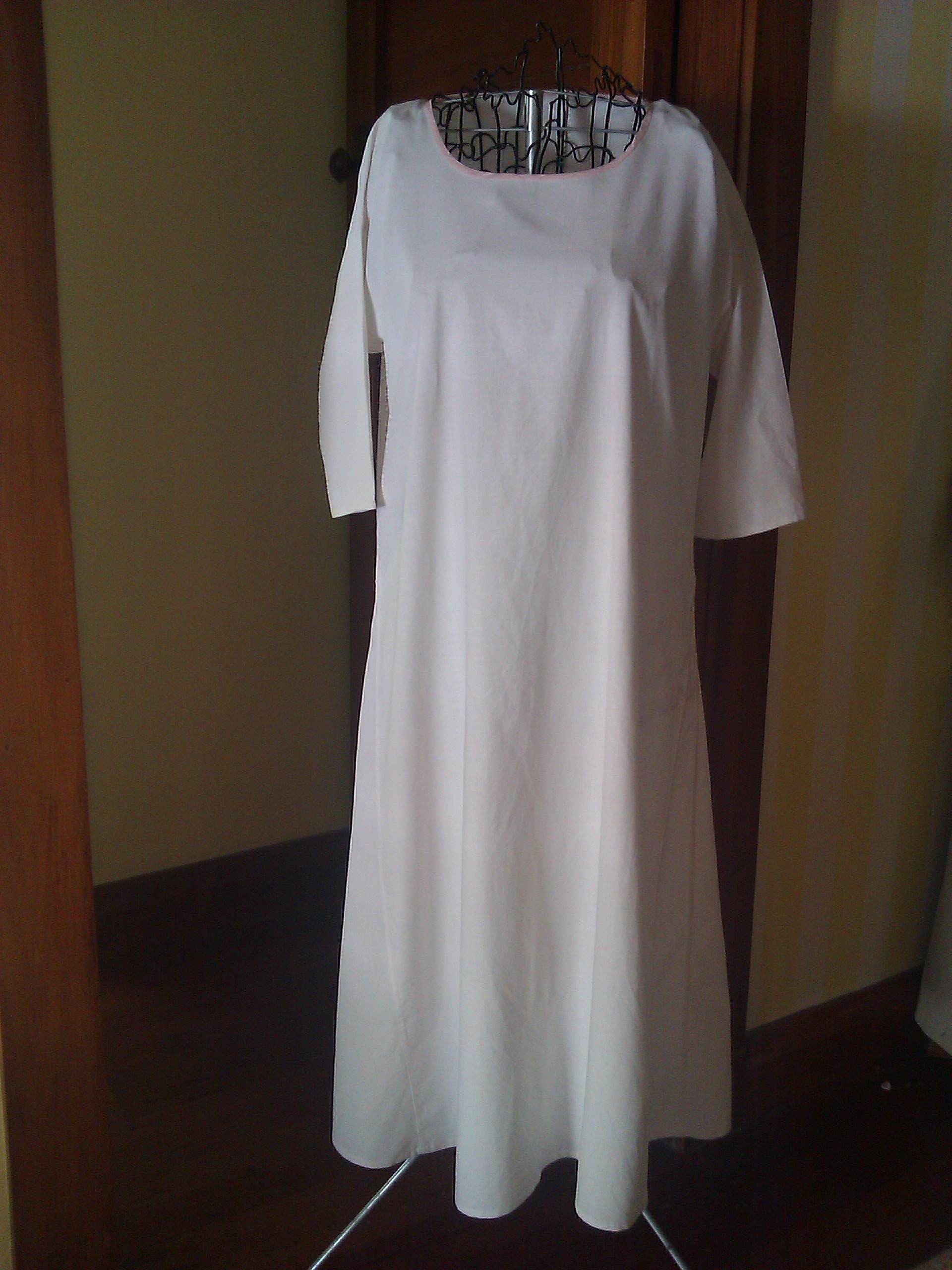
I give you, therefore, my first HSM project: The Igor Thift!
(Apologies for the exoskeletal dress-form – she’s in shape, but I haven’t got around to covering her yet.)

IgorThift

Challenge: Foundations (Jan)
Fabric: an old sheet, feels like mostly cotton
Pattern: I used marquise.de’s 18th century chemise instructions
Year: eighteenth century
Notions: thread, bias binding

How historically accurate is it? Somewhat? The pattern is all good; the fabric is possibly part man-made fibre, but “old sheet” is a historically accurate fabric, in my opinion 🙂 The binding is of uncertain age, but it is bias binding, which is historically inaccurate, as far as I know.

The construction is a bit mixed: I used historically accurate flat-felled seams, but they were sewn partly by hand and partly by ye notte quite olde enoughe hand-crank sewing machine (post WWII Japanese Singer knock-off).

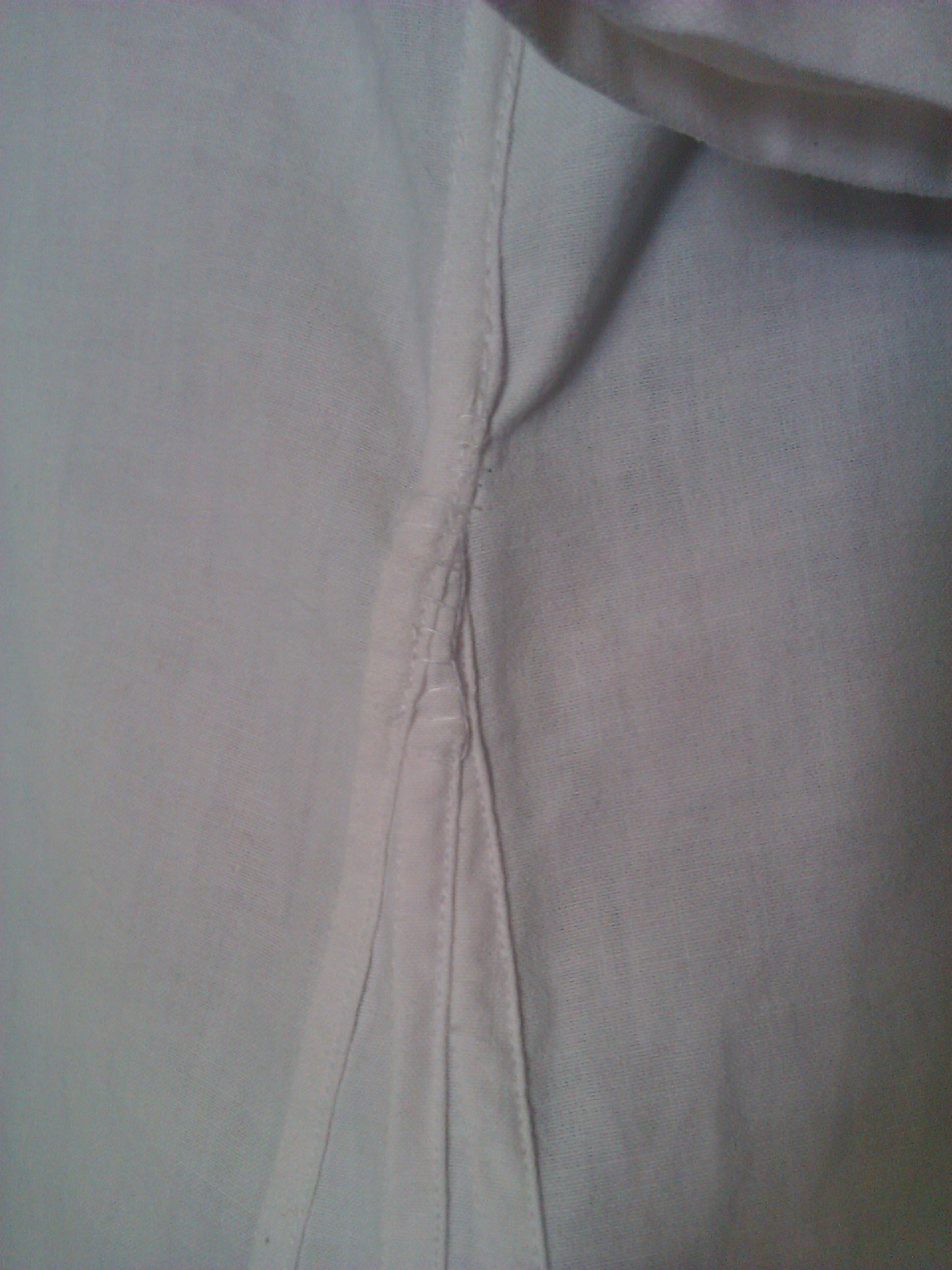
The finished shift includes lock-stitch (machine), back-stitch, running stitch, whip stitch and even, embarrasingly, blanket stitch. This, combined with the fact that the Caped Gooseberry was reading me Terry Pratchett’s The Fifth Elephant as I worked, caused me to dub this the Igor Thift. Alas, my thtitcheth stitches are not quite Igor-worthy in their tininess, although the hand-crank does up to 30 stitches per inch, should anyone be mad enough to want it to.

igor2

Hours to complete: embarrasingly many. Perhaps as many as 20? The whole process was slowed down by not deciding it was too wide until I had already sewn the side gores on. So I tore part of it off, cut two new side gores and started again on that side. (The pattern suggests adding 20cm ease – I should have done this before halving my maximum circumference, not after.) I did two side gores on each side, attached to the body along the hypotenuse for that isosceles-triangle effect.

First worn: as a nightdress for a trip to the Coromandel in the last week of January. Light and comfortable.

Total cost: time and energy. The sheet was discovered in an archaeological dig of the rag cupboard, and the binding was inherited from my grandmother’s stash. So it could also be considered as an entry for March (Stash-Busting) were it not against the rules to enter one item for multiple challenges.

What to Do Art.IWMPST14754

What I Have Learned From This Project:
1) Even with simple things, it pays to plan ahead. Especially where one is going to have three seams merging into one.
2) It’s all right for things to not be perfect.

I had originally planned to do about six items, each of which would work for two consecutive challenges. But that was when I thought Stash-busting was February and Colour Challenge Blue was March, rather than the other way around. I may still try to do six items which between them cover all twelve challenges, as I have an idea for something which will work excellently for both Blue (Feb) and War & Peace (Apr). Opinions? Advice?