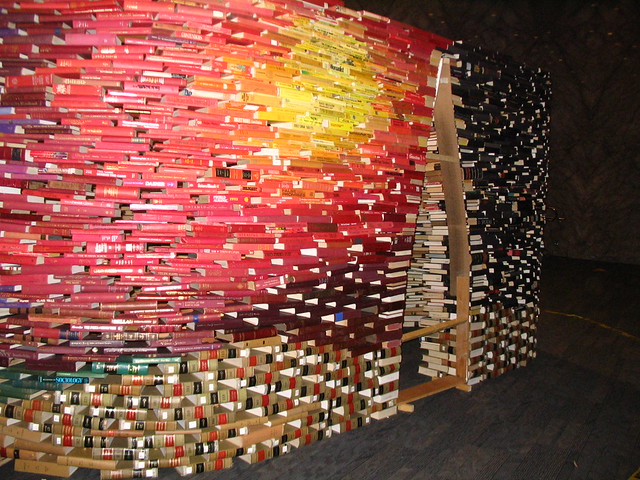
Read It Again!

Thus goes up the cry from many a small child, with their insatiable desire for the same bedtime story to be told, over and over (and over) again.

Felix Schlesinger Die Gute-Nacht-Geschichte

But it’s not just little kiddies who do it. Scratch a reader and you will find a re-reader – but what is it we’re re-reading? And why?

The winner of the gold medal, blue ribbon and all-around first prize for re-reading (re-readiness?) is the Scriptures; unsurprising given the emphasis so many traditions put on reading, re-reading, memorizing and internalizing the words of God. As Jesus said, these are “foundational words, words to build a life on.” But, leaving the Scriptures aside, as the best-seller lists do (since the same book invariably tops the list), what are the most popular re-reads?

The comments on this post reminded me of the widespread passion for re-reading The Lord of the Rings – and not just re-reading it, but re-reading it again every year. That’s dedication, especially if you aren’t a fast reader.

Some people re-read other classic novels such as Jane Austen’s Pride and Prejudice or Tolstoy’s Anna Karenina, although I have yet to hear of anyone who repeatedly reads War and Peace – apart from Countess Tolstoy, who apparently recopied and edited it seven times. That’s going above and beyond the call of duty, it seems to me. Bearing thirteen children is one thing; reading War and Peace seven times is quite another.

woman writing at desk

Many people obsessively re-read C.S. Lewis’ The Chronicles of Narnia as children, and some continue the habit. I myself, as a child, re-read pretty much everything I could get my hands on, as I was a voracious reader with limited (re)sources. I even read our children’s encyclopaedia by the volume (Vol. 1, Article 1: Abbey, which may be connected to my subsequent interest in all things monastic).

More recently, I have noticed a pattern to my re-reading. When I am tired and want to relax, I read either an old favourite – Agatha Christie, Patricia Wentworth, Ngaio Marsh, Ellis Peters – or a book by an author with whom I am sufficiently familiar to be sure I will enjoy the book. And yes, this means that when I want to relax I almost without exception curl up with a mystery (although I did curl up with The Curse of Chalion the other day).

When I am not in need of book-induced relaxation – when I have more mental energy – I tend more toward the reading of non-fiction. Books about writing, books about whatever I have an interest in at the moment, books which happened to show up in an old box from someone’s grandmother. Reading entirely unfamiliar fiction doesn’t happen as often, unless the book is very compelling when I glance into it, because it doesn’t fit into either of my two settings: Relax or Absorb Information.

Simon Glücklich Hausaufgabe

But once I’ve read a non-fiction book, I seldom feel the inclination to re-read it, and I think this reveals something about why people re-read – or at least why I re-read. I re-read books because there is something in them which I cannot fully obtain from one reading. If it’s non-fiction, it’s because I didn’t absorb enough of the information it contained the first time round.

With fiction, that doesn’t apply. I mean, look at the enormous popularity of P.G. Wodehouse’s novels. Read one, you’ve got a pretty good idea of them all, but that doesn’t stop people reading the rest and then re-reading them. Because the essence of the book isn’t in the facts of it, it’s in something altogether more evanescent. The style of the book, or perhaps its soul. You can’t break that down to its component parts to analyze why it works. The letter kills, but the spirit gives life, you could say.

Or, to steal a structure from Maya Angelou, people will forget what the book said, they’ll forget what the characters did, but they will never forget how the book made them feel. And that, I am convinced, is the secret of all re-reading. Reading the book produced in us a feeling – and with great books it’s a feeling no other book creates – and re-reading the book is the only way to feel that again. This is how reading prescriptions work; and also why we have fan-fiction.

What do you think? What books do you re-read, and why?

Re/Read

Bibliotecaestantes

Given the choice, would you rather try a new book, or re-read an old favourite?

Making it Happen

Ten years ago I had a dream: a dream of making a beautiful quilt for a friend. Something warm and cosy; something to curl up under while watching classic movies and sipping cocoa on a winter afternoon.

Crazy Quilt, 1884

I went for it.
Did I make a perfect little lap quilt? I did not. Did I make a comfortably-sized one-person wrap quilt? I did not. Did I make a freakishly over-ambitious monster crazy quilt with emphasis on the crazy?
Well, no. I started one.

I chugged away at it, but it was not long before I realized it was not going to be finished in time for the intended birthday. It’s been bundled in and out of boxes and bags and wardrobes ever since, worked on here and there, added to in fits and starts, but mostly just taking up space and making me feel guilty.

If I’m honest, this one project was a big part of my decision to make 2015 my Year of Finishing Things. Over the years it had become symbolic of my lack of self-discipline, my good intentions never followed through, and my failure to finish anything I started.

fail

Not surprisingly, all the feelings bundled up with this UFO (Unfinished Fabric Object) made me reluctant to go near the thing, let alone commit to the many, many hours it would take to finish it. But it was still there, a big fat purple plug between me and moving on. So this year, I decided, I was going to get it out of the way. I was going to finish it, and thus become a Person Who Finishes Things.

I had the best of intentions, and when those failed, I made a rough plan. That made a bit of progress, which then fizzled out, so I made a more detailed plan. Which I didn’t keep. Then I made an even more detailed plan, which led to more progress, which also fizzled out. I even made a place for it in my schedule.

What I didn’t make was a commitment. If I was already doing something else, if I didn’t feel up to it, if I just didn’t want to, I didn’t. I still wanted it done, I just didn’t want to do it. No – that’s not quite right. I wished it were done – but I didn’t want to do it.

I did do bits here and there, but the small amount of progress I made was swallowed up by the magnitude of the undertaking. The quilt top is 155cm wide and 200cm long (about 5ft by 6 1/2), and has perhaps a hundred pieces, each with multiple edges to sew, embroider and embellish. Not quite big enough for the Great Bed of Ware, but it’s felt like it at times.

Bed of Ware

But the only way out is through, and there were some things I did that helped.

First, I sat down and asked myself what the obstacles were that prevented me working on it. A big one was the amount of time and effort involved just to get it out, spread it out, figure out where to work next, and put it away again at the end – if I could only find half an hour at a time, just handling it would eat most of that.

So I found somewhere where I could leave it folded and rolled, with the active part spread out in the middle. I made it easy for myself to just sit down and do a bit. I worked on one area at a time, so I could see and gauge my progress. I also borrowed and downloaded audiobooks (legally) to listen to as I stitched away.

I haven’t finished it yet – there’s still the centre section to embellish, as well as the attaching of the backing fabric to the front. I may not finish it by the end of the liturgical year (28th November, this year) but I will have it finished by the end of the calendar year.

egg_timer

I don’t know if the intended recipient will even want it – or indeed if she ever wanted it – but I’m not doing it just for her any more, I’m doing it for me. She can use it, regift it, or donate it to the SPCA for dog bedding; I won’t mind.

It will be finished, and I will be a person who finishes things. It has long been a failing of mine to launch straight into an over-ambitious project without working my way up via smaller, more manageable projects.
I think I’m cured now.