
Have you ever had a favourite pair of socks? What was it about them that made them special – the colour, the texture, the memories attached?
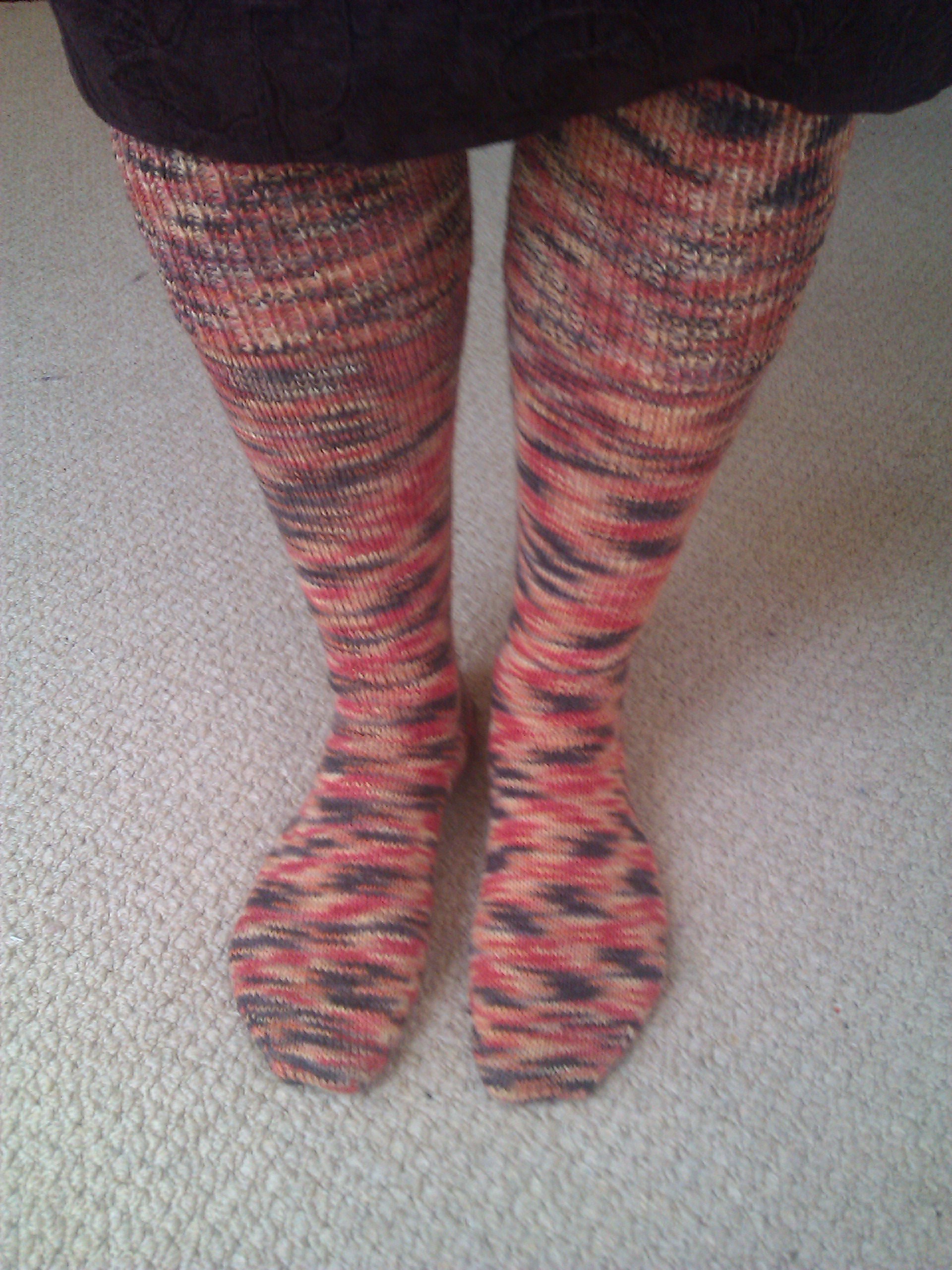 My current favourite socks are my favourites because I made them myself. Admittedly, they give the impression of badly burned legs, but the point stands: it was I who dunnit.
10 Reasons Why Cuttlefish are Amazing
Number 1: their ink is actually ink. Sepia, in fact. Yep, all those drawings by Leonardo da Vinci started life in a cuttlefish ink sac.
Number 2: They have greeny-blue blood. This is because where we have iron in our blood, creating that lovely rust colour, they have copper, creating that lovely old-copper-roof colour.
Number 3: They have three hearts (eat your paltry two hearts out, Doctor). This is because green blood isn’t as efficient with the whole oxygen-moving thing as red blood is.
Number 4: They have pupils like inverted monobrows. I mean, look at this:
 Number 5: On the subject of eyes, they apparently get their eyes all up and running before they hatch from their eggs. So if you happen to swim past a batch of cuttlefish eggs, beware – they’re watching you. And it has been suggested that they gravitate toward the sort of food they saw pre-hatch. (Death by oodles of baby cuttlefish: cutest creepy death ever.)
Number 6: Continuing on the subject of eyes, the cuttlefish has no blind spot. So don’t think you can escape…
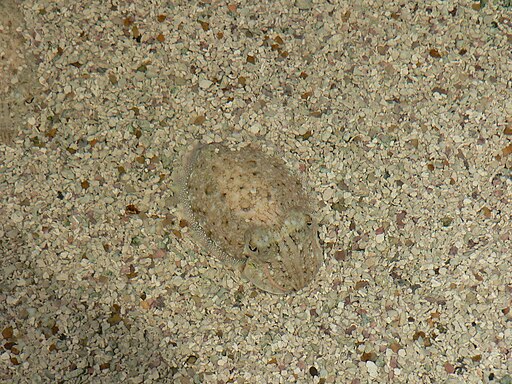
Number 7: They are masters (and mistresses) of disguise. They can change colour like sea-chameleons (despite being unable to see colour); they can change their skin texture to more closely resemble their background. And they can do all this accurately, even in near total darkness. How, no one knows. They can even present different appearances on different sides of their body.

Number 8: One of their colour patterns, used by males when in an aggro situation, is called “Intense Zebra”. (Out of such little joys is a life made…) Not to mention that there’s a species of cuttlefish called the “Flamboyant Cuttlefish”. And here’s why:
 Number 9: They have an internal shell, called the cuttlebone, which they use for going up and down like a submarine. More liquid in the shell: down. Less liquid: up. The cuttlebone has also been used for centuries by metalworkers for making moulds for little fiddly things; and more recently by owners of caged birds for keeping up their calcium intake. (The birds’ calcium intake, that is. Not their owners. As far as I know.)
Number 10: They can be terribly grand and impressive:
.jpg)
or completely gosh-darnit cute:
_all_white.jpg) Amazing critters, aren’t they? Which is why I decided to knit a cuttlefish cover for my cellphone. It’s not entirely like a cuttlefish, but it has points of resemblance. I started out intending to use this pattern but in the end it was more ‘inspired by’ than actually ‘based on’.
Amazing critters, aren’t they? Which is why I decided to knit a cuttlefish cover for my cellphone. It’s not entirely like a cuttlefish, but it has points of resemblance. I started out intending to use this pattern but in the end it was more ‘inspired by’ than actually ‘based on’.
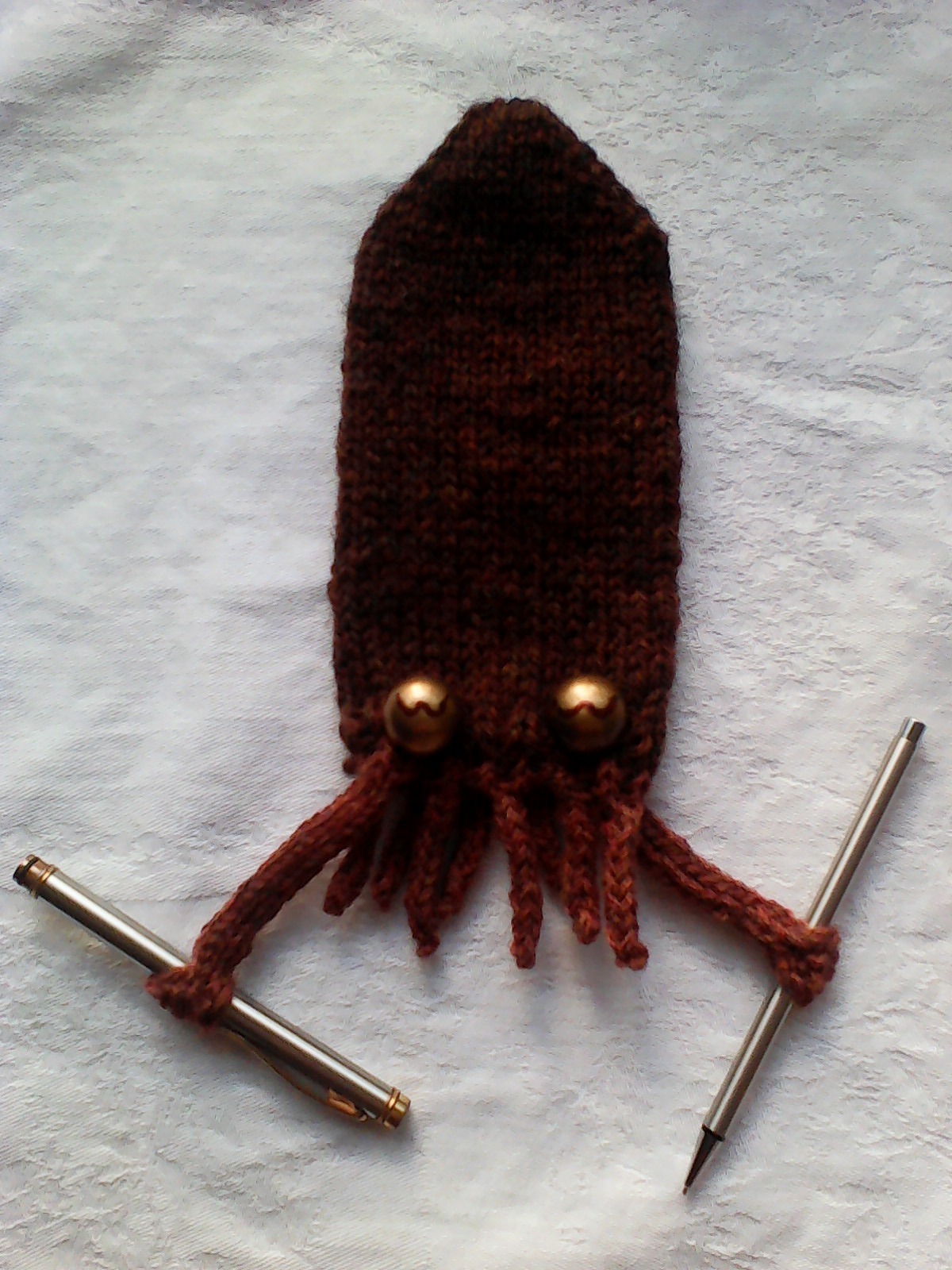
Fits smartphone measuring 63 x 120 x 10mm. Howdunnit available on request.
Eyeless Entertainment
As habitual readers of this blog may recall, in October 2015 I decluttered my eyeballs. They have now settled into their new shape, and that shape being not yet perfect, I will shortly be having a touch-up surgery.
Those of you who get squicky about eyes may wish to pull something over yours at this point, before I get into details.
 The original surgery was LASIK, where they make a flap on the front of your eyeball and carry on the earthworks underneath, before putting the flap back. For the touch-up, however, I will be having LASEK, where they just start straight in on the front of the eyeball. It’s like the difference between laying a pipe under a road, and resurfacing the road.
On the plus side, LASEK has a much lower chance of causing keratoconus (don’t look) and other unpleasant side effects. On the down side, the healing takes longer. The first three days, I have been told, are pretty unpleasant (whereas with the first surgery, the discomfort was mild and gone in hours) and then it’s a week before they take the bandage-lens off. Most disturbing of all, it could be weeks before my vision returns to normal, which is to say, capable of reading small print.
And as anyone who has known me for any amount of time will know, reading small print is pretty much my way of life. I came, I saw, I read.
_Lesendes_M%C3%A4dchen_1855.jpg)
The question is, then, what I shall do while my eyes recover. I’ve arranged for my work to carry on in my absence by having other people do the reading for me, but how shall I pass the time myself? Last time I borrowed a bunch of audiobooks, and it did not work out as well as I had hoped.
The thing is, you see, that I am a visual person. Audiobooks do not satisfy the reading urge, somehow, and nor does what I’ve heard stick. Of the various books I listened to, I don’t remember what most were, and of the one I remember most clearly, all I can remember is that the main character exclaims “By Timothy!” a lot, and the big scene at the end takes place in a house by a river. Apparently, if I can’t get my eyes into it, I can’t get my teeth into it either.
So what shall I do? For the initial, “miserable” stage, I am planning to listen to the BBC Pride and Prejudice – I’ve seen it so often I can follow along by ear anyway. Subsequently I’m planning to have a good amount of not-too-intricate knitting on hand – hopefully my sight will soon be up to that amount of detail. Also hopefully the Caped Gooseberry will read to me when he can. (Yes, I know I said I don’t take things in when I only hear them, but his voice is so nice I don’t really care.)

What other non-eye-dependent amusements might I solace my recuperation with? Learning Braille? Taking up scales and sword and going forth to wreak Justice? Ideas?