Lessons from (PseuDo)NaNo

  1. 50,000 words is a lot.
  2. I can do it.
  3. It isn’t easy.
  4. 7.8 is a really big earthquake (big enough to have its own Wikipedia page).
  5. I can’t produce creative writing on three hours’ broken sleep.
  6. Strangely, I can write scene outlines and blog posts in those conditions.
  7. A supportive spouse is worth their weight in gold.
  8. Rewards are good.
  9. The right rules can help.
  10. Sometimes you’ve just got to stop bashing your head against the wall and read.

Yes or No
50,000 words is a lot. I don’t know why exactly the NaNo people picked that exact number, but I went along with it. My final word count – well, that depends. (Lesson #11: I am better at writing than maths.) I made a note at the end of each session of how much I had written, and at the end of each day I added them up and then added them to my running total.

So far, so good. But here’s where it gets weird. Adding those daily totals together in a spreadsheet produced a different total to the running total in the planning document. Thinking myself terribly clever, I cunningly checked them against the actual number of words in the text, only to discover that that was a different total again.

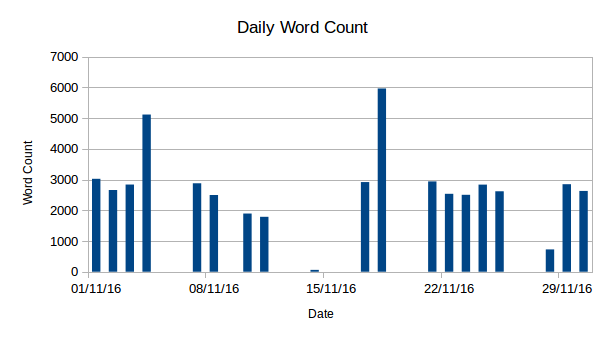
So, the final word count is somewhere between 51,244 and 51,445, neither of which is shown in the chart below. (Chart made with LibreOffice and technical helpdeskry from the Caped Gooseberry.)

november

Not exactly the steady progress of the professional writer, is it? Allow me to decode.
First week: all went well. Knitting-in-order-to-think is a lifesaver. That spike on day four is largely due to the fact that I was editing a scene I pulled from the first draft, rather than writing a new scene altogether. It helps.

Second week: lower totals, but hanging in there. By this time, the Caped Gooseberry’s bronchitis was in full swing, and the completely missing day mid-week may not have been totally unrelated to a certain large country’s election results coming in.

Third week: Well. You see that tiny little snibbin of a blue dash, just above the 15? That’s Monday the 14th. 61 words. In my defence, I was shelled out of my bed just after midnight by a 7.8 earthquake and didn’t manage to doze off again until after dawn (for an hour or two). Despite the ongoing aftershocks, I decided I had to get some work done. 61 words was all I managed.

In Case of Earthquake, Do Not Tweet [cartoon]You might charitably suppose that the total emptiness of the following two days was due to ongoing aftershocks, but not really. Tuesday I spent in preparation for Wednesday, when I drove the Caped Gooseberry down the recently-reopened motorway to have his wisdom teeth out. (OK, I spent part of Tuesday in preparation. The rest was spent keeping an eye on earthquake updates.)

By Thursday of week 3 I was about 7,000 words behind, and starting to panic. I managed to write a reasonable amount in between changing the ice-packs on my dearly beloved’s distorted face and bringing him soft things to eat. Mercifully, on Friday I was able to use another section of the first draft (suitably rewritten) which did a great deal for the health of the word count.

From there it was just a matter of steadily trudging on, scene after scene, one bite at a time. What happened on Monday 28th I don’t know. It was a beautiful day, I felt good about the story, it was gathering momentum – and I just couldn’t get going. I scraped through 761 words in the morning, had other commitments in the afternoon, and spent the evening in that unpleasant condition where you know you should be doing something but you’re too tired and the more you fret about it the more tired you get. (And then you go to bed and lie awake for hours.)

Rembrandt Saskia in BedOf course, I had a scheme of rewards planned out to boost the motivation: settling down with a book once I’d hit the word-count for the day (but not before); and three chocolate mint biscuits for each 10,000 word milestone. I also had three rules: make a pot of tea, commit the work to God, and think before writing. (I arranged for some plain knitting to facilitate this, resulting in approximately 4,737 stitches knit, though not all during thinking-time.)

Committing the work to God was a big one for me. I have been trying to make a habit of finishing what I start, and writing is an area where that wasn’t happening, despite my assurance that this is what God wants me to be doing. So for me, this was not just a test to see if I could do it, or a natty way of breaking the back of the second draft. It was an act of obedience. And as is so often the case with obedience, productivity results.

I am glad to find that I can be this productive, and I have every intention of carrying on with it. Not, perhaps, to the same extent (reaching 2,500 words per day involved a certain amount of robbing Peter to pay Paul) but something close. Maybe 1,800 words per day, or 2,000. The point is to be making steady progress (Exhibit A: Week 4, above).

hole-205448_640I would like to leave you with these words from Randy Pausch’s book The Last Lecture: “The brick walls are there for a reason. The brick walls are not there to keep us out. The brick walls are there to give us a chance to show how badly we want something.”

Those Darned Sleeves

Remember that scene in Cool Runnings when they arrive in Calgary and Sanka rushes back into the terminal to put on everything in his bag, followed by the bag? Thirteen years ago, that would have been me arriving in New Zealand, had my grandmother not met us at the airport with a better bag: a bag full of woollies, knitted with her own two hands.

Bundesarchiv Bild 183-E0127-0091-003, LPG Schenkenberg, Mitglied der LPGThat bag included a grass-green guernsey for me, a garment which I immediately put on and have worn for large parts of every year since. When it was two years old, I wore it to said grandmother’s funeral, along with some of my similarly guernseyed cousins (she was a very productive woman, my gran). I have done many wardrobe clear-outs over the years, of varying levels of drasticitude, but I have never considered getting rid of my guernsey.

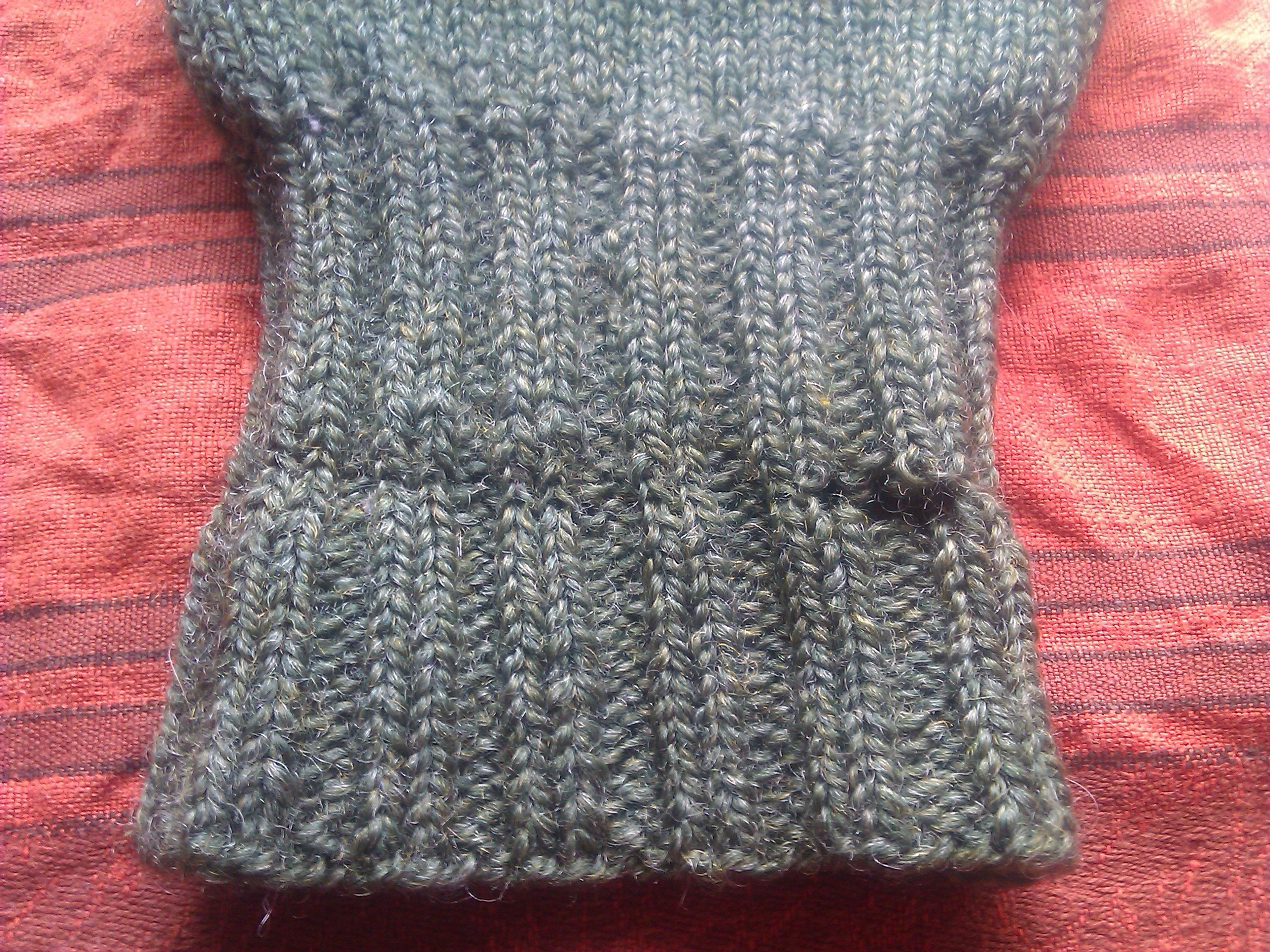
So you can imagine my distress on noticing that the cuff was wearing thin at the fold. But we were in the middle of moving house, packing everything up and so on; hardly a good time to settle down to some mending. I did manage to go through the box of ancestral happiness which contained all the odds and ends of wool left behind by this same knitting grandmother, looking for matching wool to mend with. Alas, there was not so much as a scrap of the original yarn, but I pulled out a few greens and packed them separately, so as to have them to hand.

Imagine my horror, on one of our first mornings in this house, when I pulled the guernsey on and my finger went through a hole.

hole-close
This is what our camera thinks grass-green looks like.

There was no time to be lost. I found the assortment of green yarns and compared them with the original to decide which was closest. There was one that was Close Enough to Do, I decided; no need to hit the shops before a mend could be undertaken. The next question was one of method. It may be “sleep that knits up the raveled sleave of care,” but for raveled sleave of guernsey you need some kind of a darn.

Results having finally come through (or rather worn through) from the sock-darning experiment, I thought I would go with the classic back-and-forth darn. One of my vintage handwork books recommends a sort of Swiss darning for holes in knitted things (there’s a tutorial here if you dare), but I quailed at the thought. I was by no means sure of my ability to execute it correctly – and the idea of taking scissors to the beloved garment brought me out in a cold sweat. This was no mere sock, after all. This was the last garment my gran ever made for me, and while there may be knitting where she has gone (I sure hope there is), they don’t allow for forwarding to the bereaved descendants.

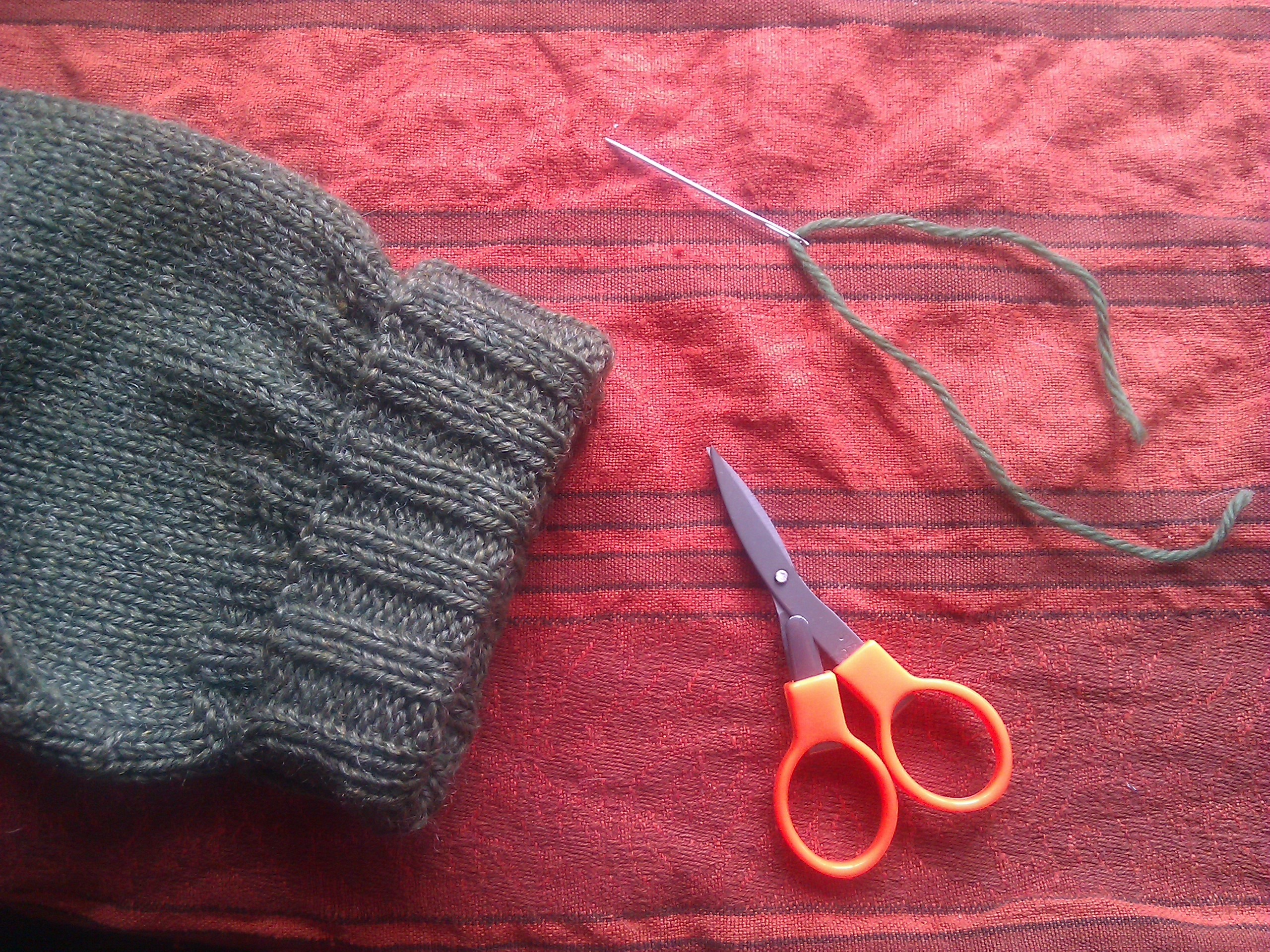
The stakes were high. I gathered my materials from the various locations to which a state of partial unpackedness had spread them.

materials
Darning flat: no egg required.

The actual darning wasn’t too much trouble, once I’d figured out a way to weave the needle in which didn’t leave long strands on the wrong side – or right side, if the cuff is folded back, though I doubt there is a right side for long unattached strands. There was more to do than I’d realized, however: the hole was small, but the eight-ply-worn-almost-to-lace section ran about halfway round the cuff. It took a while.

The problem with darning, as identified by Miss Mary Grant, is that it is not exactly mentally invigorating – but it does require you to keep your eyes on what you are doing. Happily, however, ears are not a necessary part of the darning equipage, and you can listen to music, download an audiobook from Librivox, or, like me, get your nearest and dearest to read aloud to you while you work. It tends to take longer than you think. Just when you reach the end of the patch with your up-and-downs, you realize now you have to do all the back-and-forths (or vice versa).

mend1.jpg
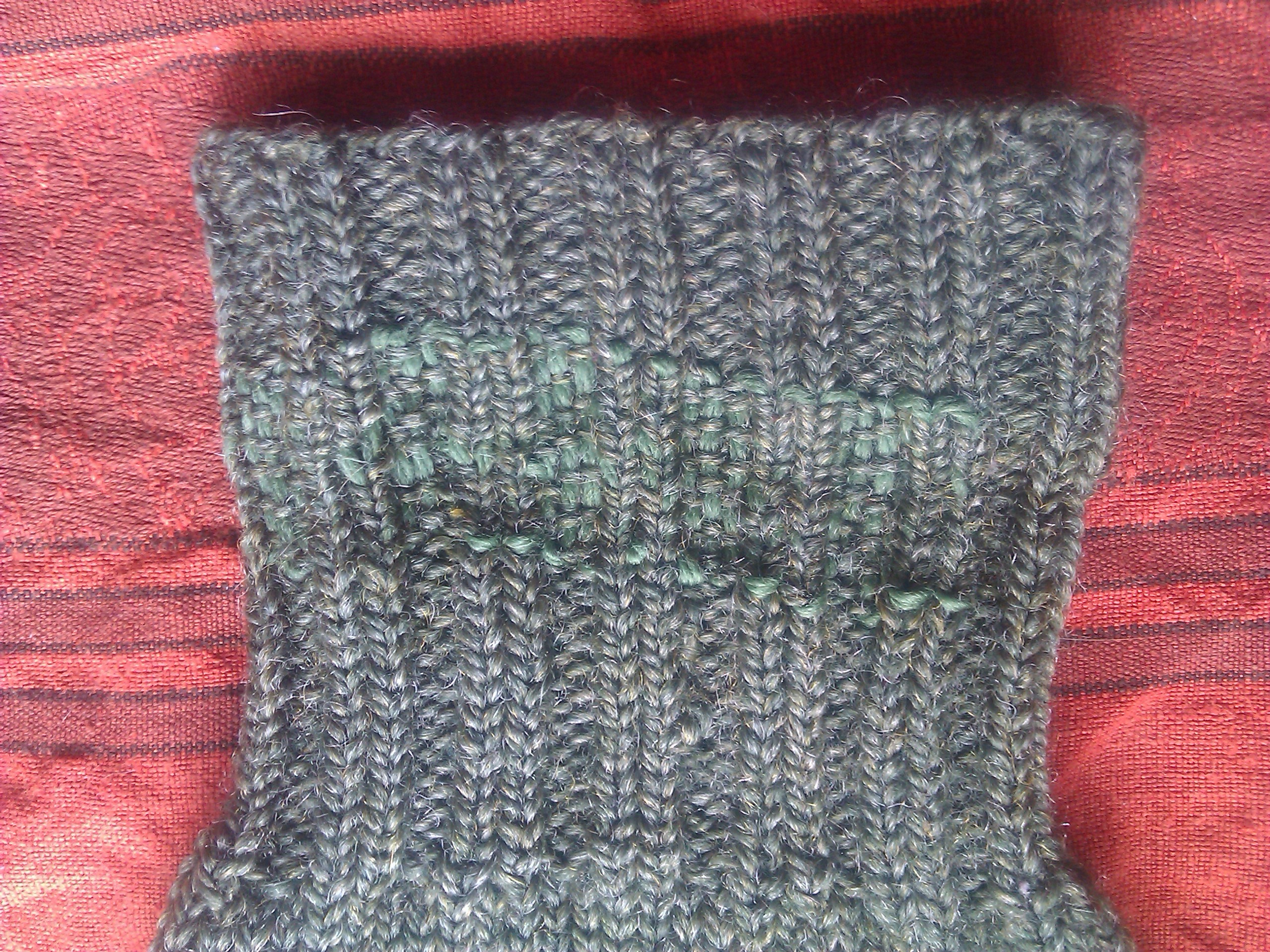
At least the camera’s odd rendition of colour makes the mend easier to see.

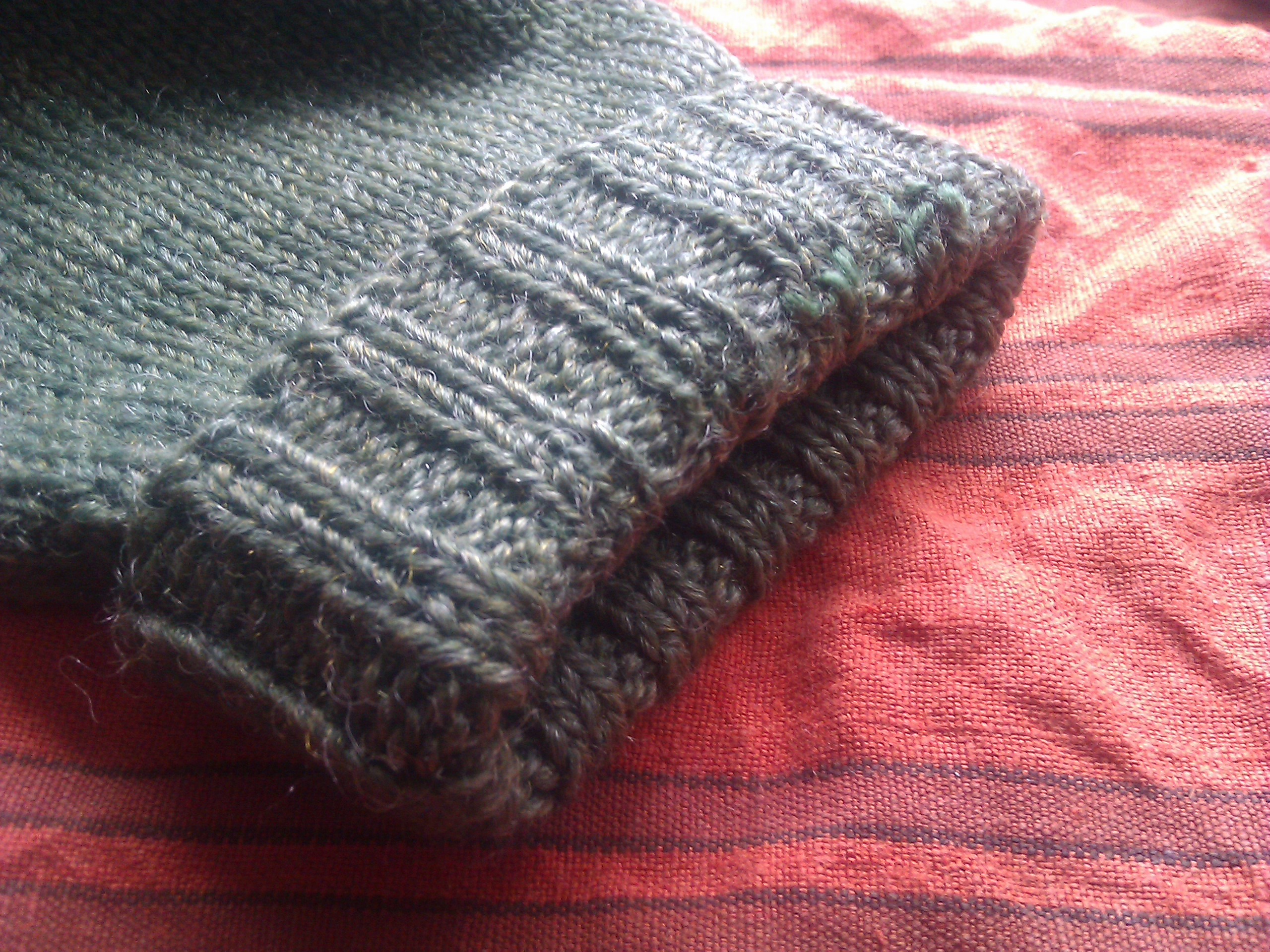
But at last it is finished. I am happy to say that the sleeve was saved: the darning not only captured any thread that was thinking of unravelling, but reinforced the whole worn area. It’s thick and sturdy now, I think it will survive.

Wikipedia describes the guernsey as “a particularly hardy item of clothing” and notes that “It is not uncommon for a guernsey to last several decades and be passed down in families.” I don’t know if my guernsey will last that long (though it is well into its second decade now), but I intend to give it every opportunity to do so.

Who knows? Maybe one day I will even have the guts to try Swiss darning. It’s certainly more beautiful than plain darning. Still, while my mend may not be pretty, it’s practical, and that’s what guernseys are all about. And I am glad that my practical skills can keep the guernsey together while it keeps me warm.

cuff
The mended cuff.

Today’s bit of Old-Fashioned wisdom is brought to you by the guernsey: Keep Warm and Carry On.

Old-Fashioned Fruitcake

The eagle-eyed among you may have noticed a change or two of late, on or about this blog. I decided, while taking an unpacking-holiday (if such a thing can exist) to spruce the place up a bit. Take it out and beat it like an old carpet, that sort of thing.

I ended up changing the featured image, the about page, my gravatar and the subtitle. (I stopped short at changing my name. One can have too much of a good thing.) Let us review the changes one by one.

First I changed the featured image to Tea Party by Louis Moeller. I don’t know who these old ladies are, but by golly they look like they’re having a grand old time. I feel like clapping on my doily cap and pulling up a chair.

woman-32551_640

Then I changed my gravatar from the reading jester to this smiley old lady, knitting. I want to be like her when I grow up, with white hair and a gentle smile and plenty of knitting. Also cats (not shown). Knitting and cats are easily come by; a smile takes only a moment; but white hair and wrinkles you have to earn.

I also rewrote the About page, if you’re interested in taking a look at that. It is still about me, though. Sorry to disappoint those of you who thought it might be about cooling systems for nuclear reactors, or how to breed newts. (Please do not try breeding newts in a nuclear reactor. The last thing we need is an increase in the world population of giant radioactive newts.)

Japanese fire belly newtAnd there’s a change to the subtitle: Old-Fashioned Fruitcake. I am, after all, an unashamedly old-fashioned person, a traitor to my time. And I am – I defy anyone to disprove it – a fruitcake. Nutty as a fruitcake, anyway. Although being an old-fashioned fruitcake, I can’t keep currant. (I am so sorry. I would like to say this will not happen again, but we both know it will.)

Yes, the Eccentric Ethic and Æsthetic is no more – although I can assure you there will still be plenty of Ethics, Æsthetics and Eccentricity scudding about the place. Just… fruitier. And, as the label suggests, old-fashioned. There will be LOLs (both kinds – laughs out loud and little old ladies); there will be handwork, housework and headwear; stationery and simplicity; tea and old technologies.

Otto Goldmann Eine gesellige Runde 1887Think of this, if you would be so good, as a non-stop tea-party to which you are always welcome to drop in for a cuppa, a chat, and a good laugh. There may even be scones, and, when the season is right, jam – but please don’t eat the Fruitcake!